
That distinction matters. For public AI projects, the hardest part is rarely deploying a capable large language model. It is deciding where the technology should operate, what information it may access, how its outputs are checked, and who is accountable when an automated recommendation affects a citizen. Karnataka’s approach, at least as described so far, recognizes that successful AI in governance requires operational discipline as much as technical capability.
For Windows users, developers, IT administrators, educators, and enterprises across Bengaluru’s technology ecosystem, this development is notable for another reason: it could turn the state into a proving ground for secure, multilingual, AI-assisted workflows that connect public services, learning environments, and the local innovation economy. The opportunity is enormous, but the safeguards must be equally substantial.
 A Working-Group Model Rather Than an Instant Rollout
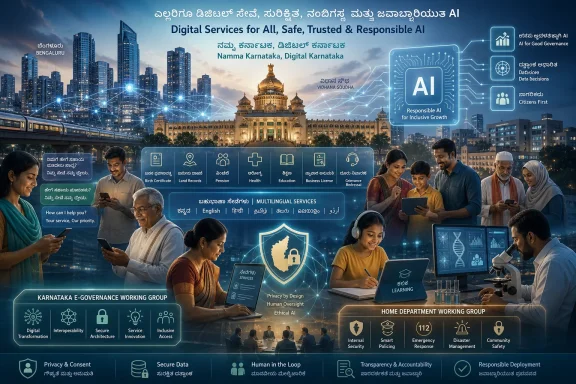
The key announcement is not a new consumer app, a state chatbot, or a fixed technology procurement. It is the creation of two working groups, one associated with the Centre for e-Governance and another with the Home Department, tasked with identifying AI priorities and advancing selected ideas. Asianet News/ANI
That may sound procedural, but it is arguably the most responsible starting point available. Generative AI can draft, summarize, translate, classify, retrieve information, and support software development at remarkable speed. None of those capabilities automatically make it suitable for high-consequence government functions. A system that helps a citizen find the correct department is very different from one that influences eligibility, policing priorities, fraud investigations, or benefits administration.
The working groups should therefore be judged by the quality of their selection process, not by the number of AI pilots they announce. The strongest initial projects will likely have several characteristics:
- Clear public value, such as reducing time spent navigating forms or locating service status.
- Bounded scope, with limited authority and well-defined inputs and outputs.
- Reliable source data, preferably from authoritative systems rather than open-web retrieval alone.
- Human review, especially where an answer can influence rights, payments, legal status, or public safety.
- Measurable outcomes, including resolution rates, accessibility gains, error rates, and escalation volumes.
- Transparent failure handling, so citizens know when they are interacting with an AI system and can reach a person.
This structure also gives Karnataka room to distinguish between AI that assists government employees and AI that interacts directly with citizens. Internal use cases—such as summarizing non-sensitive documents, drafting standard responses, translating approved material, or helping IT teams understand legacy code—can often be tested with lower public risk than outward-facing systems. Even then, security controls, document classification, retention policies, and access governance remain essential.
Why the Centre for e-Governance Is Central to the Story
Karnataka is not beginning from a paper-only service environment. The state already operates digital service-delivery infrastructure through platforms and assisted channels connected with Seva Sindhu, Bangalore One, Karnataka One, Common Service Centres, and other service points. The government describes Seva Sindhu as an effort to consolidate departmental services and make delivery more accessible, accountable, transparent, cashless, faceless, and paperless. Government of Karnataka
This existing infrastructure is an asset, but it also raises the stakes. AI does not need to replace those systems to be useful. It could serve as a carefully constrained interface layer that helps users understand what a form requires, explains service steps in plain language, routes an issue to the correct department, or summarizes a case history for an authorized official.
The critical phrase is carefully constrained. A conversational interface must not become an unofficial decision-maker. If an AI assistant gives an incomplete explanation of a service rule, mistranslates a condition, or confidently invents a requirement, the apparent convenience can create a new barrier between citizens and the state.
A good Karnataka government AI assistant would therefore prioritize official retrieval over free-form generation. It should ground answers in approved department content, show source references where possible, preserve the exact wording of legally binding rules when necessary, and make escalation to a human officer straightforward.
Multilingual AI Is a Public-Service Requirement, Not a Cosmetic Feature
Multilingual interaction was a central subject of the Anthropic meeting, according to reports of Kharge’s visit. Elets CIO In Karnataka, that focus is not simply about making a digital assistant friendlier. It is fundamental to inclusion.
A resident may be more comfortable seeking a government service in Kannada, while also needing information in English, Hindi, Urdu, Telugu, Tamil, or another language. A system designed first for English-speaking, keyboard-confident users will reproduce existing digital divides, no matter how sophisticated its underlying model may be.
Anthropic has already identified India’s linguistic diversity as a central deployment challenge. When it opened its Bengaluru office in February 2026, the company said it had worked to improve data representation for ten widely spoken Indian languages, including Kannada, and was pursuing locally relevant evaluations for tasks in areas such as agriculture and law. Anthropic
That effort is relevant, but government deployment needs testing that goes much further than fluent conversational text. A public-service AI system must be evaluated for:
- Correct handling of Kannada names, locations, and local administrative terminology.
- Translation consistency when official rules contain legal or procedural language.
- Code-switching, where a person mixes Kannada and English in the same request.
- Speech recognition and text-to-speech quality for varied regional accents.
- Accessibility for people with low literacy, disabilities, or limited experience using digital services.
- Biases that could result from incomplete data or assumptions embedded in prompts and workflows.
The most important metric is not whether an AI can produce natural Kannada prose. It is whether a resident receives the same accurate service guidance irrespective of language, location, education level, or preferred channel.
The Need for Evaluation Before Scale
Public-sector multilingual AI should be tested against a curated benchmark of real but privacy-protected citizen questions. Each answer should be assessed by domain officials, language specialists, accessibility experts, and frontline service staff. Evaluations should cover not only “correct” answers but also whether the system appropriately declines to answer, requests clarification, or routes a case to a human.
This is particularly important because AI systems can be persuasive even when wrong. A polished answer that is subtly inaccurate may be more damaging than a traditional website that simply fails to provide the information.
Karnataka’s proposed working groups have an opportunity to make multilingual evaluation a formal procurement and deployment requirement. That would be a meaningful contribution to responsible AI governance in India, especially if results are published in an understandable form and updated as systems change.
Anthropic’s Bengaluru Presence Changes the Collaboration Equation
Anthropic had announced plans in October 2025 to establish a Bengaluru office as part of its India expansion, describing the city as its second Asia-Pacific location after Tokyo. Anthropic The local office has since become a hub for the company’s work with Indian enterprises, developers, education partners, and organizations investigating public-interest use cases. Anthropic
For Karnataka, proximity matters. Engagement with an AI provider is more useful when product teams, policy specialists, developers, and public officials can repeatedly test assumptions against real local workflows. It is easier to discuss language gaps, service-design constraints, data handling, staff training, and audit expectations when those conversations are not limited to global video calls.
But local presence should not lead to vendor dependence. A mature state AI strategy needs architecture that remains portable, contestable, and interoperable. The working groups should avoid designing services around a single proprietary model’s interface or a single vendor’s workflow conventions.
Instead, Karnataka should seek systems built around durable principles:
- Authoritative government data remains under government control.
- Model providers do not receive more data than a use case requires.
- Applications can change models without rewriting the entire service.
- Every material AI interaction is logged and auditable.
- Policies, prompts, retrieval sources, and approval rules are version-controlled.
- Human decision-makers retain responsibility for consequential outcomes.
This is where the concerns of IT professionals become especially relevant. The core work will involve identity management, endpoint controls, document permissions, retention settings, data-loss prevention, audit logging, secure APIs, and incident response. The model is only one component of the stack.
For organizations built around Windows endpoints and Microsoft-centric environments, that translates into familiar enterprise questions: Which users can access the tool? Can it retrieve files from approved repositories only? Does it inherit existing permissions? Are sensitive documents blocked from prompts? Are conversations retained, exported, or deleted according to policy? Can administrators investigate a bad output or data-handling incident later?
These are not secondary implementation details. They are the actual foundation of safe enterprise AI adoption.
Education: Certifications Must Build Judgment, Not Just Tool Familiarity
The discussions also covered Claude certifications for students, professionals, and enterprises, as well as support for startups and developers. Elets CIO This could become one of the partnership’s most durable outcomes if it is treated as a broad AI literacy effort rather than a narrow product credential.
There is value in teaching people how to use AI systems effectively. Students need to understand how to ask structured questions, assess uncertain responses, cite evidence, protect sensitive information, and use AI as an aid to thinking rather than an outsourcing mechanism. Professionals need similar capabilities, along with a stronger understanding of workflow design, information security, and organizational accountability.
Anthropic’s higher-education offering frames AI use around resources for students, educators, and administrators, while emphasizing privacy, security, equitable access, and transparency about what the technology can and cannot do. Anthropic Its earlier education work also highlighted integrations intended to bring learning context—such as course material and lecture resources—into student interactions, rather than treating the model as an isolated answer engine. Anthropic
That direction is promising. The best AI education programs do not teach students to generate a passable essay in seconds. They teach them to:
- Break a complex problem into testable parts.
- Compare AI output with course material and trusted sources.
- Identify unsupported claims and hallucinations.
- Document how AI was used in an assignment or project.
- Protect personal, institutional, and research data.
- Recognize bias, overconfidence, and automation bias.
- Use AI tools to improve drafts, code, explanations, and experimentation without giving up authorship.
Academic Integrity Needs a Better Framework Than Detection Alone
The arrival of generative AI has made traditional academic-integrity models less adequate. Detection tools are unreliable as a sole basis for punishment, and blanket bans simply drive use underground. Karnataka’s educational institutions can take a more constructive route: define what kinds of AI assistance are permitted, require disclosure appropriate to the task, redesign assessment around process and reasoning, and ensure that students without paid AI subscriptions are not disadvantaged.
A certification program should therefore assess more than prompt-writing speed. It should test whether participants can verify an answer, correct a flawed response, recognize a privacy risk, and decide when a human expert is necessary.
For the state’s technology workforce, this approach can produce skills that remain useful even as individual models change. AI fluency, in the meaningful sense, is model-agnostic judgment.
AI for Science Could Strengthen Karnataka’s Research Ecosystem
The meeting also examined Anthropic’s AI for Science initiatives. Elets CIO That creates a separate but connected opportunity for research universities, biotechnology organizations, health-tech firms, and startups across Karnataka.
Anthropic’s recently introduced Claude Science is positioned as an AI workbench for researchers, with the company offering support for up to 50 AI-for-science projects and an early emphasis on biology and biomedical research. Anthropic The broader idea is straightforward: scientists spend substantial time reading literature, preparing analyses, writing and reviewing code, documenting experimental logic, and making sense of fragmented data systems. AI can assist with those tasks.
The potential benefits are meaningful:
- Faster review and organization of scientific literature.
- Help with data-cleaning and analysis scripts.
- Drafting reproducible research documentation.
- Support for hypothesis generation and experimental planning.
- Improved access to technical material for early-career researchers.
- Assistance in translating research outputs into more accessible language.
However, science is also a domain where plausible language is not evidence. An AI system can help organize hypotheses, but it cannot validate a biological claim, establish causation, or substitute for experimental replication. Research institutions must preserve rigorous provenance: researchers should know which source informed an output, which data were used, which code version produced a result, and where human scientific judgment entered the process.
The best use of AI for Science will be to reduce administrative and computational friction so scientists can spend more time on disciplined inquiry—not to automate conclusions.
Data Governance Will Decide Whether the Initiative Earns Trust
The reports of the meeting mention exploring how government datasets could support improved delivery. Asianet News/ANI That possibility is where the initiative’s upside and risk are most concentrated.
Data can make public services more responsive when used lawfully and purposefully. Fragmented systems often prevent officials from seeing a complete service picture, force citizens to submit the same information repeatedly, and make evidence-based policy more difficult. India’s National Data Governance framework identifies these siloed datasets as an obstacle to policymaking, AI use, and innovation, while calling for consent mechanisms, de-identification, dataset classification, standardization, interoperability, auditability, and safeguards against re-identification. National e-Governance Division
Those principles should be non-negotiable for Karnataka’s AI working groups. The state should resist the temptation to treat every available dataset as suitable AI fuel. Just because a government department has access to information does not mean that information should be combined, shared, or exposed to an AI system for a new purpose.
A Practical Responsible-AI Checklist
Before any citizen-facing or sensitive internal deployment, Karnataka should require a documented assessment that answers the following:
- Purpose: What exact public problem does the system solve, and why is AI necessary?
- Authority: Which department owns the process and is accountable for outcomes?
- Data minimization: What is the smallest set of data needed to operate the service?
- Privacy: Are personal data, consent, retention, deletion, and access controls clearly defined?
- Security: Can prompts, uploaded files, outputs, and integrations be protected from unauthorized access?
- Accuracy: What is the measured error rate for the relevant languages, populations, and tasks?
- Fairness: Could the system disadvantage a group because of language, location, disability, income, or digital literacy?
- Human oversight: When must an employee review, correct, or override the output?
- Appeal and recourse: Can a citizen challenge an AI-influenced response and obtain a human resolution?
- Auditability: Are decisions, sources, model versions, prompts, and changes recorded?
- Incident response: What happens if the system leaks information, gives dangerous advice, or behaves unexpectedly?
- Sunset criteria: Under what conditions is the pilot paused, redesigned, or discontinued?
This is consistent with the direction of India’s emerging AI governance framework. The national government has described a principle-based approach that seeks to balance innovation with safeguards, including new institutional capacity for AI governance and safety. Press Information Bureau A related Office of the Principal Scientific Adviser white paper argues for a techno-legal model that builds privacy, security, fairness, risk assessment, logging, attestations, audits, and accountability into the AI lifecycle rather than treating compliance as an afterthought. Office of the Principal Scientific Adviser
That framing is particularly important for the Home Department. AI can help with lower-risk tasks such as document organization, translation, call-center support, triaging administrative requests, or identifying duplicated paperwork. But anything touching investigations, surveillance, policing, intelligence, criminal allegations, or risk scoring requires a dramatically higher threshold of legal scrutiny, human oversight, and public accountability.
Startups and Developers Need Open Pathways, Not Closed Demonstrations
Karnataka’s conversations with Anthropic also included support for startups and developers. Elets CIO This is strategically significant because Bengaluru’s value to the AI sector is not limited to being a market for finished products. It is a place where developers can build tools, localize interfaces, develop domain expertise, and create practical services for India’s complex operating environment.
The strongest state support would focus on shared capabilities that lower barriers for many organizations:
- Sandboxed access to non-sensitive public datasets.
- Multilingual test suites and evaluation tools.
- Startup credits and technical mentorship.
- Clear guidance on public-sector security and procurement requirements.
- Challenge programs tied to real service-delivery problems.
- Open standards for data exchange and authentication.
- Opportunities for local firms to build accessible, secure interfaces around approved government services.
Anthropic has highlighted its use of the open-source Model Context Protocol as a way to connect AI applications with external systems, including an Indian government MCP server for authoritative statistics. Anthropic Standards-based approaches like this are valuable because they can reduce the risk that innovative public services become permanently locked to a single AI provider.
Still, openness must be paired with strong controls. An API that exposes authoritative information is useful; an AI agent with broad, poorly governed access to sensitive records is a security problem waiting to happen. The design principle should be simple: read narrowly, act even more narrowly, and log everything.
The Real Test Is Whether Karnataka Can Convert Ambition Into Trusted Services
Karnataka’s engagement with Anthropic signals a serious interest in using AI across governance, education, innovation, and science. The proposed working groups give that interest an institutional form, while the focus on multilingual services and AI skilling aligns with the realities of a diverse, digitally ambitious state. Elets CIO
The initiative’s strengths are already visible: it connects a major AI provider with a mature technology ecosystem, recognizes language access as central, includes education and developers rather than focusing solely on government automation, and explicitly invokes responsible deployment. Its risks are equally clear: sensitive data exposure, inaccurate generated answers, unequal language performance, automation bias, opaque vendor dependency, and the possibility of applying experimental technology to high-consequence decisions too quickly.
The right outcome is not a flashy state chatbot that can answer everything. It is a set of narrow, well-tested AI services that solve real problems, cite authoritative information, respect privacy, support human workers, and give citizens meaningful recourse when automation fails.
If Karnataka’s working groups treat transparency, interoperability, security, multilingual evaluation, and human accountability as deliverables—not slogans—the partnership could help establish a credible model for responsible AI in public services. The technology is advancing quickly; public trust will depend on whether governance advances just as deliberately.
