
The South First reported that the first deployment targets 478 Arivu Kendras — upgraded gram panchayat libraries — and 31 model Social Welfare residential schools. Moneycontrol and The New Indian Express independently reported the same 2,222-device Phase 1 total and statewide coverage across Karnataka’s 239 taluks and 31 districts. For public computing projects, that specificity is encouraging: the announced allocation adds up exactly, with four KEO systems at each of 478 centres (1,912 devices) and 10 systems at each of 31 residential schools (310 devices).
But this is still a rollout plan, not evidence that 2,222 systems are live in classrooms. Karnataka and KEONICS have described the deployment, while the reporting available so far does not establish installation dates by site, network and power readiness, local support arrangements, or how the devices will be maintained after the first phase. Those details will determine whether KEO becomes durable public infrastructure or another short-lived computer-lab refresh.
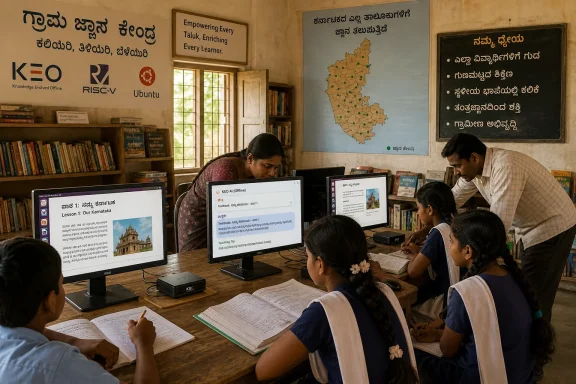 Offline AI is the practical feature, not the headline
KEO’s promised advantage is that it can answer questions against material stored on the machine even without an internet connection. The system ships with BUDDH, an educational assistant based on Karnataka’s DSERT curriculum, alongside Shikshanapedia learning material for students. The South First says BUDDH is designed for syllabus and textbook use, including explanations, summaries, quizzes and directions to relevant chapters and pages.
This is a narrower and more defensible use of local AI than presenting a low-cost machine as a replacement for an online assistant. A device with roughly 4–5 TOPS of neural-processing capacity can plausibly accelerate image classification models such as MobileNet or ResNet, as KEONICS chairman Sharath Kumar Bache Gowda told The South First. It cannot be assumed to deliver the broad knowledge, response quality or flexibility associated with cloud-hosted frontier models.
The constraint is also a feature. If BUDDH works chiefly from a curated set of local textbooks and resources, it gives schools a chance to limit answers to material that teachers can inspect. In a school setting, that is more useful than an unrestricted bot that confidently wanders beyond the prescribed curriculum. It also reduces recurring bandwidth demands and avoids making every question dependent on a third-party cloud service.
Still, offline does not automatically mean accurate. The government has not published a technical evaluation showing BUDDH’s answer accuracy, its handling of Kannada and English queries, how it cites or grounds answers in the local material, or what happens when students ask questions outside its indexed lessons. Nor has it disclosed the model size, update process, content versioning system or security controls for the local knowledge base. Those are not academic omissions: an educational AI system needs reliable correction and update mechanisms even when its core function is offline.
A RISC-V Linux computer changes the support equation
KEO uses a 64-bit quad-core RISC-V processor, 8GB of RAM, 32GB of internal storage and Ubuntu, according to The South First. The New Indian Express described the hardware as a set-top-box-like unit that requires a compatible monitor. Its reported ₹18,999 price is about ₹19,000 in the coverage from other outlets, a small difference that appears to be rounding rather than a contradictory retail tier.
RISC-V is an open instruction-set architecture, meaning the architecture itself is available under open specifications instead of being controlled like x86 or ARM instruction sets. That supports Karnataka’s stated goal of reducing dependence on proprietary hardware and software licensing. Ubuntu and LibreOffice also avoid the per-device operating-system and office-suite licensing costs associated with a conventional Windows deployment.
For IT administrators, however, open architecture does not erase operational work. A RISC-V Linux endpoint is outside the mainstream desktop fleet found in most schools, enterprises and public agencies. Existing Windows applications, conventional x86 Linux binaries, endpoint-management agents, security tools, device drivers and peripheral utilities cannot simply be assumed to run natively. Each has to be ported, replaced, accessed through a browser, or otherwise accommodated.
That makes KEO best understood as an appliance-style learning endpoint, not as a drop-in replacement for a Windows PC. It can be a sensible choice for a known workload — a browser, office documents, local curriculum libraries, beginner programming, selected AI demonstrations and media playback. It is a much harder proposition if schools expect compatibility with arbitrary Windows software, legacy educational packages or centrally managed Windows estate tooling.
The state’s approach therefore depends on keeping the workload disciplined. An inexpensive machine with 32GB of local storage will need careful image management if it must hold operating-system updates, applications, PDFs, videos, textbooks and AI model files. Educational video libraries alone can consume storage rapidly. The supplied reporting says external storage may be possible, but Karnataka has not publicly detailed the baseline storage expansion, backup, repair or device-reimaging policy for the library installations.
The first phase reaches every taluk, not every library
The geographic framing is easy to overread. The initial KEO deployment covers all 239 taluks, but it does so through two Arivu Kendras per taluk. The South First reports that Karnataka has 5,888 gram panchayat Arivu Kendras operating, of which 5,767 are digitised. By that measure, the 478 centres receiving KEO in the first phase represent only about 8% of the state’s operational Arivu Kendras.
That is not a flaw in a pilot; it is the scale reality behind the announcement. Four shared computers per selected library can provide an introduction to local AI and digital learning, but it cannot provide one-to-one computing. The 31 residential schools fare better with 10 machines each, though the reporting does not state their enrolment, lab layouts or teacher-to-device ratios.
The choice of Arivu Kendras does make practical sense. Unlike a school computer lab limited to enrolled students and opening hours, gram panchayat libraries can serve students, exam candidates, farmers, women and other residents seeking digital services. The hardware could therefore have broader community value — but only if access rules, staffing, physical security and maintenance are arranged for that wider public role.
Karnataka’s leaders have cast KEO as an inclusion effort and a way to decentralise technology opportunity beyond Bengaluru. The first deployment is a more measurable test: it will show whether a restricted, local-first PC can survive real public use while offering enough utility to justify support costs.
The launch date in the reporting needs correcting
One factual discrepancy deserves clearing up before the project’s history becomes muddled. The South First article says KEO was launched by Chief Minister D. K. Shivakumar on “Saturday, 22 August.” Multiple contemporaneous reports, including Moneycontrol and The New Indian Express, state that Shivakumar launched or unveiled the device on Friday, August 21, 2026. August 21 was indeed a Friday; August 22 was a Saturday.
That does not alter the deployment plan, but it illustrates why official programme documentation matters. The state should publish a clear specification sheet, device image and support lifecycle, BUDDH’s supported grades and languages, the exact centres selected in Phase 1, and an installation-progress dashboard. So far, outside reporting provides more operational detail than a publicly accessible technical deployment record.
There is also a difference between the messaging before and after the launch. A pre-launch Moneycontrol report referred to about 1,600 units from an initial production batch of 2,000 going to libraries. Post-launch accounts consistently describe the 2,222-system Phase 1 split of 1,912 library devices plus 310 school devices. The latter allocation is arithmetically coherent and has been repeated by several outlets, while the earlier number reads as a preliminary plan rather than the final distribution.
What Karnataka must prove next
The KEO initiative has a credible use case: a low-cost local-computing device that delivers curriculum material and selected AI functions without assuming dependable internet. Its RISC-V and Ubuntu foundation can lower licensing dependence, and its limited workload may be more appropriate for shared rural facilities than a cheaply specified Windows desktop expected to do everything.
The harder work begins once the boxes reach their destinations. Karnataka needs to demonstrate that BUDDH provides grounded answers, that course content is current in English and Kannada, that teachers can administer the systems, and that a failed unit can be repaired or reimaged without sending rural libraries into a long support queue. The first 2,222 machines will be judged less by their processor architecture than by whether a student can sit down at one in a village library, use it without a connection, and reliably learn something useful.