
For affected users, this is a model-and-platform update delivered through Windows Update rather than a conventional cumulative Windows patch or a Microsoft Store app update. That distinction is important: updating Paint, Photos, or another individual app will not by itself establish whether the underlying Image Creation component is current. Microsoft says the authoritative local check is Windows Update history, where the entry should appear as “2026-08 Image Creation version 1.2608.951.0 for AMD-powered systems (KB5124884).”
Microsoft has not published a changelog describing the specific fixes, quality changes, performance gains, or model alterations contained in version 1.2608.951.0. Administrators and users therefore have a version number and a replacement relationship to verify, but no vendor-supported basis to expect a particular improvement in generated images.
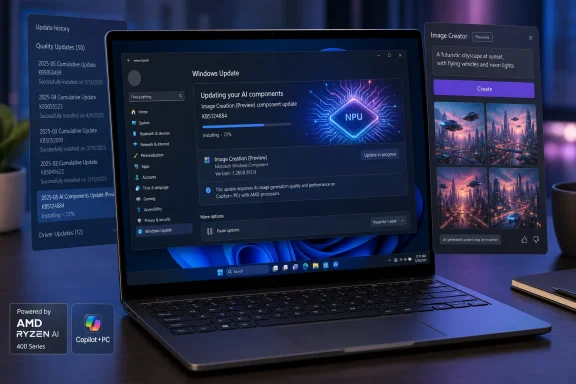 KB5124884 applies only to AMD Copilot+ hardware
The processor wording in KB5124884 is narrower than “any AMD Windows PC.” The update applies to AMD-powered Copilot+ PCs, not ordinary Ryzen desktops or laptops with an AMD GPU. Microsoft’s Copilot+ PC documentation identifies qualifying systems as machines with an NPU capable of more than 40 trillion operations per second; its supported-device guidance includes systems based on AMD Ryzen AI 300-series processors.
That hardware boundary means a PC can be running Windows 11 24H2, be fully patched, and still never receive KB5124884 if it does not meet the Copilot+ hardware requirements. A discrete Radeon graphics card does not turn a conventional desktop into a Copilot+ PC, and Microsoft’s current Windows AI documentation says its Image Generation API has an NPU-only supported execution path.
Microsoft describes the Image Creation component as enabling image generation and editing in supported Windows features and apps directly on the device. Its developer documentation separately describes Windows image-generation APIs as Stable Diffusion-powered, on-device capabilities exposed through the Windows App SDK. The terminology is close but not perfectly aligned: the support bulletin calls the package “Image Creation,” while the developer material generally calls the capability “AI Image Generation.”
What is clear is that this is underlying platform plumbing, designed to be shared by compatible software, rather than a feature release tied to one named app. Microsoft’s documentation says the model distribution and runtime are handled by Windows and that models can be shared across apps. That makes a component update more consequential than an isolated app patch, while also making it harder for users to see exactly what changed.
The prerequisite may delay installation
KB5124884 will download and install automatically through Windows Update, but Microsoft attaches one condition: the device must already have the latest cumulative update for its Windows 11 release installed. That requirement covers both Windows 11 version 24H2 and version 25H2.
In practice, this creates a two-stage servicing dependency. If an eligible AMD Copilot+ system is paused on an older monthly cumulative update, has a pending restart, or is otherwise behind on Windows quality updates, the Image Creation component may not arrive even though the standalone support article describes it as automatic.
For IT staff, the practical first check is therefore not whether a user can find an image-generation button in a particular application. Confirm the installed Windows release, confirm the current monthly cumulative update has completed, restart if Windows Update requires it, and then inspect Update history for KB5124884. Microsoft does not list a standalone installer, catalog package, or manual-download path in the bulletin.
This is also a reminder that the increasingly visible AI features in Windows 11 are being serviced on more than one cadence. Traditional security and quality fixes come through cumulative updates; inbox apps may update through the Microsoft Store; and large local AI capabilities can arrive as separately tracked Windows Update components. Troubleshooting them as though they all share one version number will produce misleading results.
The update is automatic, but the model is still optional
Microsoft’s Windows AI documentation adds a useful detail missing from the KB article: the local image-generation model is optional on Copilot+ PCs and is not preinstalled by default because it occupies several gigabytes of storage. When a compatible application requests the capability for the first time, Windows can download the model in the background through Windows Update.
That design explains why KB5124884 should not be read as a blanket activation notice for every AMD Copilot+ PC. The new component can be installed while the full image-generation model remains absent until an app invokes it and the user or app workflow permits the download. Microsoft recommends that developers explicitly handle the “not installed” state and seek user consent before triggering the model download.
The documentation also says an end user can remove the model later to recover storage. Microsoft has recently begun exposing removal of the Image Generation AI component on supported Copilot+ PCs in Windows Insider servicing, but KB5124884 itself does not spell out removal behavior, model size, download timing, or whether the replacement is retained after a user removes the optional capability.
Those omissions matter most on managed laptops with tight storage allocations or tightly controlled update policies. The support page promises automatic delivery but provides no file size, bandwidth estimate, deployment control guidance, or enterprise-management instructions. Organizations should avoid treating the KB number as evidence that every eligible endpoint has the usable image-generation model installed and ready.
What Microsoft does — and does not — say changed
The entire technical description of KB5124884 is that it contains “improvements” to the Image Creation AI component. Microsoft provides no release notes for output quality, prompt adherence, safety behavior, hardware utilization, inference speed, battery use, storage footprint, or known issues. There is also no stated relationship to a specific version of Paint, Photos, Click to Do, or a third-party application.
That leaves only one firm operational conclusion: version 1.2608.951.0 supersedes the earlier AMD component package, KB5121636. For a user facing a reproducible image-generation failure, installing KB5124884 is a reasonable baseline step after current Windows cumulative updates are installed. It is not, however, evidence that Microsoft has fixed that particular failure unless the company documents the symptom elsewhere.
Developers should read the release as a servicing update to the model layer, not a guarantee of a new API contract. Microsoft’s AI Image Generation guidance still places the feature within the Windows App SDK, requires an MSIX-packaged app with the systemAIModels capability, and requires a recent MaxVersionTested declaration. An app that lacks those requirements can fail to load an available model regardless of whether KB5124884 appears in Windows Update history.
The same boundary applies to users. A current component cannot make a feature appear in software that has not implemented Microsoft’s local image-generation APIs, has not enabled the feature for that channel, or does not support the user’s Windows configuration.
How to confirm the update on an AMD Copilot+ PC
On a device that meets Microsoft’s Copilot+ requirements, open Settings > Windows Update > Update history and look for the August 2026 Image Creation entry naming version 1.2608.951.0 and KB5124884. If it is absent, install pending Windows 11 cumulative updates first, restart the device where requested, and check Windows Update again.
Do not confuse the entry with a generic AMD graphics driver update, a Microsoft Store app update, or an Intel- or Qualcomm-specific AI component. KB5124884 is explicitly the AMD package, and Microsoft’s component servicing is processor-specific even where the visible Windows feature may look identical across Copilot+ hardware.
For now, version confirmation is the useful test. Microsoft has shipped KB5124884 automatically for eligible AMD Copilot+ PCs, but it has not said what users should expect to look, run, or behave differently after the update lands.