
That distinction matters. This is not a miniature electronic arcade machine running an emulated ROM, nor is it an LCD handheld hidden inside a LEGO shell. It is a brick-built kinetic model: pull a lever to send barrels into motion, guide Jumpman with the joystick, and use the button to make him leap. The idea is closer to a physical interpretation of Donkey Kong’s rules than a conventional video game reproduction—and that may be exactly why it has so much appeal for retro gaming collectors. LEGO describes the set’s lever, joystick and jump-button functions
For fans of Nintendo history, LEGO collecting, and the wider resurgence of retro game-room décor, the set is an unusually well-targeted piece of licensed hardware nostalgia. It does not simply borrow the game’s cabinet art. It makes the machinery of the original game—barrels, girders, ladders, hammers, climbing, and the pivotal act of jumping—the core of the build and the finished model’s interaction.
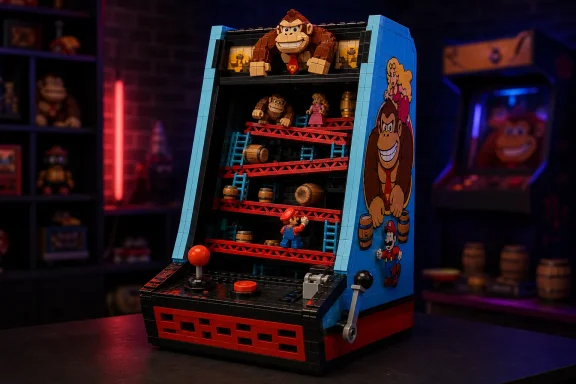 A classic arcade game rebuilt as a mechanical LEGO model
The original Donkey Kong was released by Nintendo in 1981, introducing audiences to the character then known as Jumpman, who would later become Mario. Nintendo’s own historical material identifies the game as a coin-operated title developed and distributed in 1981, while noting that Jumpman was later renamed after Nintendo of America’s landlord, Mario Segale. Nintendo’s company history
That history gives LEGO’s subject matter unusual weight. Donkey Kong is not just another recognizable cabinet from the arcade era. It is one of the foundations of Nintendo’s modern identity, a game remembered for establishing the relationship between Donkey Kong, Mario, and Pauline—represented in the new set under the original arcade-era name, Lady. Nintendo still describes the 1981 release as Donkey Kong’s debut and confirms that Mario was called Jumpman at the time. Nintendo’s Donkey Kong history feature
LEGO’s model embraces that early identity rather than translating the property into its newer Donkey Kong Country, Mario Kart, or Switch-era visual language. The cabinet uses the tall, compact silhouette associated with classic upright arcade hardware, while the interior focuses on the construction-site playfield: angled scaffolding, ladders, a hammer, Jumpman, Lady, Donkey Kong, and a stream of barrels descending toward the player character. LEGO’s official set description
The result is less a generic “Nintendo arcade machine” than a physical celebration of one highly specific game. That specificity is a strength. Donkey Kong works especially well in LEGO because its visual grammar was always geometric: ramps, ladders, beams, platforms, barrels, and a character climbing vertically toward a goal. The game’s original limitations—multiple fixed screens instead of a continuously scrolling world—also produced a composition that translates naturally into stacked brick-built scenes. Nintendo’s Shigeru Miyamoto has explained that the four-screen structure emerged from the team’s ambition to create a more expansive game on arcade hardware that could not support the scrolling they originally wanted. Nintendo’s Iwata Asks interview with Miyamoto
What the $200 set actually does
At $199.99, the Donkey Kong Arcade set sits firmly in LEGO’s adult-oriented collector category. The product is marked 18+, contains 1,367 pieces, and arrives as a display-scale model rather than a child-focused playset. LEGO’s official product page
Its core engineering is built around three actions:
- A lever releases a barrel.
- A mechanism moves the barrel through the cabinet’s level layout.
- A joystick controls Jumpman’s position while a button triggers his jumping movement. LEGO’s set specifications
LEGO says the cabinet includes 21 barrels and uses a mechanism designed to circulate them in a continuous loop. That is a particularly important detail, because it shifts the model from a one-off novelty action into a repeatable desktop game-like experience. Players will not need to reset a few loose elements after every turn; the set is intended to preserve the sense of barrels continually threatening Jumpman’s climb. LEGO’s product listing
This is where the phrase “playable LEGO arcade game” needs careful interpretation. The cabinet does not present the original game’s four distinct boards, scorekeeping, timer, changing enemy patterns, sound effects, or electronic collision detection. It cannot replicate the split-second precision and escalating challenge of the 1981 arcade program.
Instead, it transforms Donkey Kong’s central interaction into a tactile toy mechanism. Move a figure. Release an obstacle. Trigger a leap. Watch a barrel route through the course. In a market full of static display replicas, that is a more meaningful form of interactivity than it might initially sound.
A physical representation of game design
The original Donkey Kong is often remembered in simple terms: Mario climbs, Donkey Kong throws barrels, and Pauline waits at the top. But its enduring appeal comes from the way its systems create pressure. Ladders create opportunities and traps. Barrels threaten predictable routes but can be jumped over. Hammers briefly reverse the power relationship, allowing the player to destroy oncoming hazards.
Nintendo’s current Switch listing for the arcade version still summarizes those fundamentals in nearly identical terms: players navigate a construction site, avoid obstacles, climb to the top, and use the hammer to smash barrels and fireballs. Nintendo’s Arcade Archives DONKEY KONG page
LEGO has selected the right systems to preserve. The barrel mechanism and Jumpman movement do not need a microprocessor to evoke the game’s identity because they reproduce its most recognizable cause-and-effect relationship. Donkey Kong releases danger; Jumpman responds through movement and jumping.
For a collector, that can be more satisfying than a tiny screen with a simplified game preloaded. It makes the construction of the set part of understanding the game. Builders assemble the scaffolding that creates the route, the mechanisms that animate the hazards, and the controller that moves the hero. The cabinet’s logic becomes visible.
Scale, dimensions, and the practical reality of owning it
The completed model measures more than 15.5 inches (39 cm) high, 10.5 inches (27 cm) wide, and 5.5 inches (15 cm) deep. LEGO’s official specifications That makes it substantial enough to read immediately as an arcade cabinet, but still compact enough for a desk, bookcase, game-room display, or a shelf beside a console collection.
Its footprint is one of the set’s strongest practical advantages. Full-size arcade ownership has always carried hidden costs: freight shipping, repairs, screen maintenance, storage, electrical concerns, and the uncomfortable reality that original cabinets can be physically enormous. Even modern replica machines take up far more floor space than many homes can spare.
LEGO’s Donkey Kong Arcade avoids those problems. At 15.5 inches tall, it is clearly a display object rather than a cabinet substitute. Yet it still offers a larger, more architectural presence than the smaller brick-built Nintendo hardware that came before it.
The trade-off is that the set will not scratch the same itch as owning an original arcade machine. It cannot recreate the glow of a CRT monitor, the click of a coin door, the original joystick hardware, arcade audio, or the competitive ritual of chasing a high score. Enthusiasts looking for the actual 1981 game experience still have accessible digital alternatives; Nintendo’s Switch storefront, for example, offers Arcade Archives DONKEY KONG with selectable settings, arcade display options, and online high-score competition. Nintendo’s Switch store listing
That does not undermine LEGO’s concept. It clarifies its audience. This is a collectible interpretation of arcade history, not an arcade restoration project.
The price-per-piece conversation misses part of the point
A $199.99 price for 1,367 pieces will inevitably invite the familiar LEGO value calculation. On a simple per-piece basis, buyers may compare it with larger unlicensed sets, especially when the new cabinet is smaller than a full-size arcade machine and lacks electronics.
But licensed adult LEGO sets are rarely priced only around brick count. The Donkey Kong Arcade model is paying for a premium combination of Nintendo branding, display design, custom printing or artwork elements, internal mechanical engineering, and the collector appeal of a historically significant subject. It is also designed around an interactive mechanism rather than simply maximizing volume with conventional bricks.
The more useful question is whether the build offers enough experience beyond the display. Here, LEGO’s moving barrel loop, joystick-operated Jumpman, and jump button make a compelling case. A static cabinet façade would have been easier and presumably less expensive. The decision to make the model perform the visual language of Donkey Kong is what elevates it beyond an oversized ornament. LEGO outlines the barrel-loop and control mechanisms
Still, prospective buyers should set expectations appropriately. The price is for an adult LEGO collectible that happens to be playable in a mechanical sense. It is not a $200 replacement for a dedicated arcade emulator, a 1:1 cabinet, or a premium digital tabletop system.
Why Donkey Kong is a smart choice for LEGO and Nintendo
Nintendo and LEGO have already established that their partnership works best when it treats game hardware and game iconography as building challenges rather than simply applying a logo to a conventional set. The LEGO Game Boy launched in 2025 as a 421-piece, 18+ display build priced at $59.99, complete with interchangeable brick-built game cartridges and display screens. LEGO’s 2025 Game Boy announcement
That Game Boy was deliberately non-electronic. LEGO specifically noted that it contained no light, sound, or display play functions. LEGO’s Game Boy product details Its appeal was rooted in accurate form, recognizable controls, and the satisfaction of recreating a beloved object from bricks.
The Donkey Kong Arcade set extends that philosophy but pushes it into a more ambitious direction. Instead of reproducing a piece of hardware as a static artifact, it builds a physical version of a game’s action. That is a meaningful evolution for the LEGO Nintendo line.
A game defined by movement
Not every arcade classic would convert so cleanly into a mechanical LEGO set. Games built around rapid animation, shooting, or intricate digital logic can be difficult to interpret without a display. Donkey Kong is different because the defining elements are easy to express physically.
- Barrels roll downhill.
- Jumpman climbs ladders.
- A button makes him jump.
- A hammer changes how hazards are handled.
- The top of the structure represents rescue and completion.
Those are straightforward actions, but their simplicity is precisely why they remain recognizable forty-five years later. Nintendo has described Donkey Kong as its first major hit outside Japan, and its own company history characterizes the 1981 coin-op as rapidly becoming a major arcade success. Nintendo’s company history
The LEGO model benefits from that clarity. It can represent the game without relying on a printed screen or an accompanying smartphone app. The set’s playfield itself is the content.
Jumpman before Mario became Mario
The use of Jumpman is another welcome decision. Modern Nintendo branding understandably centers Mario, but the original Donkey Kong tells a different story: a carpenter character, still early in his design evolution, attempting to rescue Lady from a rampaging ape.
Nintendo’s own historical account identifies Jumpman as a carpenter and notes that he was later renamed Mario. Nintendo’s history of the 1980–1990 period The LEGO cabinet therefore acknowledges a moment before Mario became the global mascot whose name now dominates video game culture.
For retro enthusiasts, that nuance gives the model greater credibility. This is not just “LEGO Mario in an old arcade game.” It is a reconstruction of the game that helped create Mario’s future.
The best reasons to buy it
The strongest argument for the Donkey Kong Arcade set is not that it replaces a real arcade machine. It is that it occupies a category real cabinets and digital re-releases cannot fully reach: a hands-on display object that embodies the design of a classic game.
It offers a build with a purpose
A 1,367-piece adult build should offer more than repetition, and this one has a clear structural narrative. Builders assemble an arcade cabinet, then construct the mechanisms that make it animate. The internal system is not incidental; it is the reason the set exists.
LEGO also supports the build through the LEGO Builder app, which provides digital instructions, 3D rotation, zooming, and progress tracking. LEGO’s product page For builders who prefer working from a tablet or want to inspect complex mechanism steps from multiple angles, that will be useful.
It fits modern game-room décor better than full-size hardware
The finished cabinet has enough height to be a focal point but not so much bulk that it dictates a room’s layout. That makes it especially appealing for PC gaming spaces, home offices, media centers, and shelf displays that already include controllers, handhelds, boxed games, or retro peripherals.
The original cabinet’s form is iconic even at a reduced scale. Visitors do not need to recognize the exact set number to understand what it represents. The bright arcade styling, large Donkey Kong branding, and recognizable sloped playfield communicate the theme immediately.
It uses interactivity intelligently
The physical controls are more than decorative details. The lever, joystick, and jump button turn passive observation into a miniature ritual: send a barrel, guide Jumpman, then try to time a leap. LEGO’s official description specifically frames those features as a way to recreate the barrel-launching and leaping action of the arcade original. LEGO’s Donkey Kong Arcade listing
That makes the set well suited to display environments where people will actually handle it. A shelf model that can be demonstrated in thirty seconds may be more memorable than one that can only be admired from a distance.
Risks, limitations, and what collectors should consider
The Donkey Kong Arcade set is a strong concept, but it is not immune from the issues that often accompany complex licensed LEGO display models.
Mechanical play can be less forgiving than a screen
The barrel loop and moving Jumpman are the cabinet’s biggest selling points, but they are also the components most likely to demand careful use. Brick-built mechanisms can be satisfying precisely because they are visible and tactile; they can also be more sensitive to alignment, friction, accidental knocks, and incomplete assembly than an electronic game.
The set’s target audience is adults, which should help. Still, prospective owners should view the mechanism as an engineered LEGO feature, not an indestructible arcade control system. The model will likely reward careful building and measured handling more than energetic, repeated play.
The gameplay is evocative, not complete
Calling the cabinet “fully playable” is understandable shorthand, but it should not create the expectation of a literal physical port of Donkey Kong. It cannot offer the original game’s electronic scoring, lives, sound, enemy timing, multiple boards, or shifting difficulty curve.
That limitation is not a design failure. It is the boundary between a mechanical model and software. But it is worth stating plainly: buyers who primarily want to play Donkey Kong should choose the digital arcade version first, then consider the LEGO set as a companion collectible rather than a substitute. Nintendo’s current digital release offers the actual arcade program along with adjustable settings and online score competition. Nintendo’s Arcade Archives DONKEY KONG page
It is a commitment in both money and time
At 1,367 pieces and $199.99, this is not an impulse purchase. The 18+ rating signals LEGO’s intended positioning: a project for adult builders, collectors, and gift buyers rather than a quick weekend toy for younger children. LEGO’s official listing
The generous size is also a double-edged sword. It gives the cabinet presence, but buyers still need a shelf or desk surface deep enough to accommodate its 5.5-inch footprint while leaving enough clearance to operate the lever and controls comfortably.
A better kind of retro gaming collectible
The market is crowded with retro game merchandise that depends on simple recognition: a logo on a T-shirt, a miniature cabinet with a static screen, a controller-shaped desk ornament, or pixel art turned into wall décor. LEGO’s Donkey Kong Arcade succeeds because it attempts something more ambitious.
It understands that Donkey Kong was never only about its cabinet art. The game was about vertical movement, accelerating tension, improvised routes, dangerous barrels, and the now-legendary act of jumping. Nintendo itself has emphasized the importance of that jump, with Miyamoto reflecting that the game would have been extremely difficult had the character not been given the ability to leap. Nintendo’s interview on Mario’s early design
By making movement central to the model, LEGO has created something that feels closer to a tribute than a replica. It is a cabinet that invites owners to demonstrate why the original mattered, rather than merely display evidence that they remember it.
For Nintendo collectors, the set also offers a striking bridge between eras. It celebrates Donkey Kong’s 1981 arcade debut, preserves the Jumpman identity that predates Mario’s global fame, and follows LEGO’s 2025 Game Boy model in expanding Nintendo nostalgia into premium brick-built hardware. LEGO’s Game Boy announcement
The LEGO Donkey Kong Arcade 72051 will ship beginning August 1, 2026, and its $199.99 price places it squarely among premium adult display sets. LEGO’s official product page But its real value is not measured only in piece count, cabinet dimensions, or shelf presence. It is a rare collectible that asks builders to assemble a piece of gaming history—and then gives them a way to make that history move.