
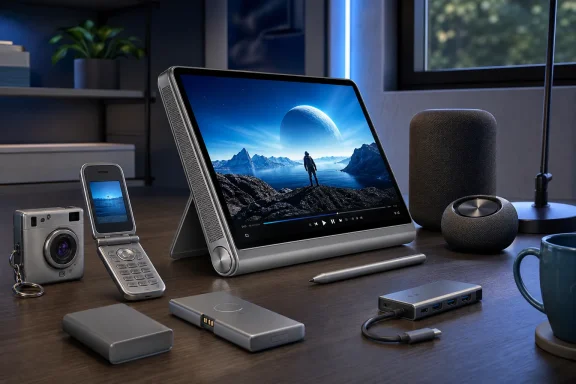
Lenovo’s new Android 16 tablet combines a 12.1-inch, 2.5K 120Hz LCD with a nine-driver JBL speaker system, a rotating kickstand, and a 10,200mAh battery rated for up to 15 hours of video streaming. Lenovo says it uses MediaTek’s Dimensity 7400 and supports its Tab Pen Plus stylus, while a microSD slot provides an easy route to extra local storage.
For Windows households, its potential value is less about replacing a laptop and more about becoming a portable companion for streaming, remote-desktop sessions, cloud files, and casual use. The speaker-heavy design makes it notably thicker than conventional tablets, but that is also the point: Lenovo is prioritizing standalone sound over the usual race toward an iPad-like slab.
 Commodore brings Sailfish back to the phone conversation
The Commodore Callback 8020 is perhaps the month’s most unusual launch. Commodore has paired a retro flip-phone design with Jolla’s Linux-based Sailfish OS, Android app compatibility, and deliberate system-level blocks for web browsers and social-media apps.
According to Commodore, the $399-and-up handset supports essentials including WhatsApp, messaging, navigation, music, hotspot functionality, and Commodore-themed games, while omitting email, browser access, and social feeds. The company says Android apps run through Sailfish’s compatibility layer, though it acknowledges that some apps—particularly those dependent on Google Play Services or specific banking protections—may not work reliably.
That makes the Callback 8020 a niche device, not a conventional smartphone substitute. But Windows enthusiasts who remember the C64 and who are increasingly wary of phone-centric account ecosystems may find its intentional limitations more interesting than its 48MP camera or nostalgic ringtones.
A power bank designed for the shared desk
Nimble’s SharePower splits a 10,000mAh USB-C battery into two magnetically connected 5,000mAh modules. Each half can charge at up to 20W alone; combined, the unit can deliver up to 35W.
That makes it a practical accessory for commuters and hybrid workers carrying a Windows ultrabook, phone, earbuds, and other USB-C hardware. It will not replace a high-output laptop power bank, but its ability to divide into two independent chargers solves a common travel problem without requiring two separate batteries.
The nostalgic gear is real—but not necessarily practical
Bang & Olufsen’s Beosystem 3000c Dune Grey Edition pairs a restored 1985 Beogram 3000 Series linear-tracking turntable with Beolab 8 wireless speakers. Only 100 systems are being produced, at $30,000 each, making it more a collector-grade restoration project than a sensible route into vinyl.
At the other end of the price scale, Kodak’s Charmera Millennium Edition is a $35 blind-box keychain camera built around a 1.6MP sensor, AVI video capture, microSD storage, and deliberately low-fidelity Y2K styling. It is a novelty camera rather than a serious alternative to a phone, but its local removable storage is a refreshing throwback in an era of automatic cloud uploads.
The practical takeaway from July’s overlooked hardware is simple: the most compelling gadgets are increasingly the ones with a narrow, clearly defined job. Lenovo is selling a tablet that treats sound as a feature, Nimble is making portable power shareable, and Commodore is betting some users would rather lose the browser than lose another evening to it.
