
Lenovo may be working on an unusually thin ThinkBook laptop, but the current “Aeroblade” leak does not establish a 3 mm laptop chassis—or even confirm that Aeroblade is the product’s final retail name. The images obtained by Windows Latest show an unannounced ThinkBook with exceptionally thin-looking edges, flatter keys, two USB-C ports housed in a noticeably raised rear-side section, and what appears to be a Windows 11 keyboard with a Copilot key. Lenovo has not announced the machine.
Wccftech’s August 7 report correctly attributes its information to Windows Latest, whose reporting is the underlying source rather than independent confirmation. The more consequential discrepancy is measurement: Wccftech’s story says the base “appears” to measure only 3 mm, while the original Windows Latest report supplies no dimensions at all. It instead says the edge looks visually thinner than the USB-C ports and explicitly cautions that the machine may use a thicker middle with tapered edges.
That turns this from a story about a record-breaking 3 mm Windows laptop into a much more credible story about a ThinkBook that may be aggressively tapered around its perimeter.
The leaked side view is striking because the long visible edge appears nearly blade-like, then rises sharply near the rear to accommodate two USB-C ports. That design is sufficiently unusual to support the broad conclusion that Lenovo is exploring a very thin ThinkBook. It does not, however, let observers calculate the thickness of the motherboard, battery, cooling hardware, display hinge, or the central portion of the bottom case.
The original Windows Latest report handles that distinction more carefully than the follow-on coverage. It says camera angle can deceive, acknowledges the possibility of a thicker center section, and describes the device as one of the thinnest chassis designs it has seen rather than assigning it a measured profile. Its own photos make the same point: the raised USB-C section is visibly thicker than the adjacent edge.
This matters because a tapered enclosure and a uniformly thin enclosure are mechanically and thermally different products. A conventional laptop can hide much of its volume above the visual lower edge: beneath the palm rest, around the battery cells, and at the rear hinge area. Lenovo could retain a fairly conventional internal stack while giving the exterior the visual drama of an ultra-thin machine.
The port pod does not prove Lenovo somehow fitted a complete PC into the apparent thickness of the edge. It more likely shows the opposite: USB-C connectors impose a minimum height that the edge could not meet, so Lenovo created a local bulge to keep the ports usable. Whether that bulge also holds part of the mainboard, cooling assembly, antenna hardware, or simply reinforcement for the rear I/O is unknown.
No official technical document currently resolves that question.
That uncertainty is more than semantic. Lenovo has used ThinkBook for a broad range of devices, including conventional clamshells, convertibles, dual-screen models, rollable-display systems, and experimental form factors. A name buried in promotional assets can survive into retail branding, change before launch, or disappear entirely.
Lenovo’s current U.S. ThinkBook storefront does not list an Aeroblade model. The company’s public ThinkBook material instead promotes existing series and configurable business laptops, without a reference to this design or its alleged naming. That absence is not evidence that the product will not launch; it means the leak remains outside Lenovo’s official record as of August 7, 2026.
There is also a small but revealing identification error in the source reporting. Windows Latest consistently describes the device as a ThinkBook, but one sentence calls the machine an “upcoming ThinkPad Aeroblade.” The images and the rest of the article point to ThinkBook, not ThinkPad. It reads as a typo, but it is another reason not to treat every label around this early leak as settled.
For IT buyers, the ThinkBook-versus-ThinkPad distinction is practical. Lenovo positions ThinkBook as its small-business line, while ThinkPad remains the better-defined enterprise family for long lifecycle options, formal manageability configurations, broader dock validation, and established corporate procurement programs. An ultra-thin ThinkBook could be attractive to mobile workers, but it should not be assumed to inherit ThinkPad deployment characteristics merely because the visual language overlaps.
The leaked keys look flatter and less sculpted than those on current ThinkBook systems. Windows Latest describes them as noticeably flatter and interprets the design as Lenovo cutting vertical height where it normally would not. Wccftech similarly identifies shallow-looking keys as the apparent trade-off needed for the profile.
That interpretation is credible, though actual key travel remains unconfirmed. Lenovo’s official specifications for recent ThinkBook models repeatedly list 1.5 mm of key travel. The ThinkBook 14 Gen 8, for example, is specified at 17.5 mm thick with a 1.5 mm keyboard; Lenovo’s ThinkBook 14 2-in-1 Gen 5 is listed at 16.9 mm and also retains 1.5 mm travel.
The comparison does not establish how much travel Aeroblade would lose. It does establish the baseline Lenovo would be departing from. If the production machine replaces the familiar 1.5 mm mechanism with a significantly shallower assembly, the compromise will be felt thousands of times per day by anyone writing email, code, reports, tickets, or documentation.
That is a sharper concern than abstract worries over thinness. Business ultraportables often spend their lives connected to a dock, external monitor, and full-size keyboard, which can make port scarcity tolerable. A compromised built-in keyboard affects the very mobile use case that an extreme-thin ThinkBook is meant to serve.
The photos also show a large touchpad, and the original report says the machine appears to include a raised camera housing that may contain webcam or infrared hardware. Those elements suggest Lenovo is not simply cutting every feature to reduce height. But they reveal nothing about typing feel, palm-rest rigidity, trackpad haptics, display quality, or whether the keyboard is backlit.
Those omissions are especially important because thinness changes the relationship between all of those specifications. A low-power processor may make an ultra-thin design practical, but it would also determine the type of workloads the laptop can sustain. A high-resolution OLED panel could make the machine feel premium while putting pressure on battery life. Soldered memory, a single storage slot, or a restricted I/O layout would affect how well the device fits small-business deployment.
The two visible USB-C ports should not be read as a complete connectivity specification. The photos do not establish whether both ports support charging, DisplayPort output, Thunderbolt or USB4, or high-speed external storage. They do not show the right side clearly enough to confirm whether Lenovo includes USB-A, HDMI, a headphone jack, a microSD slot, or any other physical connectivity.
Lenovo’s recently announced Yoga Slim 7i Ultra Aura Edition illustrates the gap between a genuinely thin laptop and the rumor’s visual claim. Lenovo specifies that 14-inch Windows 11 model at 13.9 mm thick and 975 grams, with a 75 Wh battery and three Thunderbolt 4 ports. It is thin by any normal standard, but it still has a published full-device measurement, a stated battery capacity, and clearly enumerated ports.
Aeroblade has none of that yet. A visible edge and a port bump are not substitutes for a spec sheet.
What the evidence supports is narrower: Lenovo appears to have an unannounced ThinkBook design that prioritizes an exceptionally thin-looking exterior and may sacrifice keyboard depth to achieve it. The evidence does not support a measured 3 mm chassis, “thinnest laptop ever” status, or conclusions about performance and battery life.
The first Lenovo announcement needs to answer three basic questions before this becomes a procurement story rather than an industrial-design curiosity: the maximum chassis thickness rather than the apparent edge thickness, the actual keyboard travel, and the processor-and-battery combination that will determine sustained Windows 11 performance. Until then, the raised USB-C section is the leak’s most useful clue: it shows where the physics of an ultra-thin laptop have already forced Lenovo to make room.
That turns this from a story about a record-breaking 3 mm Windows laptop into a much more credible story about a ThinkBook that may be aggressively tapered around its perimeter.
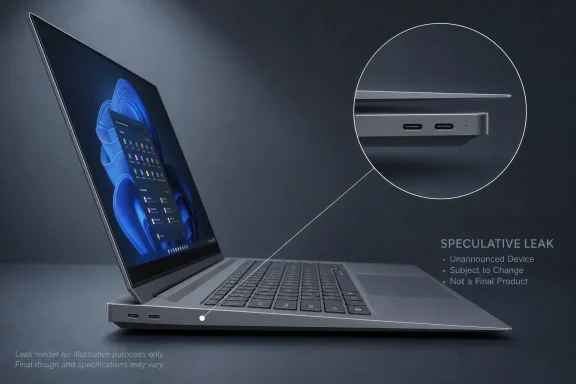 The leak shows an edge, not the chassis thickness
The leaked side view is striking because the long visible edge appears nearly blade-like, then rises sharply near the rear to accommodate two USB-C ports. That design is sufficiently unusual to support the broad conclusion that Lenovo is exploring a very thin ThinkBook. It does not, however, let observers calculate the thickness of the motherboard, battery, cooling hardware, display hinge, or the central portion of the bottom case.The original Windows Latest report handles that distinction more carefully than the follow-on coverage. It says camera angle can deceive, acknowledges the possibility of a thicker center section, and describes the device as one of the thinnest chassis designs it has seen rather than assigning it a measured profile. Its own photos make the same point: the raised USB-C section is visibly thicker than the adjacent edge.
This matters because a tapered enclosure and a uniformly thin enclosure are mechanically and thermally different products. A conventional laptop can hide much of its volume above the visual lower edge: beneath the palm rest, around the battery cells, and at the rear hinge area. Lenovo could retain a fairly conventional internal stack while giving the exterior the visual drama of an ultra-thin machine.
The port pod does not prove Lenovo somehow fitted a complete PC into the apparent thickness of the edge. It more likely shows the opposite: USB-C connectors impose a minimum height that the edge could not meet, so Lenovo created a local bulge to keep the ports usable. Whether that bulge also holds part of the mainboard, cooling assembly, antenna hardware, or simply reinforcement for the rear I/O is unknown.
No official technical document currently resolves that question.
“Aeroblade” is a marketing-material label, not a confirmed Lenovo product
Windows Latest says it found “Aeroblade” in marketing materials associated with the laptop, while the chassis itself bears only the ThinkBook name. The outlet also notes it could not find an earlier Lenovo product with that name, and its own reporting leaves open two possibilities: a ThinkBook Aeroblade product family, or a standard ThinkBook carrying Aeroblade as an internal or campaign label.That uncertainty is more than semantic. Lenovo has used ThinkBook for a broad range of devices, including conventional clamshells, convertibles, dual-screen models, rollable-display systems, and experimental form factors. A name buried in promotional assets can survive into retail branding, change before launch, or disappear entirely.
Lenovo’s current U.S. ThinkBook storefront does not list an Aeroblade model. The company’s public ThinkBook material instead promotes existing series and configurable business laptops, without a reference to this design or its alleged naming. That absence is not evidence that the product will not launch; it means the leak remains outside Lenovo’s official record as of August 7, 2026.
There is also a small but revealing identification error in the source reporting. Windows Latest consistently describes the device as a ThinkBook, but one sentence calls the machine an “upcoming ThinkPad Aeroblade.” The images and the rest of the article point to ThinkBook, not ThinkPad. It reads as a typo, but it is another reason not to treat every label around this early leak as settled.
For IT buyers, the ThinkBook-versus-ThinkPad distinction is practical. Lenovo positions ThinkBook as its small-business line, while ThinkPad remains the better-defined enterprise family for long lifecycle options, formal manageability configurations, broader dock validation, and established corporate procurement programs. An ultra-thin ThinkBook could be attractive to mobile workers, but it should not be assumed to inherit ThinkPad deployment characteristics merely because the visual language overlaps.
The keyboard looks like the clearest sacrifice
The potentially material change visible in the images is not a claimed 3 mm edge. It is the keyboard.The leaked keys look flatter and less sculpted than those on current ThinkBook systems. Windows Latest describes them as noticeably flatter and interprets the design as Lenovo cutting vertical height where it normally would not. Wccftech similarly identifies shallow-looking keys as the apparent trade-off needed for the profile.
That interpretation is credible, though actual key travel remains unconfirmed. Lenovo’s official specifications for recent ThinkBook models repeatedly list 1.5 mm of key travel. The ThinkBook 14 Gen 8, for example, is specified at 17.5 mm thick with a 1.5 mm keyboard; Lenovo’s ThinkBook 14 2-in-1 Gen 5 is listed at 16.9 mm and also retains 1.5 mm travel.
The comparison does not establish how much travel Aeroblade would lose. It does establish the baseline Lenovo would be departing from. If the production machine replaces the familiar 1.5 mm mechanism with a significantly shallower assembly, the compromise will be felt thousands of times per day by anyone writing email, code, reports, tickets, or documentation.
That is a sharper concern than abstract worries over thinness. Business ultraportables often spend their lives connected to a dock, external monitor, and full-size keyboard, which can make port scarcity tolerable. A compromised built-in keyboard affects the very mobile use case that an extreme-thin ThinkBook is meant to serve.
The photos also show a large touchpad, and the original report says the machine appears to include a raised camera housing that may contain webcam or infrared hardware. Those elements suggest Lenovo is not simply cutting every feature to reduce height. But they reveal nothing about typing feel, palm-rest rigidity, trackpad haptics, display quality, or whether the keyboard is backlit.
Cooling, battery capacity, and ports remain the real unanswered specifications
The leaked material contains no processor, graphics, memory, storage, display, battery, weight, cooling, wireless, or port-speed specifications. There is no stated launch date, price, market availability, serviceability plan, or warranty positioning. Lenovo has not said whether the model is intended for the United States or other regions.Those omissions are especially important because thinness changes the relationship between all of those specifications. A low-power processor may make an ultra-thin design practical, but it would also determine the type of workloads the laptop can sustain. A high-resolution OLED panel could make the machine feel premium while putting pressure on battery life. Soldered memory, a single storage slot, or a restricted I/O layout would affect how well the device fits small-business deployment.
The two visible USB-C ports should not be read as a complete connectivity specification. The photos do not establish whether both ports support charging, DisplayPort output, Thunderbolt or USB4, or high-speed external storage. They do not show the right side clearly enough to confirm whether Lenovo includes USB-A, HDMI, a headphone jack, a microSD slot, or any other physical connectivity.
Lenovo’s recently announced Yoga Slim 7i Ultra Aura Edition illustrates the gap between a genuinely thin laptop and the rumor’s visual claim. Lenovo specifies that 14-inch Windows 11 model at 13.9 mm thick and 975 grams, with a 75 Wh battery and three Thunderbolt 4 ports. It is thin by any normal standard, but it still has a published full-device measurement, a stated battery capacity, and clearly enumerated ports.
Aeroblade has none of that yet. A visible edge and a port bump are not substitutes for a spec sheet.
Treat Aeroblade as a design leak until Lenovo puts numbers behind it
There is enough in Windows Latest’ images to take the possibility of an ultra-thin ThinkBook seriously. The apparent rear-side USB-C pod, flat-key profile, dual-tone chassis, large touchpad, and ThinkBook palm-rest branding look like a coherent product rather than a generic concept render. Wccftech’s report also reinforces that the material exists, but it does so by relying on the same original reporting.What the evidence supports is narrower: Lenovo appears to have an unannounced ThinkBook design that prioritizes an exceptionally thin-looking exterior and may sacrifice keyboard depth to achieve it. The evidence does not support a measured 3 mm chassis, “thinnest laptop ever” status, or conclusions about performance and battery life.
The first Lenovo announcement needs to answer three basic questions before this becomes a procurement story rather than an industrial-design curiosity: the maximum chassis thickness rather than the apparent edge thickness, the actual keyboard travel, and the processor-and-battery combination that will determine sustained Windows 11 performance. Until then, the raised USB-C section is the leak’s most useful clue: it shows where the physics of an ultra-thin laptop have already forced Lenovo to make room.
References
- Primary source: Wccftech
Published: August 7, 2026 at 3:01 PM UTC
Loading…
wccftech.com - Related coverage: support.lenovo.com
Loading…
support.lenovo.com - Related coverage: blogs.windows.com
Introducing a powerful new chapter for Windows PCs, accelerated by NVIDIA RTX Spark
Today at NVIDIA GTC, Microsoft and NVIDIA announced the world’s most powerful and efficient thin-and-light Windows PCs ever. Accelerated by NVIDIA RTX Sparkblogs.windows.com - Related coverage: lenovo.com
Loading…
www.lenovo.com - Related coverage: pcsupport.lenovo.com
Loading…
pcsupport.lenovo.com - Related coverage: psref.lenovo.com
Loading…
psref.lenovo.com - Related coverage: lenovo.com
Loading…
www.lenovo.com - Related coverage: intel.com
Loading…
www.intel.com - Related coverage: pcsupport.lenovo.com
Loading…
pcsupport.lenovo.com - Related coverage: tk.lenovo.com.cn
Loading…
tk.lenovo.com.cn - Related coverage: wccftech.com
Loading…
wccftech.com - Related coverage: news.lenovo.com
Lenovo at CES 2026: Smarter AI for More Intuitive and Connected PC Experiences - Lenovo StoryHub
Lenovo announced its latest consumer-focused innovations, expanding its Windows 11-based Yoga™ and IdeaPad™ portfolios with new AI laptops, AI desktops, and peripherals.news.lenovo.com - Related coverage: notebookcheck.net
Loading…
www.notebookcheck.net - Related coverage: psrefstuff.lenovo.com
Loading…
psrefstuff.lenovo.com - Related coverage: studioai.lenovo.com
Loading…
studioai.lenovo.com - Related coverage: techtoday.lenovo.com
Loading…
techtoday.lenovo.com - Related coverage: windowscentral.com
Loading…
www.windowscentral.com - Related coverage: windowscentral.com
Loading…
www.windowscentral.com - Related coverage: tomsguide.com
Loading…
www.tomsguide.com - Related coverage: psref.lenovo.com
Loading…
psref.lenovo.com - Related coverage: news.lenovo.com
Loading…
news.lenovo.com