

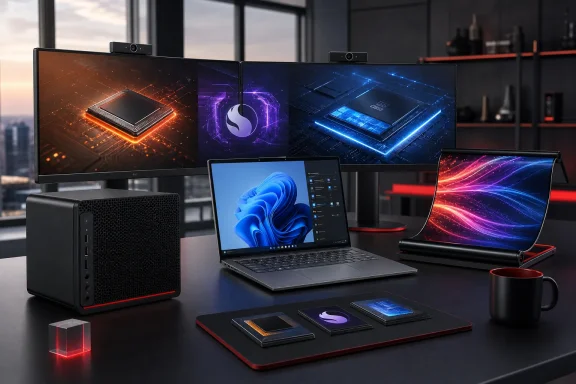
That changes the useful takeaway for Windows users and IT buyers. The ten-product leak was right about Lenovo preparing a substantial ThinkCentre, ThinkVision and ThinkBook wave, plus the Project Swan rollable concept. But the official page points to a much more deliberate split between AMD’s high-end local-AI desktop hardware, Qualcomm’s Arm-based portable business PC push, and Intel-based ThinkBook systems than the initial images alone could establish.
Windows Latest reported the lineup on August 27 from pre-release images. Lenovo’s publicly visible event page now names the models and, for several machines, their processor families. It does not provide full specifications, prices, regional availability, Windows editions, memory configurations, or ship dates. Those omissions matter more than the cosmetic details in the leak for organizations that must decide whether any of these systems fit their deployment standards.
ThinkCentre X Ultra is an AMD AI desktop, not an RTX Spark box
The ThinkCentre X Ultra is the strongest evidence that Lenovo is treating compact desktops as local-AI endpoints rather than simply smaller office PCs. Windows Latest had identified a cube-shaped machine with unusually extensive I/O, including two Thunderbolt ports, HDMI, DisplayPort, Ethernet and front USB-C. Lenovo’s event listing adds the missing platform detail: AMD Ryzen AI PRO Max.
That removes the article’s speculation that the machine may use Nvidia RTX Spark, a platform Lenovo is separately pairing with the Yoga Pro 9n Gen 11 and Yoga 9n 2-in-1 Gen 11. The distinction is substantial. RTX Spark positions Lenovo’s Yoga systems around Nvidia’s discrete AI and graphics stack, while Ryzen AI PRO Max puts the ThinkCentre X Ultra in AMD’s commercial processor family, where manageability, CPU performance, integrated graphics and a neural processing unit are part of one platform.
For IT departments, the processor confirmation is more useful than the Mac mini comparison. A Ryzen AI PRO Max-based ThinkCentre could be relevant where a small, fixed desktop needs to run supported local AI workloads, attach multiple displays and remain manageable under an enterprise hardware program. Yet Lenovo has not said how much memory the X Ultra will support, whether it uses soldered or replaceable memory, what class of graphics capability is enabled in the final configuration, or which operating-system images will be offered.
The port arrangement also deserves a more cautious reading than the leak gave it. Thunderbolt connectivity signals high-bandwidth expansion potential, but it does not by itself prove a workstation configuration, discrete graphics support or enterprise-class remote-management capabilities. Those are product-page questions Lenovo has still left unanswered.
M75s and M75q move to Ryzen AI PRO
Lenovo’s page identifies the refreshed ThinkCentre M75s Gen 6 and ThinkCentre M75q Gen 6 as AMD Ryzen AI 7 PRO systems. This confirms the important part of Windows Latest’s report: the older Ryzen PRO 8000-era M75 desktop families are being updated rather than replaced by new form factors.
The M75s Gen 6 remains the 8.4-liter small-form-factor model, while the M75q Gen 6 keeps the one-liter Tiny design. That separation continues to make practical sense in managed Windows estates. The M75s is the choice for offices that need PCIe expansion, more flexible storage options or a path to an add-in graphics card; the M75q is built for desks, kiosks, VESA-mounted deployments and cramped spaces where a conventional tower is an inconvenience.
Ryzen AI 7 PRO is significant because it makes the update more than a routine CPU-number change. Microsoft’s Windows AI features and the broader Copilot+ PC category have made NPU performance a procurement consideration, particularly for organizations planning device refreshes that will run through the rest of the decade. However, a PRO-branded AI processor does not automatically make every configuration a Copilot+ PC. Microsoft’s baseline also depends on memory and storage requirements as well as an NPU capable of at least 40 TOPS.
Lenovo has not yet published the final NPU rating, RAM ceilings, service manuals, or configured part numbers for either Gen 6 desktop. Buyers should therefore avoid treating the announcement-page processor badge as a finished deployment specification. The useful news is that both chassis are continuing and shifting into AMD’s newer commercial AI platform—not that every M75 configuration will carry identical Windows AI capabilities.
ThinkBook is splitting across Qualcomm and Intel
The official listing exposes the clearest divergence from the leaked article’s forecasting. Lenovo calls the mainstream model the ThinkBook 14 Gen 9 (14-inch Snapdragon) and specifies Qualcomm’s Snapdragon X2 Plus with eight CPU cores. Windows Latest had suggested a possible Intel Panther Lake refresh for the ThinkBook 14 based on its familiar physical design and port layout. Lenovo’s listing says otherwise.
For Windows buyers, that makes this ThinkBook 14 more consequential than another conservative aluminum business notebook. An Arm-based Snapdragon X2 Plus system will have a different compatibility and management conversation from an Intel model. Native Windows on Arm applications continue to grow, but organizations with older x86 line-of-business software, specialized peripherals, endpoint-security drivers, virtualization dependencies or internally maintained utilities should validate them on the exact Snapdragon hardware before approving it as a fleet standard.
The ThinkBook 14x Gen 2 goes in the other direction. Lenovo lists it as an Intel system powered by Core 7 Series 3. That aligns with the product’s role as a more premium conventional ThinkBook, but the official language does not establish the complete CPU SKU, graphics setup, memory capacity or display options. It also does not confirm the panel details, weight and color choices described by Windows Latest.
The practical result is a bifurcated ThinkBook lineup rather than a single silicon refresh. The 14 Gen 9 appears to be Lenovo’s Qualcomm business-laptop play; the 14x Gen 2 remains an Intel-based alternative. Organizations that want ARM battery-life and NPU advantages may see a viable option in the former, while companies that need the least complicated x86 application transition will likely focus on the latter until Lenovo provides full configuration sheets.
Aeroblade and Project Swan are concepts, with different jobs
Windows Latest portrayed ThinkBook Aeroblade as potentially Lenovo’s thinnest ThinkBook yet, using chassis images and unusually flat keys to infer aggressive thickness targets. Lenovo’s event page labels it Project AeroBlade Proof of Concept and associates it with an Intel Core Ultra 7 Lunar Lake processor.
That designation is the crucial caveat. A proof of concept is not a shipping roadmap commitment. Lenovo may show the machine’s industrial design, thermal approach and Windows experience without ever bringing the same device to retail. There is no official thickness figure, no battery capacity, no port list, no price and no release window. The comparison with the Acer Swift 7’s sub-10mm chassis therefore remains speculation, not a product claim.
Project Swan is similarly listed as a proof of concept, but its value is easier to understand. Independent reports from TechSpot and Frandroid, both drawing on Windows Latest’s images, describe a ThinkBook with an OLED screen that expands horizontally from housings along the sides of the display. Lenovo’s page independently confirms that Project Swan is part of the September 3 program and identifies it as a Lunar Lake-powered concept.
Swan’s horizontal expansion is aimed at desktop-style work: side-by-side documents, spreadsheets, browser windows and wide timelines without carrying a separate portable monitor. The tradeoff is mechanical complexity. The rails, motors and flexible panel add potential weight, cost, durability questions and repair complications that conventional clamshells avoid. Lenovo has already commercialized a vertically expanding ThinkBook Plus Gen 6 Rollable, but Swan should be evaluated as research hardware until Lenovo discloses reliability testing, warranty coverage and an actual sales plan.
Four ThinkVision displays arrive with Teams certification
The monitor side of the leak also holds up, though Lenovo’s naming is more exact than the initial report. The company lists the ThinkVision P34WD-4v, T34WD-4v and T32UD-4v, alongside the ThinkVision P27UL-40—not simply “P27UL,” as Windows Latest called it.
Lenovo marks all four as certified for Microsoft Teams. That supports the leak’s observation that three of the designs appear to include integrated webcams with privacy shutters, and it turns the displays into more than ordinary docking screens. For hybrid workers, a monitor with a built-in camera, speakers and conferencing certification can reduce desk clutter and make a fixed workstation easier to standardize.
Still, Teams certification alone does not answer the questions that determine whether these displays replace existing docks and webcams. Lenovo has not published resolution, panel technology, refresh rates, webcam resolution, USB-C charging limits, KVM behavior, Ethernet availability or supported operating systems. The P34WD-4v and T34WD-4v names strongly suggest 34-inch wide-format models, and the T32UD-4v suggests a 32-inch display, but buyers should wait for formal data sheets rather than infer final specifications from product names and renders.
Lenovo will take the stage in Berlin on September 3 with a lineup that is no longer merely a leak: the company has effectively confirmed the names, broad categories and several processor choices itself. The remaining questions—price, serviceability, memory, display specifications, regional timing and whether AeroBlade or Swan ever become products customers can buy—will determine whether this is a meaningful Windows PC refresh cycle or mainly a showcase for Lenovo’s hardware ambitions.
Update: ThinkCentre X Ultra specifications, pricing and November availability emerge (September 3, 2026)
Lenovo has now disclosed the ThinkCentre X Ultra’s first concrete configuration details. According to Ubergizmo’s report from the launch, the 1.6-liter desktop can be configured with an AMD Ryzen AI Max+ PRO 495 processor, up to 128GB of unified memory, and 131 TOPS of AI performance. That replaces the earlier uncertainty around memory capacity and final processor tier.
The system is positioned for heavier local inference rather than ordinary office AI features. Lenovo reportedly says up to four X Ultra units can be linked as a cluster, pooling compute and memory for larger models, longer context windows and concurrent AI-agent workloads. The company is also pairing the hardware with its AMD Ryzen AI Developer Center, with tools and preconfigured workflows for Windows and Linux.
For IT buyers, Lenovo has now confirmed enterprise-oriented features including ThinkShield, AMD PRO technologies and AMD DASH remote management. The ThinkCentre X Ultra is expected to start at $3,699 and become available in November 2026, although regional configurations and final service options may vary.
Update: Additional details (September 4, 2026)
According to Technetbooks, the 1.6-liter ThinkCentre X Ultra measures 183 × 183 × 51 mm and supports up to 128GB of LPDDR5X-8533 memory, with as much as 96GB assignable to the integrated GPU. It reportedly includes two M.2 2280 PCIe Gen4 x4 SSD slots, 10Gb Ethernet, DisplayPort 2.1, HDMI 2.1, two USB-A 10Gbps ports and twin Thunderbolt 4 ports. Front connectivity is said to include two 10Gbps USB-C ports with 15W power delivery.
The report also identifies optional MediaTek MT7925 or Realtek RTL8922AE wireless adapters and a configurable expansion slot. For Lenovo’s accompanying AMD business desktops, it says the M75s Gen 6 and M75q Gen 6 use Ryzen AI PRO 400G desktop processors, while the one-liter M75q includes a PCIe Gen4 expansion slot.
References
- Lenovo ThinkCentre X Ultra Mini PC Features AMD Ryzen AI Max+ PRO 495 technetbooks.com · 2026-09-04T04:28:00+00:00
- Lenovo ThinkCentre X Ultra Packs 128GB of Unified Memory Into a Ultra-compact AI Desktop Ubergizmo · 2026-09-03T16:00:17+00:00