
That difference is more important than the headline “256GB RAM and 48GB VRAM.” The ThinkStation P4 is not a single fixed specification; it is an OEM workstation platform with regional configurations, component qualification rules, and power-and-thermal limits that can vary by SKU. IT buyers should treat the first purchasable configurations as the actual product available in their country, rather than assuming every component listed in Lenovo’s global datasheet can be ordered today.
Notebookcheck first reported the broader retail availability and says the U.S. P4 starts at $1,849. Lenovo had announced on May 13 that the workstation would appear in select worldwide markets starting in June 2026, with North American availability scheduled for August. Independent coverage from TechFinitive and Thurrott had reported the same staged timing before Lenovo published retail details.
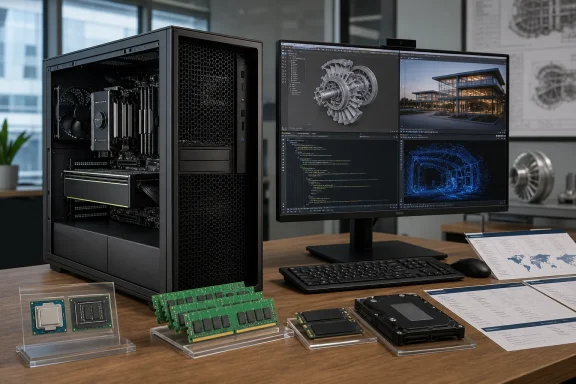 The P4 brings Ryzen PRO back into a serious tower workstation
The ThinkStation P4 is a roughly 30-liter desk-side tower built around AMD’s PRO 675 chipset and Ryzen PRO 9000 processors, topping out at the 16-core Ryzen 9 PRO 9965X3D. Lenovo also lists the Ryzen 7 PRO 9745, Ryzen 7 PRO 9755, Ryzen 9 PRO 9955, Ryzen 7 PRO 9755X3D, and Ryzen 9 PRO 9965 among the available processor options.
The 9965X3D deserves attention because it pairs workstation-oriented AMD PRO management and security features with 3D V-Cache, a large additional L3 cache intended to improve performance in workloads that repeatedly reuse sizable working data sets. ComputerBase identified it as AMD’s first Ryzen PRO processor with 3D V-Cache when Lenovo launched the system. That may help selected engineering, code-compilation, simulation, and content-creation workloads, but it does not make cache capacity a universal performance upgrade; buyers running heavily threaded CPU rendering or virtual machines still need to match cores, memory capacity, storage, and software licensing to the work at hand.
For Windows administrators, the larger story is the availability of a mainstream OEM tower with AMD PRO hardware rather than a Threadripper PRO platform. The P4 occupies a space below Lenovo’s larger ThinkStation P8 and PX systems: it is meant for a single professional GPU and an up-to-16-core Ryzen CPU, not a rack-adjacent multi-GPU compute box. That design should make it more plausible for individual engineers, architects, and developers who need ISV-certified hardware at a desk, but it also establishes clear expansion limits.
Lenovo certifies the P4 for professional applications from vendors including Autodesk, ANSYS, Dassault, PTC, Siemens, Bentley, Avid, Altair, and Nemetschek. Certification is one of the practical distinctions between this and a self-built Ryzen 9 desktop: it does not guarantee every project will perform well, but it gives organizations a defined hardware-and-driver support path when a professional application fails or renders incorrectly.
The headline configuration is not the platform maximum
Notebookcheck’s retail report describes a maximum configuration with the NVIDIA RTX PRO 5000 Blackwell 48GB, up to 256GB of RAM, and 33TB of storage. The graphics card is a 300W, dual-slot professional GPU with 48GB of ECC GDDR7 memory, four DisplayPort 2.1 outputs, and support for NVIDIA’s professional software stack. For local model inference, large visualization scenes, GPU rendering, and memory-heavy creative work, 48GB is a meaningful step above gaming-class cards.
Yet Lenovo’s global announcement and P4 datasheet describe a different ceiling. Both continue to list the RTX PRO 6000 Blackwell Workstation Edition and its lower-power Max-Q counterpart, each with 96GB of GDDR7 ECC memory. They also list up to three M.2 NVMe SSDs and three 3.5-inch hard drives, reaching 48TB of total storage: 12TB of SSD capacity plus 36TB of HDD capacity.
The discrepancy has a straightforward operational implication: the announced specification is not evidence that an option is orderable in a specific region. Notebookcheck says the RTX PRO 6000 variants that Lenovo promoted at launch are absent from the newly reported U.S. configuration path. Lenovo has not issued a public explanation for whether the omission reflects supply, system qualification, power-delivery constraints, regional product planning, or a later addition still to come.
The same caution applies to storage. The reported 33TB maximum appears to represent three M.2 drives plus two 3.5-inch hard drives, rather than the three-HDD setup in Lenovo’s datasheet. That is a reduction of 15TB from the published platform maximum, and it matters for teams planning to keep large project repositories, scan data, media caches, or local model datasets inside the workstation. A system ordered with fewer factory drive bays or storage carriers may not be economically upgraded later without Lenovo-specific parts.
The 72GB RTX PRO 5000 is not a GPU market delay
Notebookcheck also says the 72GB version of the RTX PRO 5000 Blackwell would not officially arrive until late September 2026. That claim needs a narrower reading. NVIDIA announced the RTX PRO 5000 72GB as generally available on December 18, 2025, and NVIDIA’s current product page lists both 48GB and 72GB versions. NVIDIA’s documentation also lists the 72GB card as supported in its current virtual GPU software.
What may still be delayed is Lenovo’s qualification or availability of that specific card inside the ThinkStation P4 in particular markets. Lenovo’s Philippines P4 page, for example, lists both 48GB and 72GB RTX PRO 5000 variants and says the 72GB model is estimated to arrive in the third quarter of 2026. That makes it inaccurate to frame the card itself as unreleased; the relevant question for procurement is whether Lenovo has released the corresponding P4 option code, at what price, and in which country.
That distinction matters most for organizations buying hardware for virtualized or local AI workloads. The extra 24GB of VRAM can determine whether a workload fits on one GPU rather than requiring model quantization, lower batch sizes, CPU offload, or a more expensive multi-system deployment. But a future option should not be included in a deployment plan until Lenovo lists it in a purchasable configuration and confirms its driver and application certification status.
Memory capacity comes with an ECC trade-off
The ThinkStation P4’s 256GB memory figure is genuine, but it is not a blanket ECC configuration. Lenovo’s datasheet specifies support for up to 256GB using four 64GB non-ECC CUDIMMs at up to 6400MT/s. Its ECC UDIMM limit is 128GB, using four 32GB modules at up to 5600MT/s.
That split deserves more attention than it usually receives in workstation marketing. A buyer choosing 256GB is choosing capacity and potentially higher advertised transfer rates over ECC protection. For many GPU-assisted visualization, content, and developer workstations, that can be a rational decision. For engineering simulation, financial processing, scientific analysis, or long-lived systems whose contents must remain dependable under sustained heavy use, the 128GB ECC limit may be the more consequential specification.
ComputerBase also noted that Lenovo’s 6400MT/s memory claim exceeds the DDR5-5600 speed listed in AMD’s processor specifications. Lenovo itself adds the necessary qualification: supported memory speed varies by configuration. Buyers should therefore request the exact CPU, DIMM type, capacity, and validated memory speed in a quote instead of assuming a processor’s best-case product-page figure will apply to a fully populated four-DIMM system.
Expansion is solid, but this is still a one-GPU workstation
The P4 includes one PCIe 5.0 x16 slot, one PCIe 4.0 x4 slot, and two PCIe 4.0 x1 slots. Lenovo offers 500W, 750W, and 1,100W power supplies, optional liquid cooling for higher-power CPU choices, Wi-Fi 7, 2.5GbE networking, and optional higher-speed Ethernet adapters. Windows 11 Pro is supported, alongside Ubuntu and Red Hat Enterprise Linux.
Those features give the P4 a credible upgrade path for additional storage, faster networking, capture hardware, or specialized I/O. They do not turn it into a multi-GPU AI server. The RTX PRO 5000 Blackwell alone is rated at 300W, and the top Ryzen PRO chips can demand substantial power under sustained workloads. Anyone specifying a GPU, 16-core CPU, large memory population, multiple drives, and a 10GbE adapter should ensure the quote includes the 1,100W supply and the appropriate cooling configuration.
Lenovo’s retail arrival therefore delivers a useful new Windows workstation option, but it also exposes a familiar gap between a platform launch and what buyers can actually deploy. The P4 is worth evaluating for teams that want Ryzen PRO, professional NVIDIA graphics, and a supported tower form factor. The purchase decision should hinge on the precise regional configuration sheet—especially GPU, ECC memory, storage bays, power supply, and certifications—not on the 96GB-GPU and 48TB-storage maximums Lenovo still advertises globally.
