
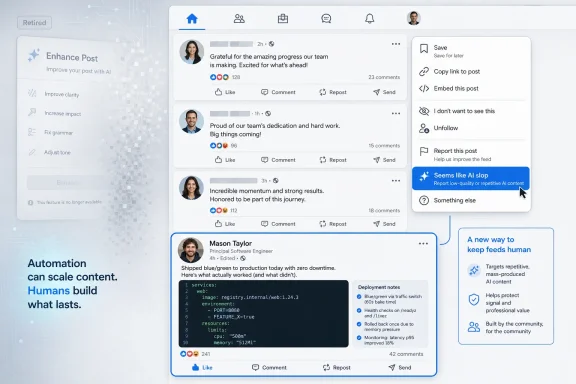
LinkedIn has removed its Enhance Post AI writing feature and added a new report option labeled “Seems like AI slop,” a striking reversal for a Microsoft-owned platform that spent years making AI-assisted posting easier. The change, introduced July 30, puts LinkedIn in the unusual position of withdrawing a generative-writing tool while asking members to help train systems that suppress the sort of generic content those tools can produce.
As reported by TechTimes and tested by 404 Media, the new option is available through a post’s three-dot menu. Flagging a post hides it from the reporting member’s feed and is intended to feed LinkedIn’s quality and authenticity systems.
LinkedIn Chief Product Officer Hari Srinivasan said the replacement is a narrower proofreading capability for grammar and spelling, rather than a tool that rewrites a user’s message into the familiar polished-but-interchangeable LinkedIn voice. That distinction matters: AI as an editor remains welcome; AI as a ghostwriter is now a reach and trust problem.
The product decision arrives after Pangram Labs found that more than 40% of LinkedIn long-form posts in its sample were flagged as fully AI-generated, the highest share among the social platforms it studied. Pangram’s figures are detection estimates rather than a definitive count of machine-written posts, but the broader conclusion matches what regular LinkedIn users have experienced: the feed increasingly rewards high-volume professional aphorisms, recycled career advice, and automated engagement.
Microsoft’s broader AI strategy makes the retreat especially notable. Copilot and other generative AI products remain central to the company’s commercial pitch, including workplace productivity. LinkedIn’s change is not an abandonment of AI assistance; it is an admission that a social feed cannot remain useful if automation erases authorship, expertise, and individual voice.
For IT professionals, recruiters, and technical leaders using LinkedIn to share genuine implementation experience, the practical upside is clear. Less generic content in recommended feeds should create more room for posts that contain specific troubleshooting details, deployment lessons, code samples, or hard-earned operational context.
The platform says it is also using machine-learning classifiers to identify and reduce low-quality or AI-generated content in recommendations, particularly posts from outside a user’s direct network. In effect, LinkedIn is trying to clean the discovery layer of its feed without necessarily treating every AI-assisted post as a policy violation.
That approach is more defensible than a blanket ban. Many professionals use AI to correct grammar, translate a draft, organize notes, or make technical writing more accessible. The harder question is whether LinkedIn’s systems can consistently distinguish that work from content generated largely to manufacture reach.
A Stanford study published in 2023 found that widely used AI detectors misclassified 61.22% of TOEFL essays written by non-native English speakers as AI-generated. LinkedIn’s new tool is not simply an AI detector, but user reports can still become a biased signal if members disproportionately flag writing that feels stylistically unfamiliar rather than demonstrably automated.
LinkedIn will need safeguards that go beyond detecting repetitive phrasing. It should audit whether reports concentrate around particular languages, regions, industries, or writing styles, and give creators meaningful feedback and recourse before a reputation signal becomes a ranking penalty.
Substack CEO Chris Best framed the same concern differently when Substack added Pangram-powered scanning on July 21, coining “Claudefishing” for content presented as human thought when it is largely machine-produced. His warning that Substack should not “turn into LinkedIn” appears to have landed at an awkward moment for the professional network.
LinkedIn’s first move is not a technical fix so much as a product-policy line: polish your work if needed, but do not outsource the perspective people came to read. The test now is whether its classifiers—and its users—can enforce that line without punishing legitimate human voices.
LinkedIn Chief Product Officer Hari Srinivasan said the replacement is a narrower proofreading capability for grammar and spelling, rather than a tool that rewrites a user’s message into the familiar polished-but-interchangeable LinkedIn voice. That distinction matters: AI as an editor remains welcome; AI as a ghostwriter is now a reach and trust problem.
 LinkedIn Is Responding to a Problem It Helped Scale
The product decision arrives after Pangram Labs found that more than 40% of LinkedIn long-form posts in its sample were flagged as fully AI-generated, the highest share among the social platforms it studied. Pangram’s figures are detection estimates rather than a definitive count of machine-written posts, but the broader conclusion matches what regular LinkedIn users have experienced: the feed increasingly rewards high-volume professional aphorisms, recycled career advice, and automated engagement.Microsoft’s broader AI strategy makes the retreat especially notable. Copilot and other generative AI products remain central to the company’s commercial pitch, including workplace productivity. LinkedIn’s change is not an abandonment of AI assistance; it is an admission that a social feed cannot remain useful if automation erases authorship, expertise, and individual voice.
For IT professionals, recruiters, and technical leaders using LinkedIn to share genuine implementation experience, the practical upside is clear. Less generic content in recommended feeds should create more room for posts that contain specific troubleshooting details, deployment lessons, code samples, or hard-earned operational context.
The Report Button Is Also a Training Signal
LinkedIn has not publicly detailed thresholds for action, an appeal process for creators, or precisely how a “Seems like AI slop” report affects distribution. That opacity is important. A private hide action is one thing; a report that becomes training data for automated feed ranking is another.The platform says it is also using machine-learning classifiers to identify and reduce low-quality or AI-generated content in recommendations, particularly posts from outside a user’s direct network. In effect, LinkedIn is trying to clean the discovery layer of its feed without necessarily treating every AI-assisted post as a policy violation.
That approach is more defensible than a blanket ban. Many professionals use AI to correct grammar, translate a draft, organize notes, or make technical writing more accessible. The harder question is whether LinkedIn’s systems can consistently distinguish that work from content generated largely to manufacture reach.
The False-Positive Risk Is Not Theoretical
Crowdsourced reporting creates an obvious failure mode: readers may equate unfamiliar, formal, or concise writing with machine output. That carries special risk for professionals writing in a second language.A Stanford study published in 2023 found that widely used AI detectors misclassified 61.22% of TOEFL essays written by non-native English speakers as AI-generated. LinkedIn’s new tool is not simply an AI detector, but user reports can still become a biased signal if members disproportionately flag writing that feels stylistically unfamiliar rather than demonstrably automated.
LinkedIn will need safeguards that go beyond detecting repetitive phrasing. It should audit whether reports concentrate around particular languages, regions, industries, or writing styles, and give creators meaningful feedback and recourse before a reputation signal becomes a ranking penalty.
Substack CEO Chris Best framed the same concern differently when Substack added Pangram-powered scanning on July 21, coining “Claudefishing” for content presented as human thought when it is largely machine-produced. His warning that Substack should not “turn into LinkedIn” appears to have landed at an awkward moment for the professional network.
LinkedIn’s first move is not a technical fix so much as a product-policy line: polish your work if needed, but do not outsource the perspective people came to read. The test now is whether its classifiers—and its users—can enforce that line without punishing legitimate human voices.