
Phoronix first reported that Intel’s CVS driver has been extended from Arrow Lake, Lunar Lake, and Panther Lake to Nova Lake during the Linux 7.3 merge window. The upstream Linux media pull referenced in that report places the work in the kernel’s V4L2 camera subsystem, where the driver manages ownership of the CSI-2 connection between the operating system and firmware.
The practical news is narrow but useful: a Linux 7.3-based system should now recognize the Nova Lake-specific controller identifiers rather than treating the hardware as an unknown device. That reduces one early compatibility obstacle for future laptops that use Intel’s presence-detection stack. It does not mean every Nova Lake webcam, infrared sensor, lock-screen policy, or OEM privacy feature is already working in Linux.
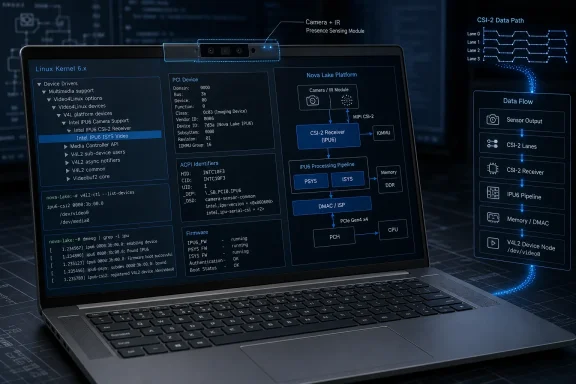 What Intel CVS Actually Handles
“Computer Vision Sensing” can sound like an AI camera application, but the CVS driver described by Phoronix is lower in the stack. It is a V4L2 sub-device driver concerned with the link between camera sensors, Intel’s sensing controller, and firmware. That makes it a dependency for capabilities such as wake-on-approach, walk-away lock, and adaptive display dimming when a PC maker chooses to ship the necessary sensors and firmware.
Those features are familiar to Windows users because modern business laptops increasingly use camera and infrared hardware for presence sensing, Windows Hello-related authentication flows, and display power management. On Linux, however, having a sensor present is only the beginning: the kernel needs to identify the controller, negotiate the camera data path correctly, and expose usable devices before a desktop environment or OEM tool can make policy decisions from the sensor data.
The Linux CVS driver addresses part of that first layer. It does not itself establish how GNOME, KDE, a corporate endpoint-management tool, or an OEM utility should decide when to lock a session or dim a panel. Nor does it prove that every Nova Lake design will expose the same camera and sensor arrangement.
That distinction is worth keeping clear. A driver appearing in the mainline kernel is strong evidence that the hardware interface is being prepared for broad distribution support. It is not a promise of feature parity with a manufacturer’s Windows image on the day a new laptop reaches customers.
The Nova Lake Change Is Mostly Identification Work
According to Phoronix, the Nova Lake addition consists of new PCI device IDs and ACPI IDs for the Intel CVS and IPU bridge code. Those IDs are how a kernel matches physical hardware and firmware-described devices to the right driver at boot. Without them, a driver may contain the basic functional logic but never attach to the new platform.
This is why the update is meaningful even though it is small. Intel’s newest laptop platforms typically need a collection of seemingly mundane identifiers added across graphics, audio, USB, camera, power-management, and sensor drivers. Missing any one of those links can leave an otherwise supported component absent, nonfunctional, or dependent on an out-of-tree patch.
The modest scope also sets expectations. The reported change does not add a new computer-vision algorithm, a Linux equivalent to a Windows presence-sensing control panel, or a documented Nova Lake camera pipeline. It tells Linux to associate an existing CVS implementation with new Intel platform IDs.
For administrators, that means this is not something to deploy independently. There is no standalone CVS package to install and no tuning switch that turns on Nova Lake presence detection on current hardware. The relevant delivery vehicle is the kernel version eventually adopted by a distribution, along with the camera firmware, user-space services, and laptop-specific ACPI implementation shipped by the OEM.
Linux 7.3 Is an Upstream Milestone, Not a Fleet Readiness Signal
The change has landed during the Linux 7.3 merge window, so it belongs to code headed toward a future stable kernel release rather than a broadly deployed enterprise kernel today. Distribution timing will vary: rolling releases can pick up mainline changes rapidly, while Ubuntu LTS derivatives, Red Hat Enterprise Linux, SUSE enterprise releases, and corporate-managed distributions generally carry them later through their own backport and validation processes.
That delay matters for organizations that evaluate new Intel laptop generations at launch. A device can boot successfully with an older kernel while still lacking peripheral support that users expect, particularly around webcams, microphones, sensors, fingerprint readers, power states, and function keys. The CVS enablement lowers the risk for one class of camera-adjacent hardware, but it does not certify a Nova Lake laptop for Linux.
IT teams should therefore treat the Linux 7.3 CVS update as an item for procurement and validation tracking rather than a reason to approve a model immediately. Before standardizing on a particular Nova Lake system, test the actual shipping configuration with the intended distribution and kernel stream:
- Confirm that the internal camera, infrared hardware, microphone array, suspend and resume behavior, and external docks work on the exact firmware revision supplied by the vendor.
- Verify whether the intended desktop environment or management stack exposes any useful presence-sensing behavior, rather than assuming that a loaded CVS module creates it.
- Check whether the OEM has published Linux support guidance, firmware updates, and recovery media for the specific SKU, since component substitutions can change support even within a single laptop family.
The upstream code helps distributions build support before retail hardware becomes common. It cannot resolve missing firmware, proprietary sensor behavior, or OEM decisions to reserve certain features for Windows utilities.
No Change for Existing Windows Deployments
This is Linux kernel work, so it does not update Windows 11, Intel’s Windows drivers, Windows Hello, or existing device-management policies. Windows administrators should not expect it to alter behavior on current Arrow Lake, Lunar Lake, or Panther Lake fleets.
Its relevance to Windows-focused PC buyers is indirect: Intel’s upstream enablement provides an early view of which hardware blocks are expected to appear in the Nova Lake laptop generation. CVS support appearing alongside the platform’s other Linux groundwork suggests that vendors may continue shipping proximity and camera-sensing hardware as a standard part of future premium PC designs.
But Intel has not used this kernel addition to announce which Nova Lake systems will include those sensors, what features they will expose, or whether capabilities will vary by consumer, commercial, and regional SKU. Phoronix’s report identifies the driver expansion; it does not supply a product list, release timetable, or OEM support matrix.
The Remaining Work Is Above the Driver
The value of this merge is that future Nova Lake systems will have a mainline path for the sensing controller rather than beginning life with unsupported hardware. The remaining question is whether laptop makers and Linux distributions complete the higher-level work that turns a recognized controller into reliable, user-visible presence features.
For now, Nova Lake buyers who need Linux should read the CVS addition as encouraging evidence of early kernel preparation, while continuing to judge support by the specific laptop’s camera, firmware, and distribution results.