
round_up() to round_down(), but the kernel record shows this was not a cosmetic logic preference: the old calculation exposed hardware-reserved compression memory to the VRAM allocator, allowing it to corrupt GPU page tables.PC Gamer highlighted Torvalds’ unusually candid account of the AI-assisted debugging session. The underlying Linux commit, independently covered by Phoronix and The Register, supplies the part that gets lost in the viral version: the assistant did useful repetitive work, but Torvalds supplied the system-level reasoning, kept the investigation alive, and verified a fix for a real memory-corruption defect.
The practical lesson for developers is less flattering than “AI fixed a kernel bug.” It is that an AI agent can be productive while still being wrong about whether a problem is solvable. Its confidence, including a recommendation to stop investigating, was not evidence.
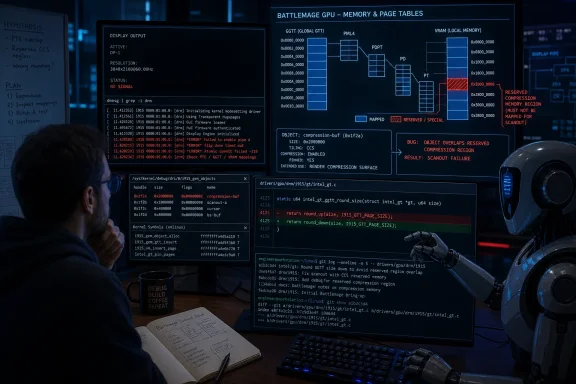 The one-line fix prevented reserved VRAM from being allocated
Torvalds committed the change on August 20, 2026, to the drm/xe Intel graphics driver in the Linux mainline tree. The affected code, get_flat_ccs_offset(), calculates where flat Compute Command Streamer storage begins. That memory is used by Intel graphics hardware for compression metadata and must remain outside the pool of ordinary VRAM available to the operating system and applications.
The defect came from rounding the start of that reserved range up to a 128 KiB boundary. Because the allocator treated everything below the rounded address as usable VRAM, the rounding operation published a sliver of compression storage as free memory whenever the hardware-reported address was not already aligned exactly as expected.
On Torvalds’ Intel Battlemage G21 system with 16 GiB of VRAM, the mistake exposed the final 2 KiB of a memory page. A Mesa virtual machine repeatedly placed a level-3 GPU page table there during a cold boot. Intel’s compression hardware then overwrote part of that page table before userspace had fully started, causing the compositor’s initial submission to fail and GNOME Display Manager to restart it in a loop.
The visible symptom was a black screen on an otherwise running Linux installation. Restarting GDM could make the machine usable because the next Mesa virtual machine might allocate its page tables elsewhere. That is a diagnostic clue, however, not a reliable workaround; it merely changes the memory-allocation lottery.
The patched driver rounds the boundary down to the 4 KiB page size used by the allocator, excluding the page containing the reserved region. Torvalds also replaced an assertion that could agree with the bad rounded-up value and therefore fail to catch the very condition it was intended to detect.
This is the key correction to the loose framing that the function was technically sound but did not do what Torvalds wanted. The kernel commit describes a concrete corruption path, from a bad VRAM boundary to overwritten page tables and a display-manager crash loop. The code was wrong in a way that happened to require a very particular hardware and allocation pattern to become consistently visible.
Twenty-four debug patches produced evidence; they did not make the decision
Torvalds wrote that the diagnosis required 24 patches adding progressively more debugging information and 18 kernel boots. He called the process a “debug session from hell” and said the unnamed AI assistant did much of the grunt work: generating instrumentation and analyzing the resulting observations.
But he also wrote that the assistant repeatedly concluded the issue was impossible to solve and suggested writing a report instead. Torvalds continued to direct the work until the evidence narrowed the problem to the bad rounding operation.
That division of labor matters. The AI apparently helped turn hypotheses into debug code and helped process outputs across a long series of boots. It did not independently establish the correct model of the hardware, decide that the premature stop recommendation was unjustified, or sign off on a patch that changes how protected GPU memory is allocated.
Torvalds’ description is a useful counterweight to both poles of current AI coding marketing. This was neither an autonomous agent resolving a kernel defect nor a worthless chatbot blocking an engineer’s work. It was a supervised tool that accelerated the mechanical parts of an investigation while demonstrating a severe failure mode: treating an incomplete search as proof that no solution exists.
For teams using coding agents, “the model says it cannot be fixed” should be treated as a request for a new debugging strategy, not a terminal result. A model can summarize the evidence it has seen; it cannot know that the next instrumentation patch will expose a missing fact.
The AI model was not identified in the primary record
Several follow-on reports have named Google Gemini as Torvalds’ assistant. The public Linux commit itself does not name a model, provider, prompt setup, tool integration, or the contents of the 24 intermediate debugging patches. The commit says only “an AI.”
That omission is important because it prevents this incident from serving as a credible benchmark for any specific coding product. There is no public evidence of the model version, how much repository context it received, whether it had shell or source-control access, which suggestions Torvalds rejected, or what human-authored debugging work occurred between prompts.
The record does establish that Torvalds credited the assistant with substantial diagnostic labor and allowed it to write the main commit explanation. It does not establish that a named model found the flaw on its own, that the same workflow will reproduce elsewhere, or that a coding agent can safely decide when a difficult incident should be abandoned.
Developers evaluating AI tools should insist on the details missing here: reproducible inputs, the agent’s allowed actions, a log of changes it proposed, and an independently verifiable outcome. Without those, anecdotes about an AI “solving” or “failing” at a bug are mostly narratives about the human operating it.
The fix is headed toward stable consideration, but affected users need distribution packages
The faulty logic traces back to Linux commit 37173392741c, identified in Torvalds’ fix as an earlier Xe VRAM offset calculation change. Torvalds’ new patch carries a request to copy the correction to stable kernel branches, but that line is not the same thing as a completed backport or a distro update.
As of Thursday, August 27, the confirmed fact is that the fix is in Torvalds’ mainline Linux tree. Linux users should not assume it has already arrived in the kernel shipped by Ubuntu, Fedora, Arch, SUSE, or an enterprise distribution. Distribution maintainers still need to select, package, test, and publish the change for their supported kernels.
The reported reproduction is specific: an Intel Battlemage G21 system with 16 GiB of VRAM, using the Xe driver, where a cold boot consistently placed a critical GPU page table in the exposed area. That is enough to establish the bug, but it is not enough to say every Intel Xe device—or every Linux system with an Intel Arc GPU—is affected at the same rate.
Admins investigating cold-boot black screens on Xe-driven Battlemage machines should preserve kernel and GDM logs, record the exact kernel build, and check whether their kernel includes Torvalds’ 818bebeb63dd fix. Testing a kernel with the patch in a controlled environment is reasonable where the issue is reproducible; deploying an unvetted mainline kernel broadly is not.
Windows users do not need to alter an Intel Windows graphics-driver installation because of this report. The patched component is Linux’s in-kernel drm/xe driver, not Intel’s Windows display driver stack. The broader engineering lesson still applies to Windows development, especially for teams using agents to diagnose kernel-adjacent, driver, memory-management, or distributed-system failures.
AI debugging needs explicit human stop gates
Torvalds’ approach suggests a disciplined workflow for coding assistants. Give the agent a constrained task—add a reversible probe, interpret a trace, compare two execution paths—but preserve human control over the hypothesis, the scope of each change, and the decision to stop.
A useful internal rule is that an agent may recommend ending an investigation, but it cannot end one. Require the assistant to state what evidence would disprove its conclusion, then use that proposed test as the next checkpoint. In this case, continued instrumentation converted an alleged impossibility into a measurable memory-boundary error.
The patch is a reminder that difficult bugs often sit at the boundary between layers: hardware addresses, driver assumptions, memory allocators, GPU page tables, Mesa, and the desktop session. An assistant can move quickly through logs and code, but it still needs an engineer who knows which boundary is plausible, which observation is meaningful, and when “unsolvable” simply means the evidence is not in yet.