
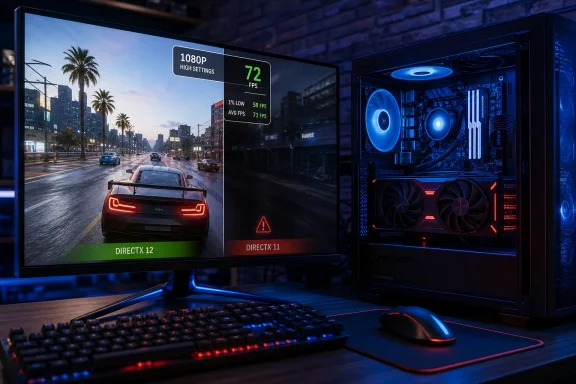
The headline result is encouraging but nuanced. In the tested configuration, Forza Horizon 5 averaged 62.5 FPS at 1080p Low, Cyberpunk 2077 reached 32.8 FPS, and Red Dead Redemption 2 averaged 39 FPS at 1080p Medium. Shadow of the Tomb Raider produced an especially revealing result: approximately 15 FPS when run through DirectX 11, yet 62 FPS at 1080p Highest under DirectX 12. Those figures make the system less a conventional gaming-PC recommendation than a clear illustration of where Chinese PC silicon has made tangible gains—and where its software maturity still has a long way to go.
 Overview: A Real Windows Gaming PC, Not a Curiosity Build
The most important part of the GPUSpecs experiment is not a single benchmark result. It is that the Zhaoxin KX-7000/Lisuan LX7G100 platform behaves like a recognizably modern PC gaming system. It can run x86 Windows software, accepts a discrete GPU, and supports enough contemporary game APIs to handle several big-budget titles at 1080p.
That distinction matters. For years, discussion around homegrown Chinese PC processors and graphics hardware often focused on office deployments, public-sector systems, light multimedia machines, or technical demonstrations. Gaming is less forgiving. A usable gaming platform needs more than enough compute throughput; it needs stable drivers, broad API support, working game profiles, functional anti-cheat compatibility, acceptable frame pacing, and reliable behavior across countless game engines.
The experiment follows an earlier attempt using the same Zhaoxin KX-7000 CPU with Moore Threads’ MTT S80 graphics card. That configuration reportedly encountered major obstacles in graphics-intensive games, particularly because of driver immaturity. Replacing the MTT S80 with Lisuan’s newer LX7G100 substantially changed the outcome, delivering playable results in several demanding games even though the processor itself became a visible performance limit. TweakTown’s account makes the contrast clear: software enablement, rather than raw specifications alone, was the decisive upgrade.
For Windows enthusiasts, this is a useful reminder that GPU competition is not won solely through shader counts, memory capacity, or manufacturing nodes. The driver is the bridge between silicon, Windows, DirectX, Vulkan, game engines, display hardware, and users’ expectations. A graphics card that looks strong on paper but cannot reliably run mainstream games is not yet a competitive gaming product.
The Benchmarks: Playable Results With Important Conditions
The frame-rate results are best understood as a demonstration of baseline viability rather than a verdict that the LX7G100 is a powerful mainstream gaming GPU. Settings varied by title, and the KX-7000 processor was not a neutral test bed capable of exposing the card’s full potential.
Still, several results stand out.
Games that reached a usable 1080p experience
According to the reported testing, the following games delivered either broadly playable or genuinely smooth average frame rates:
- Forza Horizon 5: 62.5 FPS average at 1080p Low.
- Shadow of the Tomb Raider, DirectX 12: 62 FPS average at 1080p Highest.
- Resident Evil 3: 67.2 FPS average at 1080p.
- Red Dead Redemption 2: 39 FPS average at 1080p Medium.
- Cyberpunk 2077: 32.8 FPS average.
- Black Myth: Wukong: 30 FPS average at 1080p Low. Reported benchmark results
There is no need to overstate those numbers. Thirty frames per second in Cyberpunk 2077 or Black Myth: Wukong at reduced settings is not where most enthusiasts want a new desktop graphics card to land. Yet it remains a meaningful threshold for a new GPU architecture and an independent driver stack operating in an ecosystem traditionally dominated by three companies.
Forza Horizon 5, Resident Evil 3, and the DirectX 12 version of Shadow of the Tomb Raider tell a more positive story. These results suggest that the LX7G100 can be competent in games and rendering paths that line up with its current software optimizations. The implication is not merely that the card can render frames, but that its driver can handle enough of the modern DirectX 12 environment to produce credible 1080p gaming behavior.
The alarming DirectX 11 gap
The weaker results reveal why the platform remains difficult to recommend as an all-purpose Windows gaming machine. Shadow of the Tomb Raider reportedly ran at only around 15 FPS under DirectX 11, even though its DirectX 12 mode reached 62 FPS. Rocket League averaged 33.7 FPS at 1080p High, while Grand Theft Auto V delivered just 12.1 FPS at 1080p with the highest settings. The original report identifies DirectX 11 driver optimization as the central weakness.
That kind of API split is more informative than any overall FPS average. A GPU that is relatively effective in DirectX 12 but weak in DirectX 11 has not solved the compatibility problem; it has solved part of it.
DirectX 11 remains deeply embedded in the Windows gaming catalog. It powers an enormous number of older blockbusters, esports titles, live-service games, indie releases, remasters, and PC ports. A Windows gaming PC cannot be judged only by the newest API path available in selected games. It must also cope with the vast back catalog that players actually own.
The GTA V result is especially sobering because the game’s age does not automatically make it easy to run on every driver stack. Mature NVIDIA, AMD, and Intel drivers contain years of title-specific fixes and compiler tuning for legacy APIs. The LX7G100’s poor showing is a reminder that GPU driver development is cumulative. It is not enough for an architecture to support DirectX 11 in principle; its implementation needs extensive real-world optimization.
Why DirectX 12 Is the Bright Spot
The LX7G100’s best results were concentrated in modern rendering paths, particularly DirectX 12. That is strategically significant because DirectX 12 places more explicit control in the hands of game developers and engine designers than older APIs, potentially reducing some categories of CPU-side driver overhead.
However, it would be too simplistic to say DirectX 12 “solves” the Lisuan platform’s driver issue. A modern API gives a new GPU vendor a better place to start, but each major title still requires validation. Shader compilation behavior, memory management, synchronization, presentation, upscaling, and game-specific engine quirks can all shape the final experience.
Lisuan’s launch materials positioned the LX7G100 as a DirectX 12-capable card with support for Vulkan 1.3, OpenGL 4.6, and OpenCL 3.0, alongside a claim that more than 100 games would work as intended at launch. TweakTown’s launch coverage also listed games such as Cyberpunk 2077, Black Myth: Wukong, Elden Ring, and Red Dead Redemption 2 among titles identified for support.
The new testing suggests that this broad compatibility claim should be interpreted carefully. “Runs as intended” can mean that a game launches, renders properly, and remains stable. It does not necessarily promise parity with competing GPUs, consistent high settings, strong 1% lows, or good results across each available API.
That is not unusual for a new vendor. Intel’s Arc graphics launch demonstrated how hard it can be to build a driver stack that performs consistently across old and new Windows games. TweakTown noted during the LX7G100 launch that even Intel required substantial post-launch driver work to become a more persuasive alternative in gaming. Lisuan now faces the same long-term task, though with far fewer years of accumulated Windows graphics expertise behind it.
The Lisuan LX7G100: Promising Hardware, Early-Stage Positioning
The Lisuan LX7G100 is more than a low-end display adapter. It is a purpose-built discrete gaming GPU based on a 6nm process, equipped with 6,144 cores, 12 GB of GDDR6 memory, and a 225W power rating. TweakTown’s benchmark report places those specifications alongside claims of RTX 4060-class performance.
In practical terms, the current evidence indicates that the RTX 4060 comparison was ambitious. Independent testing from a higher-end Ryzen 7 9800X3D platform found the LX7G100 well behind the RTX 4060 across a broad game suite, with performance also trailing cards such as Intel’s Arc B580 and AMD’s Radeon RX 6600 XT. Tom’s Hardware’s analysis concluded that the RTX 4060 could be between 20% and 70% faster, depending on the game.
That does not invalidate the GPUSpecs results. It puts them in context.
A GPU paired with the KX-7000 is operating in a constrained system where the processor can suppress the card’s potential, particularly at 1080p and in CPU-sensitive games. The better question is not whether the LX7G100 matches an RTX 4060 in every benchmark—it clearly does not based on current independent comparisons—but whether it can deliver a functional modern-game experience on a wholly Chinese CPU/GPU platform. The answer is increasingly yes, with substantial qualifications.
Other reviews place the card closer to older midrange competition. PC Gamer’s assessment of a separate benchmark run found the LX7G100 far behind the RTX 3060 and RTX 4060 in games, even while identifying the architecture and game compatibility as encouraging signs for an early product. Its report also observed that the card lacks hardware ray-tracing support and dedicated matrix hardware for AI acceleration.
That missing feature set matters in the current market. Ray tracing, AI-based upscaling, frame generation, and advanced video capabilities have become important parts of the mainstream GPU value proposition. A GPU that performs below the RTX 4060 while omitting some of the ecosystem features associated with modern GeForce, Radeon, and Arc products must compete aggressively on price, availability, or strategic value.
The price problem
Pricing may be the LX7G100’s most difficult commercial challenge. Tom’s Hardware reported a price of roughly $485, or around 3,300 yuan, for the card. That analysis argued that the price positioned the GPU against materially stronger alternatives.
For an enthusiast outside China, that makes the LX7G100 hard to justify as a purely rational purchase. At this performance level, buyers normally expect either substantially lower power draw, a lower price, a unique feature, exceptional software support, or a compelling upgrade path. Lisuan currently offers something different: an independent, locally developed graphics ecosystem with growing Windows support.
That can be strategically valuable. It is not automatically compelling consumer value.
The Zhaoxin KX-7000 Is Both Enabler and Bottleneck
The Zhaoxin KX-7000 deserves credit for enabling the experiment at all. It is an x86-compatible desktop processor with eight cores, eight threads, a maximum 3.7 GHz clock, PCIe 4.0 support, and compatibility with DDR4-3200 or DDR5-4800 memory. Tom’s Hardware’s KX-7000 review coverage also noted its chiplet design and 32 MB of L3 cache.
Yet its gaming performance ceiling is a major constraint. Earlier CPU testing found that the KX-7000 improved upon its predecessor but struggled against much older mainstream Intel and AMD processors, including Intel’s Core i3-8100 and AMD’s Ryzen 5 5600G. The same review reported particularly weak single-threaded results, an area that remains crucial for many games.
This means the GPUSpecs system should not be used to define the LX7G100’s absolute performance. It defines platform performance—the combined result of a developing CPU architecture, a new GPU architecture, early drivers, and a Windows game workload.
The CPU bottleneck also changes how the positive results should be read. In games where the system achieves 60 FPS, the LX7G100 may have more headroom than the result suggests. In titles that remain around 30 FPS, the limiting factor could shift between CPU execution, graphics throughput, driver overhead, asset streaming, and game-engine behavior.
A more balanced test matrix would eventually include the LX7G100 with:
- A fast mainstream Intel or AMD processor to isolate GPU performance.
- A KX-7000 platform to measure the all-Chinese system experience.
- Multiple driver revisions to show the pace of optimization.
- DirectX 11, DirectX 12, and Vulkan variants where available.
- Frame-time and 1% low measurements, not only averages.
That approach would help distinguish architectural limits from software work still waiting to be done.
WHQL Certification Is Meaningful—but It Is Not a Performance Guarantee
One of Lisuan’s strongest accomplishments is its reported Microsoft WHQL certification. The LX7G100 was presented as the first GPU from a Chinese vendor to reach that milestone, a significant signal for Windows compatibility and driver distribution. TweakTown’s launch report described it as the first non-NVIDIA, AMD, or Intel GPU release to arrive with the certification.
WHQL matters because Microsoft’s Windows Hardware Compatibility Program uses the Windows Hardware Lab Kit to test hardware and drivers for Windows compatibility and reliability. Microsoft’s documentation explains that vendors use the process to test their hardware and driver packages, then submit results for certification.
The practical benefits can include a more conventional installation experience, stronger enterprise credibility, and the possibility of driver distribution through Windows Update. Microsoft states that WHQL can digitally sign driver packages after they pass the relevant Hardware Lab Kit testing, and that signed packages can be distributed through Windows Update. Microsoft’s WHQL guidance is clear on that process.
But certification should not be confused with proof of first-class gaming performance. WHQL validates a driver package’s Windows compatibility path; it does not certify that every DirectX 11 game will run quickly, that every anti-cheat system will cooperate, or that every game engine has been tuned.
This distinction is crucial to interpreting the LX7G100. WHQL is a real strength because it suggests Lisuan has built a more disciplined foundation than some early Chinese GPU efforts. The weak DirectX 11 figures show why the work is not finished. Compatibility is the entry ticket. Optimization is the long campaign that follows.
What This Means for the Windows Hardware Landscape
The emergence of a playable Chinese CPU-and-GPU Windows gaming system should not be reduced to an argument over whether it beats a particular GeForce or Radeon card. It matters because the Windows PC ecosystem benefits when more companies can participate meaningfully in x86 computing and discrete graphics.
For consumers, additional competition can eventually mean:
- More resilient supply chains.
- More choice at different price and performance tiers.
- Better incentives for established vendors to improve value.
- Greater regional availability of compatible hardware.
- New software and driver-development investment.
For Windows itself, the significance is even broader. Windows remains the dominant desktop gaming platform partly because it supports a staggeringly broad range of hardware combinations. Every credible new GPU vendor adds complexity, but it also reinforces the platform’s role as the open, flexible center of PC gaming.
Lisuan’s immediate challenge is to turn a promising debut into a sustainable driver program. The most urgent priorities are evident:
- Close the DirectX 11 performance gap.
- Improve frame-time consistency and 1% lows.
- Expand game-specific testing beyond launch-window titles.
- Build a reliable release cadence for Windows drivers.
- Clarify real-world performance positioning rather than leaning on optimistic RTX 4060 comparisons.
- Make the price reflect current capability and feature support.
The KX-7000 platform has a parallel task. Zhaoxin must improve single-threaded performance, firmware maturity, memory compatibility, and software distribution if it wants to become a practical option for enthusiasts rather than a fascinating niche processor. Its ability to run a modern x86 Windows gaming environment is important; its ability to remove the bottleneck will determine how far the platform can go.
The Lisuan LX7G100 and Zhaoxin KX-7000 combination is therefore best understood as a credible first platform, not a finished challenger. It proves that a system outside the Intel-AMD-NVIDIA triumvirate can now reach playable 1080p performance in several modern games, especially those built around DirectX 12. At the same time, its DirectX 11 weaknesses, CPU constraints, missing high-end graphics features, and unfavorable performance-per-dollar position show exactly how much driver engineering and hardware iteration remain.
That is still progress worth watching. In PC graphics, the hardest achievement is not producing one card that can render a game. It is building the hardware, drivers, compatibility processes, and developer trust needed to keep improving across every generation.
