
For Windows users and PC builders, the announcement matters because it puts a sharper label on a problem that has become increasingly obvious as generative AI moves onto local hardware: raw SSD capacity alone is not enough. Large language models, agent workflows, retrieval systems, image models, and long-context assistants stress system RAM, bandwidth, I/O latency, cooling, power budgets, and software resource management at the same time. Longsys is betting that the dividing line between memory and storage can be managed more intelligently—and, in selected workloads, made less rigid.
That is an ambitious proposition. It could produce more flexible designs for AI PCs and mini systems, particularly where adding vast amounts of DRAM is expensive or physically impractical. It also introduces familiar caveats: fast NVMe storage remains dramatically slower than RAM in latency-sensitive tasks, AI software must be designed to exploit tiered data placement effectively, and headline performance claims will need careful validation on real Windows applications rather than controlled demonstrations.
 Background: Why Edge AI Is Turning Storage Into a System Problem
The broad appeal of edge AI is straightforward. Instead of sending every prompt, image, sensor stream, document, or voice request to a cloud data center, a device performs more work locally. That can reduce dependence on a network connection, improve responsiveness, protect sensitive data in certain deployments, and make an AI feature available where cloud processing is impractical.
But local inference shifts a difficult engineering burden to the endpoint. A capable AI PC does not merely need a fast processor or neural processing unit. It also needs enough memory to hold model weights and active context, sustained storage performance to load and manage data, cooling that can preserve speeds during long workloads, and software that can prevent one resource from choking another.
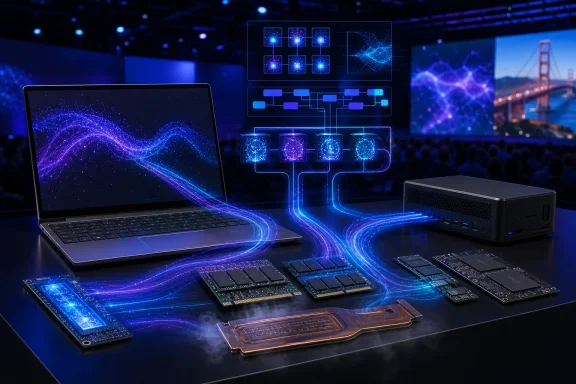
Longsys frames its answer as storage-compute synergy. In the company’s terminology, “Edge AI Storage Fusion” joins chips, storage, memory, and intelligent scheduling algorithms to address traditional boundaries between the storage and memory subsystems. The stated aim is to make storage a computing-support and resource-scheduling layer rather than treating it solely as a place where files wait to be retrieved. Longsys’ announcement describes the two-part “fusion” concept
That language should not be mistaken for a claim that NAND flash replaces DRAM. It cannot, at least not in the conventional performance sense. System memory offers much lower latency and supports the rapid, repeated access patterns central to most inference pipelines. What a tiered architecture can do is determine which data must remain in fast memory, which data can be cached, compressed, prefetched, or offloaded, and how to minimize pauses when information moves between tiers.
This is particularly relevant to modern AI workloads. Model parameters consume memory. So do key-value—or KV—caches, which retain context during token generation. Mixture-of-Experts models add further scheduling complexity because only part of a model may be active for a given task, but deciding what to keep ready and what to fetch can determine whether the interaction feels fluid or frustrating.
The industry’s shift is therefore not simply from “more storage” to “faster storage.” It is from disconnected components toward a more coordinated local AI platform. An April report on Longsys’ storage-processing architecture characterized that movement as memory moving beyond data access toward system-level coordination as AI shifts from cloud-centric training to edge inference. DigiTimes’ report on Longsys’ SPU architecture
What Longsys Plans to Show at FMS 2026
Longsys says its FMS presentation will address three deployment categories:
- AI Box intelligent hosts
- AI PC terminals
- AI Mobile embedded devices
That selection is sensible from a market perspective. Each category faces a similar underlying challenge—running more sophisticated AI closer to the user—but the engineering compromises differ substantially.
An AI Box or compact intelligent host may have room for an M.2 SSD, active cooling, replaceable memory, and more generous power delivery. An AI PC has to balance performance against battery life, thin chassis designs, acoustic limits, and a mainstream bill of materials. Embedded mobile devices operate under still tighter constraints, with highly integrated boards, limited thermal headroom, soldered storage, and a strong preference for low power consumption.
Longsys says it will target four recurring pain points: inadequate compute adaptation, imbalanced resource scheduling, high retrofit costs, and stability concerns. The company’s FMS release identifies those target areas That list is more meaningful than it might initially sound.
“Compute adaptation” is not only about choosing a faster CPU. A local AI implementation has to match model size, quantization level, NPU capability, GPU memory access, RAM capacity, SSD performance, and application behavior. A poorly balanced system can have impressive peak specifications but still spend much of its time waiting for data movement or throttling under sustained load.
“Retrofit cost” is equally important. PC and device vendors cannot redesign every motherboard simply to support a new AI feature. Solutions that fit established M.2 footprints, standard storage interfaces, or familiar memory layouts may have a more realistic path to commercial adoption than architectures requiring wholesale platform changes.
AI PCs Are the Most Visible Windows Opportunity
For the Windows ecosystem, the AI PC portion of Longsys’ strategy deserves the closest attention. Windows laptops and desktops are becoming the most accessible place to deploy local assistants, coding models, image-generation tools, transcription pipelines, and enterprise knowledge-search systems without relying entirely on remote services.
Yet the term AI PC can hide enormous differences between devices. One system may have an NPU suited for lightweight background effects and small assistant tasks. Another may combine a high-end integrated GPU or discrete GPU with 64GB, 96GB, or more memory for running larger models locally. The storage requirements grow with the intended use: model files can consume tens or hundreds of gigabytes, while workflows involving document collections, image assets, checkpoints, and multiple models can expand quickly.
Longsys has already positioned its edge-AI work around local large-language-model deployment. At COMPUTEX 2026, it presented AIDIMM memory modules and AILPBGA embedded-memory products designed for edge inference, describing memory capacity, bandwidth, thermal control, and lower redesign requirements as central priorities. Longsys’ COMPUTEX 2026 release FMS therefore appears less like an isolated reveal and more like a continuation of a broader effort to package storage and memory as one coordinated AI platform story.
That continuity is useful. It indicates that Longsys is not pitching an SSD as a miracle substitute for RAM. Instead, it is presenting a stack in which capacity, memory bandwidth, packaging, storage media, and software policy can be tuned to a device’s specific AI role.
The Storage Foundry Model: Customization as the Product
The most distinctive part of the FMS announcement may be Longsys’ Storage Foundry model. Chief Scientist Dr. Chen Jian is scheduled to present a session titled “Intelligence at the Edge: Powered by the Storage Foundry Model,” focused on the logic behind the approach. FMS’ event post confirms the session, speaker, Santa Clara location, and August 4–6 schedule
Rather than defining the model as a single product line, Longsys describes it as a cross-functional operating model that spans:
- Chip design
- Hardware design
- Firmware and software
- Packaging technology
- Industrial design
- Packaging and testing
- Materials engineering
- Manufacturing
Longsys has outlined those links in its description of the edge-AI Storage Foundry model
This matters because AI endpoints are increasingly specialized. A rugged industrial controller, a compact retail AI appliance, an automotive-grade embedded device, and a Windows mini PC may all benefit from local inference, but they do not need the same physical form factor, endurance profile, operating temperature range, firmware behavior, capacity, or thermal design.
Traditional component buying tends to divide the job neatly: select a processor, select DRAM, select an SSD, integrate them, then tune the software. The Foundry model tries to offer greater control over the boundaries between those decisions. In theory, that can reduce integration delays and create more purpose-built systems.
The business case is strongest for OEMs and system integrators that build products in volume. A company producing thousands of purpose-designed AI terminals may value a storage supplier that can alter firmware, package design, thermal materials, validation procedures, and capacity configurations without forcing the buyer to orchestrate every part of the supply chain.
For do-it-yourself PC builders, the impact will be indirect. Few enthusiasts will order a custom storage architecture. They may, however, eventually benefit if OEM-driven work leads to better small-form-factor SSD cooling, more compact high-capacity drives, firmware optimized for AI data patterns, or systems that manage local model storage more predictably.
A Legitimate Differentiator, but Not a Shortcut
The Foundry framing has real merit because performance bottlenecks are often created at the interfaces between components. A controller can be fast, but limited by heat. A compact drive can fit a desired enclosure, but lose its advantage under sustained writes. A high-capacity module can be technically available but poorly matched to the platform’s power or routing constraints.
At the same time, customization introduces risks. Every tailored configuration can expand the validation burden. Firmware variation requires rigorous quality control. Platform-specific tuning can complicate long-term support, driver compatibility, and replacement options. For enterprise buyers, a deeply customized component is valuable only if its lifecycle management, security patching, supply availability, and field-service process are equally mature.
The best version of storage customization is therefore not maximal uniqueness. It is targeted specialization built on stable interfaces. Windows device makers should want solutions that accommodate AI-specific needs while retaining predictable NVMe behavior, conventional provisioning tools, transparent health reporting, and straightforward operating-system compatibility.
The Technology Behind the “Fusion” Pitch
Longsys has previously disclosed several elements that give more substance to its FMS messaging: the SPU, or Storage Processing Unit; the iSA, or Intelligence Storage Agent; HLC, described as High Level Cache; compact PCIe Gen5 mSSD products; and thermal approaches intended to keep high-speed storage operating under sustained AI load. Longsys’ MemoryS 2026 overview details the earlier SPU, iSA, HLC, and mSSD disclosures
SPU and iSA: Hardware Plus Scheduling
Longsys describes the SPU as a dedicated processing unit for intelligent storage architectures, distinct from a conventional SSD controller. The iSA is positioned as the scheduling layer that coordinates data movement for AI inference, including expert offloading, KV-cache management, and prefetch behavior. Longsys’ technical description of SPU and iSA
Conceptually, this is an attempt to make the storage layer more aware of inference behavior. Instead of relying only on the host CPU, operating system, or application runtime to decide when data should move, an intelligent storage subsystem might identify warm and cold data, compress selected contents, stage anticipated data, and reduce avoidable memory pressure.
That approach has potential in workloads with repeatable access patterns. A local AI agent that repeatedly uses a large knowledge base, cycles among specific experts in a Mixture-of-Experts model, or handles long-context sessions may benefit if the system consistently predicts what to retain nearby.
The harder question is how much of that intelligence can be generalized. AI runtimes evolve rapidly. Models have different layer structures, quantization formats, cache behaviors, and access patterns. A solution that excels with a tightly integrated demonstration could deliver more modest benefits across the messier range of applications that Windows users actually install.
Longsys has claimed that its HLC technology can move warm and cold data to SSD storage and reduce DRAM requirements by nearly 40 percent in selected scenarios. It also says its testing included a jointly optimized agent host with AMD’s Ryzen AI Max+ 395 processor, where a 256K long-context scenario reduced DRAM usage by nearly 40 percent. Longsys’ MemoryS 2026 announcement provides those figures and test context
Those are vendor-reported results, not independent benchmarks, and should be treated accordingly. The most useful follow-up at FMS will be methodological detail: model identity, quantization, context length, token-generation performance, storage configuration, RAM amount, operating environment, and comparison baseline. A 40 percent reduction in DRAM consumption can be compelling, but only if it does not impose a latency penalty that defeats the user experience it is intended to improve.
PCIe Gen5 mSSD and the Physical Constraints of AI PCs
Longsys has also discussed a compact PCIe Gen5 mSSD in a 20×30mm form factor compatible with M.2 2230, with pathways to other formats. The company has cited sequential speeds up to 11GB/s read and 10GB/s write, random performance up to 2.2 million read IOPS and 1.8 million write IOPS, and capacity up to 8TB. Longsys’ published mSSD specifications
The importance of an M.2 2230-class device is not merely speed. Small PCs, handhelds, compact workstations, and thin laptops often impose harsh spatial constraints. A high-capacity, high-performance drive in a shorter footprint can give system designers options that a standard M.2 2280 SSD cannot.
But PCIe Gen5 performance comes with a familiar qualification: heat. Sustaining multi-gigabyte-per-second throughput in a compact device is difficult. Longsys says it has developed a thermal solution involving vapor-chamber and thermal-interface materials, reporting 181 seconds of 11GB/s peak-performance retention in its internal comparison and 1,991GB of continuous read capacity. Longsys’ thermal-performance claims and test figures
Again, the result is promising but preliminary from a buyer’s perspective because it is supplier testing. Sustained behavior depends on chassis airflow, ambient temperature, host power policy, drive placement, workload mix, firmware revision, and whether the system is simultaneously loading a model, generating output, and charging a battery. In a slim Windows laptop, storage thermals cannot be evaluated in isolation.
Strengths of Longsys’ Edge AI Storage Strategy
Longsys’ strongest strategic choice is that it is addressing system balance rather than treating AI as a simple race for bigger drives. The company’s own product portfolio spans embedded storage, SSDs, mobile storage, and memory modules, while its FORESEE industrial brand and Lexar consumer brand place it across several storage markets. Longsys’ company profile and product-line overview That breadth gives the company a plausible foundation for talking about AI devices across multiple form factors.
Several other strengths stand out.
- Clear deployment focus: AI Box hosts, AI PCs, and embedded mobile devices are concrete product categories, not an abstract “AI everywhere” claim.
- Attention to memory pressure: The biggest barrier to running larger local models is frequently available memory, not only compute throughput. Techniques that reduce unnecessary DRAM use could widen the range of practical local deployments.
- Recognition of thermals: Sustained local AI workloads are not brief benchmark bursts. They can involve lengthy model loading, indexing, generation, or agent execution. Storage cooling is a serious design issue in compact hardware.
- Potentially lower platform cost: If a system can preserve acceptable responsiveness with less DRAM, or support a larger model without redesigning a board, that may materially improve the economics of AI hardware.
- Full-stack engineering proposition: Coordinating firmware, packaging, materials, and validation may help remove bottlenecks that a component-by-component purchasing model overlooks.
This is also a useful corrective to the assumption that all AI performance must be solved by ever-larger GPUs. At the edge, cost, power, physical space, reliability, and deployment scale often matter as much as raw compute. Storage-aware data orchestration may become an important complement to more powerful processors.
The Risks: Latency, Software Dependency, and Benchmark Discipline
The strategy’s largest technical risk is simple: storage is not memory. Even very fast PCIe Gen5 NVMe devices cannot provide the access latency of DRAM. Any architecture that substitutes storage for active memory must choose its offload targets carefully, prefetch effectively, and avoid thrashing—where data is repeatedly moved between tiers and performance collapses.
That is why the software layer is central. Longsys’ iSA concept may prove valuable if it can understand workload behavior without requiring fragile, app-specific modifications. But it may be less effective if applications, drivers, model formats, or Windows AI frameworks change faster than the scheduling layer can accommodate.
There is also a transparency challenge. Terms such as “storage-compute synergy” and “intelligent scheduling” can describe genuinely useful engineering, but they can also obscure the variables that determine whether a design performs well. Buyers should insist on measurable answers:
- What model and quantization were tested?
- How much system RAM and VRAM were present?
- What was the token-per-second impact before and after offload?
- How did first-token latency change?
- What happened under sustained, thermally constrained operation?
- Does the solution require a modified application runtime or proprietary software stack?
- What remains compatible with standard Windows storage tools and enterprise-management workflows?
The question of endurance also deserves attention. AI workloads can be read-heavy once models are loaded, but caching, swapping, retrieval indexing, logs, and frequent model updates can create significant writes. SSD endurance, write amplification, garbage collection behavior, and firmware recovery policies will remain central to long-term reliability.
Finally, storage offload is not a universal answer for consumer Windows PCs. A user who wants reliable local inference across a variety of tools may still be better served by a system with ample RAM and a capable GPU or NPU. Longsys’ technologies may be most compelling where memory upgrades are constrained, device form factors are fixed, or a tailored AI workload allows predictable optimization.
What FMS 2026 Needs to Prove
FMS 2026 is an opportunity for Longsys to move the discussion from architecture language to operational evidence. The company has already established the main storyline: edge AI needs storage that is more customized, thermally resilient, software-aware, and closely coordinated with memory. Longsys’ FMS announcement
To convert that story into a compelling platform proposition, the company should show reproducible comparisons rather than only peak specifications. The most persuasive demonstrations would place identical model workloads on otherwise comparable AI PCs or compact hosts, reveal memory usage and responsiveness in real time, expose the thermal data, and explain exactly what the SPU, iSA, and HLC layers are doing.
It would also help to distinguish clearly among three claims that are often blurred together in AI hardware marketing:
- Capacity expansion — storing larger models and datasets locally.
- Memory reduction — lowering the DRAM footprint of a specific workload.
- Performance preservation — maintaining usable latency and throughput while data is tiered across RAM and storage.
A design can succeed at the first two while struggling with the third. Windows users will ultimately care most about the third. A local assistant that technically runs but responds slowly, stutters during long-context work, or causes a thin laptop to throttle is not an AI experience worth celebrating.
Conclusion
Longsys’ “Edge AI Storage Fusion” initiative captures a real and growing opportunity in the Windows hardware market: local AI is exposing the limits of a design philosophy that treats processors, memory, and storage as largely separate concerns. AI PCs and embedded AI devices increasingly need those resources to operate as a coordinated system.
The company’s Storage Foundry model, SPU and iSA concepts, compact Gen5 mSSD work, and focus on thermal engineering together form a coherent answer to that challenge. The potential upside is meaningful—more deployable local AI, lower memory costs in constrained designs, better use of compact hardware, and a path toward more specialized endpoint systems.
The crucial test will be whether Longsys can show that its architecture delivers consistent, measurable benefits outside carefully chosen demonstrations. If the company can pair its storage innovation with transparent benchmarking, durable Windows compatibility, and repeatable real-world responsiveness, it may help redefine storage as an active layer in the emerging edge AI PC rather than a passive component waiting at the edge of the system.
