
For the United States, this is not simply an agreement to assemble a fast unmanned boat. It is an attempt to import a combat-proven operating concept: low-cost, remotely operated or increasingly autonomous vessels that can scout, strike, relay communications, launch other drones, complicate naval operations, and potentially defend themselves against aircraft. For Ukraine, it is a chance to turn hard-won battlefield innovation into durable industrial partnerships beyond its borders.
The caveat is equally important. A memorandum of understanding is not a funded Pentagon production contract, and public reporting has not identified a first U.S. order, a first recipient, a final U.S. configuration, or a unit price. Reporting on the arrangement makes clear that those programmatic decisions remain ahead. Still, the MAGURA partnership matters because it demonstrates how quickly Ukraine’s drone ecosystem is becoming a source of technology and operational lessons for allied militaries rather than solely a recipient of foreign aid.
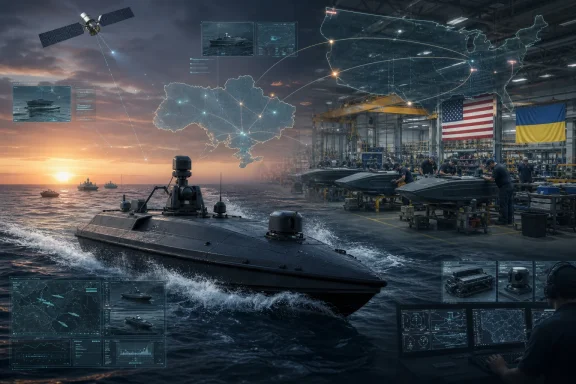 A Ukrainian Naval Drone Program Comes to the United States
The agreement joins two companies with sharply complementary capabilities. UFORCE brings the MAGURA family, its autonomy stack, mission concepts, and experience operating in one of the world’s most electronically contested maritime theaters. RECONCRAFT brings U.S. boatbuilding capacity and an established background in vessels intended for demanding military, law-enforcement, and special-operations environments. RECONCRAFT says it manufactures its boats in the United States and builds vessels as large as 120 feet, giving the firm a relevant industrial foundation even though MAGURA itself is a much smaller craft. RECONCRAFT’s company profile emphasizes patrol, interceptor, landing-craft, riverine, and offshore vessel families.
The publicly stated plan is broader than hull fabrication. UFORCE says the American partnership is intended to make its aerial, maritime, and ground unmanned systems, advanced autonomy software, and command-and-control technology available in the United States. Its announcement therefore frames MAGURA as part of a wider U.S.-Ukraine unmanned-systems relationship rather than as a one-off naval procurement project.
That distinction is significant. A drone boat’s value lies partly in its fiberglass or polymer hull, propulsion, and payload capacity—but much of the real capability resides in the systems that allow it to navigate, communicate, identify threats, coordinate with other platforms, and be controlled safely from afar. The U.S. production effort will need to preserve the lessons learned by Ukrainian operators while also adapting the system to American communications, cybersecurity, weapons integration, logistics, and training requirements.
The project has an additional political and industrial dimension. Bloomberg Government characterized the partnership as involving MAGURA drones as well as their software and command-and-control technologies, and cited an analyst describing it as an unusually advanced U.S.-Ukrainian defense-industry agreement. Bloomberg Government’s report places the effort within a broader U.S. push to expand autonomous military capability and domestic production capacity.
Background: Why MAGURA Became a Global Reference Point
MAGURA achieved international recognition during Ukraine’s campaign to challenge Russian naval operations in the Black Sea. The program’s impact was not based on any single vessel or any one claimed strike. Its importance came from a sustained demonstration that relatively compact uncrewed surface vessels, operating with intelligence support and human control, could impose costs and force a major fleet to alter how it used ports, patrol areas, and sea lanes.
Ukraine’s Group 13, a unit of military intelligence, operates the MAGURA family. The group’s commander told the Associated Press that Ukrainian maritime drone operations had helped curb the movement of Russia’s once-dominant Black Sea force, even as Russia adapted its defenses and reduced the opportunity for earlier high-profile attacks. The AP’s reporting is particularly useful because it avoids treating the story as a static success narrative: it notes both the operational pressure placed on Russia and the countermeasures that have made attacks more difficult.
That evolution is central to understanding why the United States is interested. MAGURA is not valuable merely because it can be used as a one-way attack craft. It is valuable because the Ukrainian program has continuously adapted to an opponent actively trying to detect, jam, destroy, deceive, and evade it. In acquisition terms, that means the platform arrives with battlefield feedback that is extremely difficult to recreate through laboratory tests or routine exercises.
UFORCE describes MAGURA as a modular unmanned surface vessel platform used across missions including area denial, reconnaissance, strike, resupply, underwater reconnaissance, and aerial-drone launch operations. The company’s platform page also presents mission configurations ranging from one-way attack and remotely operated weapon stations to mine warfare, logistics, short-range air defense, and drone “mothership” roles.
Not every company claim should be read as an independently audited specification. UFORCE says MAGURA platforms have struck more than a dozen warships, completed hundreds of missions, and fielded more than 1,000 MAGURA V7 units. Those numbers provide useful insight into the scale the company is pursuing, but they should be treated as manufacturer statements rather than as public Pentagon or allied-government assessments. UFORCE’s published claims and specifications nevertheless show why the platform has attracted international attention.
MAGURA V5, MAGURA V7, and the Shift From Drone Boat to Maritime System
The term “MAGURA drone” can create the misleading impression that there is only one fixed design. In practice, the family has evolved into multiple variants and mission packages. The Associated Press describes the smaller MAGURA V5 as a ramming drone and the larger MAGURA V7 as a weapons platform, with both remotely controlled from compact operator consoles. AP’s account captures the crucial difference: the V7 is a reusable and adaptable platform concept, not simply a bigger explosive boat.
The published V7 performance envelope
UFORCE lists the MAGURA V7 at roughly 7.1 to 7.3 meters in hull length, with a top speed of around 39 knots, a published range of roughly 800 nautical miles, and a payload capacity of 650 kilograms. The page also lists diesel power in the 250-to-350-horsepower range and either waterjet or sterndrive propulsion. UFORCE’s MAGURA V7 specifications are substantial on paper, but exact performance will necessarily vary by payload, sea state, fuel, control equipment, sensors, and mission profile.
That variability is one reason the U.S. version should not be assumed to be a carbon copy of a Ukrainian boat. American-built MAGURA vessels could use different communications hardware, encryption, navigation systems, camera suites, electronic-warfare protection, datalinks, weapons interfaces, or fuel and maintenance components. Even a seemingly simple substitution—such as a different radio, satellite link, or optical sensor—can change electrical demand, cooling requirements, software validation, and the boat’s operational characteristics.
The industrial goal, then, is not just to reproduce a hull. It is to preserve the architecture that permits rapid payload and software change. That is where MAGURA potentially offers the United States something more valuable than an off-the-shelf craft: a working example of how a maritime platform can be evolved at wartime speed.
Sidewinders on a drone boat
The V7’s most striking configuration is its reported integration of AIM-9 Sidewinder missiles. Ukraine has presented the system as able to engage crewed aircraft from the sea, and UFORCE describes its platforms as having confirmed manned-aircraft kills using Sidewinders and other sea-launched interceptor concepts. UFORCE’s sea-based air-denial overview identifies the Sidewinder configuration as combat-proven.
Independent reporting supports the broader development without eliminating all uncertainty around individual engagement details. The Associated Press reported that Ukrainian operators demonstrated a MAGURA V7 equipped with modified U.S.-made Sidewinder air-to-air missiles and that Ukraine’s intelligence agency said a MAGURA drone downed a Russian fighter aircraft in May. AP’s report called the episode a potential breakthrough in maritime warfare.
The key innovation is conceptual. A surface vessel normally needs protection from low-flying aircraft and helicopters, especially if those aircraft are hunting it. By placing infrared-guided interceptors on a fast, low-profile unmanned boat, Ukraine has tried to reverse that relationship. Aircraft seeking to kill the drone can become targets themselves.
This does not mean a MAGURA V7 is a substitute for a warship’s integrated air-defense system. It does mean a hostile helicopter, patrol aircraft, or fighter operating at low altitude near a drone swarm may have to account for a threat that previously would not have existed. That kind of uncertainty can alter tactics even when only a limited number of boats carry missiles.
Beyond explosive attack missions
The MAGURA program’s strategic value expands further through modularity. UFORCE says its maritime platforms can carry and launch UAVs for sea-to-land missions, operate as communications relays, execute reconnaissance, support logistics, and perform mine-warfare-related functions. The company’s configuration overview also lists surface-to-air defense, persistent maritime tracking, port protection, riverine patrol, and amphibious support or denial among potential roles.
A report in March described UFORCE testing interceptor UAVs launched from MAGURA vessels to destroy incoming attack drones near Odesa. Ukrainska Pravda’s coverage characterized the configuration as a naval platform deploying interceptors upon detection of approaching targets. If this capability matures, it could turn a drone boat into a small mobile counter-drone node—an especially relevant idea for port defense, convoy protection, dispersed operations, and expeditionary basing.
The American Interest: Indo-Pacific Lessons Without a Clean-Sheet Program
The MAGURA agreement arrives as the U.S. military explores how unmanned surface vessels could contribute to maritime deterrence and distributed operations. American interest is not theoretical. U.S. special-operations personnel tested Ukrainian-made MAGURA-class vessels in the Indo-Pacific during an exercise in the Philippines, where a drone reportedly struck and sank a decommissioned target vessel. Reporting on that test described it as the first such Indo-Pacific test of Ukrainian-made MAGURA boats by U.S. personnel.
The demonstration occurred in the orbit of Balikatan 2026, a major U.S.-Philippine exercise that ran from April 20 to May 8. U.S. Indo-Pacific Command said the exercise involved more than 17,000 personnel from the Philippines, United States, Australia, Japan, Canada, France, and New Zealand, with training across air, land, sea, space, and cyber domains. U.S. Indo-Pacific Command’s Balikatan overview also highlighted maritime security, coastal defense, distributed logistics, anti-submarine warfare, search and rescue, and live-fire elements.
That environment helps explain the potential appeal of MAGURA-style systems. The Indo-Pacific’s vast distances, archipelagic geography, contested straits, and emphasis on sea denial create a demand for systems that are numerous, distributed, difficult to track, and less costly to risk than crewed ships. A modular unmanned surface vessel could support surveillance in one mission, act as a decoy or communications relay in another, and carry a strike or defensive payload in a third.
The operative word is could. A Black Sea drone boat cannot be lifted unchanged into a Pacific scenario. The operating environment differs in sea states, distances, weather, logistics, satellite coverage, allied interoperability, rules of engagement, commercial shipping density, and adversary capabilities. MAGURA’s Ukrainian combat history offers an invaluable starting point, but the U.S. military will have to develop its own tactics, sustainment model, and command authority for any American deployment.
Why speed of adoption matters
RECONCRAFT co-founder Joe Silkowski said the partnership could provide American forces with greater capability faster than developing a new platform from the ground up. TechRadar’s account of the announcement reported that argument, and it is persuasive at a basic acquisition level. A platform that has already operated in combat can compress the earliest stage of the development cycle.
But speed must be defined properly. Producing a first hull quickly is not the same as fielding a mature system at scale. The difficult work includes:
- Integrating U.S.-approved encrypted communications and command systems.
- Hardening software and datalinks against intrusion, jamming, spoofing, and supply-chain compromise.
- Establishing maintenance procedures, spares inventories, repair training, and test infrastructure.
- Determining which payloads can be exported, transferred, armed, and operated under U.S. policy.
- Validating safe navigation and positive control around civilian and allied vessels.
- Creating doctrine for launch, recovery, failure response, target identification, and escalation control.
These are not reasons to discount the partnership. They are the practical requirements that will determine whether it becomes an enduring U.S. naval drone manufacturing program or remains a promising industrial collaboration.
The Software Story Is as Important as the Boat
For a Windows and technology audience, MAGURA’s most important lesson may be that future maritime capability is increasingly software-defined. A vessel can have an effective hull and ample payload capacity, but its military relevance depends heavily on the quality of its perception systems, operator interfaces, network resilience, mission-planning tools, video feeds, telemetry, and autonomy software.
The AP reported that MAGURA operators use suitcase-sized consoles with joysticks, screens, and safety switches. It also reported that Ukraine sees future progress in deeper AI integration, using operational video and sensor data to reduce operator workload and improve target search. The AP’s interview with Group 13 describes a model in which humans remain involved while automated tools increasingly help locate and classify potential targets.
That is a more realistic model than the popular image of an entirely independent “robot boat.” In a complex maritime environment, fully autonomous action raises difficult technical and legal questions. Commercial vessels, fishing boats, allied ships, civilian crews, marine traffic, deceptive signatures, weather effects, and electronic interference all complicate any automated decision.
The near-term advantage is likely to come from human-machine teaming rather than complete autonomy:
- The system fuses cameras, navigation data, sensors, and mission intelligence.
- Software highlights anomalies and possible targets for the operator.
- The operator evaluates the context and retains authority over consequential decisions.
- The vessel executes navigation, stabilization, routing, or terminal maneuvers faster than a person could manage manually.
- Mission data feeds back into future software improvements and training pipelines.
Ukraine’s experience is particularly relevant because it has had to operate under electronic warfare pressure. AP noted that Russian adaptation has constrained some of the earlier dramatic strikes. Its reporting is a reminder that no autonomy system remains static once an opponent begins observing, capturing, jamming, and countering it.
The Risks: Cost, Scale, Cybersecurity, and Mission Creep
The MAGURA production plan has clear strengths, but it should not be romanticized. The first risk is cost escalation. Neither UFORCE nor RECONCRAFT has publicly disclosed what a U.S.-built MAGURA will cost, and reports have not identified the deal’s value. Ukrainska Pravda’s account notes that a value was not disclosed, while TechRadar similarly reported no announced U.S. pricing.
That uncertainty matters because the economic logic of expendable maritime systems depends on cost. An autonomous boat that can disable or threaten a much larger platform may be attractive even if it is destroyed. But each U.S.-specific addition—secure radios, specialized sensors, ruggedized electronics, military certifications, domestic supply requirements, weapons integration, and support contracts—can erode the price advantage.
The second risk is production scale. “Hundreds” and “thousands” per year are ambitions, not confirmed output. Scaling to those levels would require recurring orders, supplier capacity, trained workers, standardized designs, test facilities, and stable procurement demand. Reporting on the agreement explicitly notes that no order, quantity, delivery recipient, or unit price has been announced.
The third risk is cybersecurity. An armed, connected autonomous vessel creates an exceptionally attractive target for hostile intelligence services. The vulnerability is broader than the boat’s main control link. It includes software updates, vendor access, mission-planning workstations, operator laptops, radio-frequency components, cloud or data-storage systems, engineering drawings, maintenance tools, and firmware embedded throughout the supply chain.
That is why domestic manufacturing should not be confused with automatic security. Building the hull in Oregon or South Carolina may improve supply assurance and support U.S. oversight, but a secure MAGURA program will require rigorous software assurance, identity management, signed updates, segmented networks, red-team testing, incident response, and persistent vulnerability management. The vessel may be unmanned, but the digital ecosystem behind it is large and potentially exposed.
Finally, there is a strategic risk of mission creep. MAGURA’s modularity is an advantage precisely because it can be adapted to many roles. Yet every added role also raises questions about command authority, escalation, target discrimination, and coordination with crewed ships and aircraft. A surface drone launching a UAV, towing a sensor, carrying interceptors, or operating near civilian traffic must be governed by clearer rules than a simple training target run.
What the Partnership Really Signals
The deeper importance of American MAGURA production is not that the United States is buying a single foreign design. It is that a combat-tested Ukrainian maritime drone ecosystem is being treated as a source of innovation worth industrializing in the United States.
For years, defense acquisition debates have focused on whether Western militaries can move quickly enough to absorb commercial technology and adapt to rapidly changing threats. MAGURA offers a concrete test. The United States now has an opportunity to pair Ukrainian operational learning with American engineering, manufacturing, software security, testing, and sustainment resources.
Success would mean more than delivering boats. It would mean establishing a repeatable pathway for allied battlefield innovations to become secure, scalable, interoperable U.S. systems without losing the speed and adaptability that made them valuable in the first place.
The MAGURA program has already shown that relatively small autonomous vessels can influence naval behavior far beyond their size. Whether U.S. production turns that lesson into a dependable capability will depend on funding, integration discipline, software resilience, and doctrine—not on the boat alone.