
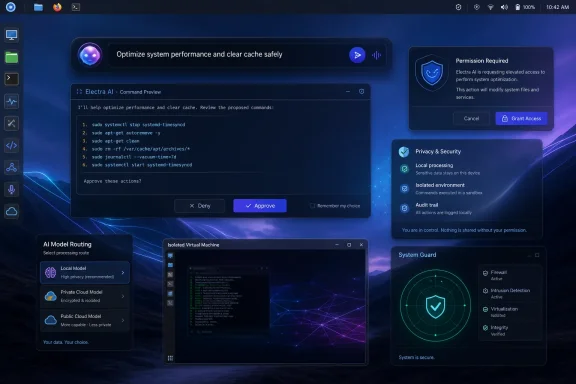
The appeal is straightforward: instead of copying commands from ChatGPT or Gemini into a terminal, users can ask Electra to inspect, plan, and—with permission—execute changes on the local Linux installation. That could be compelling for desktop Linux newcomers and power users alike, particularly when the assistant exposes its proposed actions in a terminal view rather than silently changing the system.
But AI-OS is also a reminder that an assistant with operating-system privileges needs to be evaluated less like a productivity app and more like an automation platform.
 Electra Is the Product, Not a Cinnamon Respin
MakuluLinux’s official AI-OS material describes Electra as an always-available floating input bar with intent routing: a request to debug code goes to a coding mode, while a request to change networking or install drivers is directed to command mode. The distribution also advertises file-manager context actions, a quick-action panel, voice input, persistent memory, Telegram integration, and access to a broad catalogue of cloud models.
That is the distinction Raymer emphasized to LinuxInsider. Rather than merely linking users to a third-party AI service, AI-OS is intended to combine the model-routing layer, application interface, terminal automation, and desktop integration into one environment.
For users, the practical upside is reduced friction. An assistant that can query the machine’s state, read an error, explain its repair plan, and run approved commands is far more useful than a web chatbot that relies on copied logs and screenshots.
The Distribution’s Own Details Need a Careful Read
There is an early documentation mismatch worth noting. LinuxInsider describes AI-OS as using a Linux Mint Debian Edition variant base, while MakuluLinux’s current official AI-OS release page says it is based on Ubuntu 24.04 LTS with Cinnamon 6.2.9. Administrators considering a test deployment should verify the ISO’s actual package sources, kernel, update path, and supported upgrade model rather than assuming either description is definitive.
The official documentation also makes clear that Electra is not wholly local by default. The AI Center connects to MakuluLinux’s Electra backend for model routing, conversation history, and Patreon-tier validation; the project advertises access to dozens of hosted models. An offline model is included, according to LinuxInsider, but its capability and hardware requirements will determine how realistic a fully local workflow is for most users.
That architecture matters because the assistant may see prompts, system context, commands, and potentially files or logs needed to complete a request. The value proposition is contextual access—and that is also the primary security and privacy consideration.
Automation Raises the Stakes for Desktop Linux
MakuluLinux says Electra asks for permission and shows its repair process before acting. That is a welcome design goal, but it is not a substitute for conventional controls. A bad recommendation, an overly broad command, a compromised service connection, or a vulnerable plugin can have more serious consequences when the interface is built to administer the host.
The project’s own status material describes deep integration through mechanisms such as D-Bus and AT-SPI accessibility services, alongside a plugin system and external-service connectors. Those capabilities can make AI-OS feel unusually capable, but they also expand the trust boundary beyond a conventional desktop installation.
Windows admins will recognize the pattern: an AI agent with device-management power should be treated more like privileged automation than a search box. Test it in a virtual machine first, use a noncritical account, keep backups, and inspect exactly which accounts, tokens, cloud services, and permissions are involved before giving it access to valuable systems.
The “Finance Bot” Is the Least Enterprise-Ready Feature
The most unusual component is Electra’s finance bot, which LinuxInsider says can create content sites, affiliate promotions, printable designs, and other automated revenue projects. MakuluLinux’s documentation similarly advertises an autonomous finance engine and multiple revenue streams.
That is likely to attract curiosity, but it should not be confused with reliable income generation. Automated publishing, affiliate linking, domain speculation, and AI-generated product listings carry platform-policy, copyright, disclosure, tax, and reputation risks. For a work device, it is also an obvious reason to keep the system separate from corporate accounts and browser profiles.
AI-OS has a genuinely interesting premise: make Linux administration conversational without hiding the commands that do the work. Its success will depend less on the Jarvis-style branding than on whether MakuluLinux can make that power auditable, privacy-conscious, and safe enough to trust outside a lab VM.
