
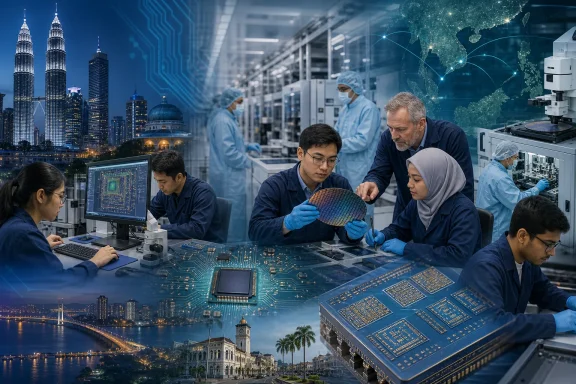
Digital News Asia reported on the programme’s August 3 opening at the Advanced Semiconductor Academy of Malaysia, or ASEM, in Cyberjaya. Nuffic, the Dutch international-education organisation coordinating the initiative, and participating universities confirm that the course ran through August 14, combining lectures, hands-on assignments, company visits and networking. The programme involved students from Malaysia, Indonesia, Singapore, Thailand and the Philippines.
For Windows and enterprise technology readers, the connection is not abstract. The chips used in PCs, servers, networking equipment, AI accelerators and industrial systems depend on a supply chain that stretches from Dutch equipment and research institutions to Southeast Asian assembly, testing, manufacturing support and increasingly IC design. The course is intended to expose students to more of that chain—yet the public record also shows the gap between a valuable pilot programme and the workforce pipeline Malaysia says it needs.
 A talent programme attached to a formal semiconductor pact
The Malaysia-Netherlands semiconductor relationship is no longer limited to trade missions and university exchanges. Malaysia’s Ministry of Investment, Trade and Industry says the countries signed their Memorandum of Cooperation on Semiconductor Industry in The Hague on September 5, 2025. The framework established an annual bilateral semiconductor dialogue and specifically identified talent development, research and development, technology sharing, policy exchange and market information as areas for cooperation.
That date matters because it corrects the impression that the talent initiative emerged entirely from discussions during former Dutch Prime Minister Mark Rutte’s 2023 Malaysia visit. Those discussions helped set the relationship in motion, according to Malaysian officials, but the binding cooperation framework arrived later, in September 2025. The 2026 student programme is therefore better understood as an early project operating alongside the memorandum, rather than the agreement’s original foundation.
The Dutch government’s own public funding record is unusually candid about the programme’s purpose. It describes the 2026 course as a replication and improvement of a 2025 pilot, designed to prepare 60 high-performing bachelor’s students for careers in Southeast Asia’s growing semiconductor and medical-technology industries. It also says the course connects them directly with Dutch and Malaysian employers that help fund it.
That last point deserves attention. The programme is not simply classroom diplomacy. It creates a recruitment and relationship channel between Southeast Asian engineering students and companies in the Dutch and Malaysian high-tech sectors. Nuffic’s programme description explicitly says one objective is to facilitate Southeast Asian talent’s access to the Dutch innovation sector. That can expand professional options for graduates, but it also puts Malaysia’s stated concern about retaining skilled engineers into sharper focus.
Sixty students are 0.1% of Malaysia’s stated target
Malaysia’s National Semiconductor Strategy calls for 60,000 skilled local engineers to be trained and upskilled by 2030, backed by at least RM25 billion in fiscal support. The programme’s 60 participants equal 0.1% of that national target.
That does not make the course unimportant. A selective programme with industry access can help establish faculty relationships, shared curricula, internship routes and future postgraduate pathways. Its value lies in the quality of exposure and in whether participating institutions turn the course material into repeatable local training—not in the headcount from one August cohort.
The mismatch does make some of the launch rhetoric worth treating carefully. ASEM and Selangor Information Technology and Digital Economy Corporation chief executive Yong Kai Ping told Digital News Asia that Malaysia’s two IC design parks had around 400 engineers and 18 IC design companies after 24 months, and that more than 800 students had received training. Those are signs of a growing cluster, but they are not yet evidence that the country has solved the volume, specialization and retention challenges embedded in the 60,000-engineer goal.
Malaysia’s immediate strength remains concentrated in the semiconductor back end: assembly, testing, packaging and related manufacturing services. The Malaysian Investment Development Authority has repeatedly put the country’s share at about 13% of global back-end semiconductor output. The National Semiconductor Strategy seeks to pull more activity toward IC design, R&D and advanced manufacturing, where engineering depth, intellectual property, specialist tooling and experienced management matter as much as the availability of entry-level graduates.
A two-week course can introduce students to lithography, metrology, cleanroom practice, mechatronics and the design-to-manufacturing chain. It cannot substitute for sustained university programmes, supervised chip-design projects, access to electronic design automation tools, tape-out experience, postgraduate study or the multi-year industrial mentorship needed to develop senior engineers.
The programme’s geographic claims changed between planning and delivery
There is a small but revealing discrepancy in the public descriptions of the 2026 programme. Nuffic’s pre-event programme page said final-year STEM students would be nominated from six Southeast Asian countries: Malaysia, Singapore, Vietnam, Thailand, Indonesia and the Philippines. The completed programme, as described by Digital News Asia, Nuffic’s later communications and Universitas Gadjah Mada in Indonesia, involved 60 participants from five countries—Malaysia, Indonesia, Singapore, Thailand and the Philippines.
Vietnam was included in the advertised eligibility list but does not appear in the post-event participant descriptions. No public explanation has been offered for the change.
This is not a scandal, but it is the kind of detail that matters when governments frame talent projects as regional capacity building. A programme designed around Southeast Asia’s shared semiconductor ambitions needs clear reporting on which countries actually participate, how students are selected and whether participation expands over time. The Netherlands’ published material says nominations were limited to designated universities and that self-nominations were not accepted, which makes university selection and national representation central to the programme’s reach.
The locations are also broader than the Cyberjaya opening suggests. Nuffic says the 2026 programme was hosted at both ASEM and Universiti Sains Malaysia, placing activity in Kuala Lumpur-area Cyberjaya and Penang. That makes practical sense: Cyberjaya is being positioned around IC design activity, while Penang remains a major manufacturing and semiconductor-services centre. Moving students between those settings offers a clearer view of Malaysia’s ambitions than a single-campus programme could.
Dutch equipment expertise and Malaysian manufacturing are complementary—but neither is transferable by ceremony
Dutch Ambassador Jacques Werner told the opening audience that roughly 85% of integrated circuits worldwide are produced using machines designed in the Netherlands. The broad argument is sound: the Netherlands holds a strategic place in semiconductor equipment, most visibly through ASML and its monopoly position in extreme-ultraviolet lithography systems, alongside companies such as ASM, NXP and BESI.
Still, the statistic should be read as a diplomatic shorthand rather than a precise description of a chip’s production chain. Semiconductor manufacturing depends on equipment, materials, software, component suppliers, foundries, assembly and test providers, and customers across multiple countries. Dutch-designed equipment is exceptionally important at certain stages, particularly leading-edge lithography, but it does not mean Dutch firms “produce” 85% of the chips in consumer or enterprise hardware.
Malaysia’s role is equally significant but different. Its established assembly, test and packaging footprint gives it a strong platform for advanced packaging, automation equipment, supply-chain services and locally anchored engineering jobs. The challenge is converting that footprint into more domestic design capability and R&D ownership while competing for talent with Singapore, Taiwan, South Korea, Europe and the United States.
Yong’s reported salary figures illustrate the pressure. He said graduates trained during their final university year have taken jobs paying roughly RM5,000 to RM8,000 monthly, while some overseas roles are advertising substantially higher compensation in Singapore dollars. Digital News Asia attributed those figures to Yong; no independently published breakdown was provided for job placement rates, job categories, retention periods or how many graduates joined Malaysian firms rather than employers abroad.
Those omissions are more consequential than a press-event salary range. If Malaysia is using public support to build a domestic semiconductor base, it should measure how many trainees remain in the local industry, move into IC design or advanced manufacturing roles, and progress into specialist or management positions after several years.
What a durable pipeline would require
The programme has stronger foundations than a typical one-off corporate workshop. Nuffic says it is a multi-year initiative planned through 2028, building on the 2025 pilot. It is supported by Dutch government funding, Khazanah Nasional, the Brabant Development Agency, Malaysian universities and industry partners including ASML, Nexperia, BESI, Greatech, Neways, Hittech and the Malaysia Semiconductor Industry Association.
Khazanah’s broader K-Youth programme is also substantial by comparison: the sovereign fund said in January 2025 that it had allocated RM200 million to train and develop 11,000 young Malaysians in high-value sectors, including semiconductors. But the same practical test applies. Training commitments only become industrial capacity when graduates have roles, equipment access, mentors and reasons to build careers locally.
Malaysia has correctly identified that semiconductor development reaches beyond conventional chip plants. Medical devices, automotive electronics, agricultural robotics, factory automation and defence technologies all need people who can work across hardware, firmware, manufacturing and systems integration. Windows PC users may never see the results of a Malaysian-Dutch training course directly, but future laptops, edge AI systems and enterprise infrastructure will increasingly reflect where component and engineering capacity is built.
The second Netherlands–Southeast Asia programme shows that the Malaysia-Netherlands memorandum has moved from diplomatic language to an operating project. The next meaningful measure is no longer whether another opening ceremony happens in 2027. It is whether the partners publish outcomes: who completed the programme, where they worked, whether Vietnam and other regional participants return, and how a 60-student course becomes a repeatable pathway toward Malaysia’s 60,000-engineer commitment.
