
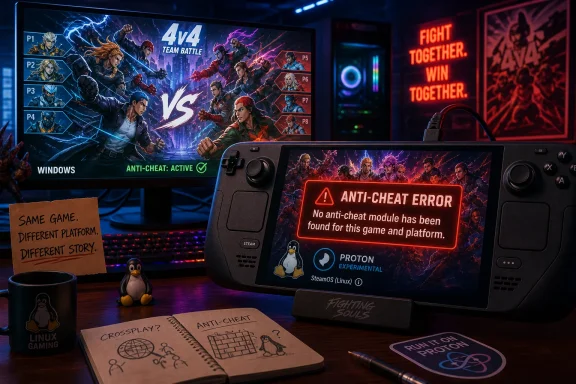
The message reported by players is direct: “No anti-cheat module has been found for this game and platform.” For a competitive 4v4 tag fighter built around online matches, ranked play, private rooms, and a broad PC audience, that is more than a minor launch-day inconvenience. It prevents affected players from entering the game at all.
The situation matters well beyond the comparatively small Linux desktop audience. SteamOS is the foundation of the Steam Deck, and Valve’s handheld remains one of the most visible PC gaming devices outside the traditional Windows ecosystem. A game that launches on Steam but cannot clear its anti-cheat checks through Proton creates immediate uncertainty for handheld players, living-room PC users, and anyone who expected the Steam version to function across the platform’s increasingly diverse hardware base.
For Windows players, Marvel Tōkon: Fighting Souls remains a straightforward PC release rather than a Linux compatibility experiment. But the beta failure is still a meaningful test of how publishers, developers, anti-cheat vendors, and storefronts communicate platform support in an era where “PC” no longer automatically means only Windows on a desktop tower.
 A Promising Open Beta Hits a Platform Wall
Marvel Tōkon: Fighting Souls is positioning itself as one of the most ambitious fighting games in recent memory. Developed by Arc System Works and published for PlayStation 5 and PC, it brings Marvel characters into a stylized, team-based fighting format designed around four-character squads, dramatic assists, striking anime-inspired presentation, and a competitive online structure.
The open beta is intended to give players a broad look at the game’s central systems before launch. It includes online and local matches, ranked and casual options, training features, room matches, an open lobby environment, story-oriented elements, and an expanded playable roster compared with prior tests.
That scope makes the Linux problem particularly visible. This is not a single-player demo that can be bypassed with an offline mode or a workaround. The anti-cheat component appears to stop the game at startup, meaning the beta’s core experience is inaccessible before players can test controls, performance, network stability, or matchmaking.
The beta runs from July 24 through July 26, a brief period that gives the development team limited time to gather broad technical feedback. For Linux and Steam Deck users, the lost access is especially frustrating because an open beta is precisely where compatibility problems should be identified and addressed ahead of the full release.
At present, the evidence supports a carefully limited conclusion: the Marvel Tōkon: Fighting Souls open beta is not working through Linux-based platforms because the game’s Easy Anti-Cheat implementation does not find a compatible anti-cheat module for that environment. It does not definitively prove that the retail release will have the same issue.
That distinction is critical. Betas often use separate builds, restricted backend configurations, limited deployment settings, and rapidly changing game files. Still, the proximity of the full release means the issue deserves more attention than a typical early technical snag.
What Is Actually Failing?
The central issue is not that Marvel Tōkon: Fighting Souls is fundamentally incapable of running on Linux hardware. The more specific issue is that the game’s anti-cheat layer is blocking access when launched through Proton, Valve’s Windows compatibility technology for Linux and SteamOS.
Proton Is Not Traditional Emulation
Proton is a compatibility layer that allows many Windows PC games to run on Linux-based systems. It is deeply integrated into Steam on the Steam Deck and is also used by desktop Linux players who run games through SteamOS, Bazzite, Fedora, Arch Linux, Ubuntu-based distributions, and other variants.
For many games, the experience is remarkably close to native Windows play. A large number of DirectX titles run through Vulkan translation layers, controller support is mature, and Steam’s interface makes launching compatible games relatively simple.
However, anti-cheat systems remain one of the most significant barriers to universal compatibility.
A game may render correctly, recognize controllers, connect to its servers, and run at a stable frame rate—yet still be unplayable if its anti-cheat service denies the session. In online multiplayer games, the anti-cheat check is often not an optional component. It is a gatekeeper.
Easy Anti-Cheat Is the Immediate Blocker
Marvel Tōkon: Fighting Souls appears to use Easy Anti-Cheat, commonly abbreviated as EAC. The technology is designed to identify cheating tools, tampered files, unauthorized modifications, and other behavior that could undermine fair online play.
That goal is understandable, especially for a competitive fighting game with ranked modes and an emerging tournament community. Online integrity is not a peripheral concern. A single bad exploit can damage matchmaking, frustrate legitimate players, and rapidly erode confidence in a new competitive title.
The issue is that EAC support under Proton is not automatic merely because a game uses Easy Anti-Cheat. The developer and publisher must configure, enable, package, and validate the necessary support for the game’s particular anti-cheat integration.
The reported error suggests that the Linux-compatible anti-cheat component required for the current beta build is absent, unavailable, or not correctly recognized. The visible result is a complete launch failure rather than a degraded or partially functional online experience.
Why This Is Not Simply “Linux Does Not Support Easy Anti-Cheat”
One of the most important points in this story is that Easy Anti-Cheat can support Linux, Proton, and Steam Deck environments. The presence of EAC alone does not make a game incompatible with SteamOS.
That distinction prevents an overly simplistic reading of the situation.
Support Exists, but Developers Must Enable It
Over the past several years, anti-cheat compatibility has improved significantly. Valve, Epic, and game developers have created pathways for certain Easy Anti-Cheat games to work through Proton without requiring a separate native Linux version of the game.
But the support must be intentionally activated and tested. It is not safe for players to assume that every EAC-protected title on Steam will run on Steam Deck merely because other EAC games do.
For developers, enabling compatibility can involve technical configuration, game build packaging, backend settings, release validation, and ongoing maintenance. Even when the underlying tools are available, individual titles may have different requirements depending on their engine, networking systems, anti-cheat setup, distribution model, and security policies.
This is why the Marvel Tōkon beta issue should be described as an implementation or deployment problem, not as proof that Linux gaming has reached a hard technical limit.
A Fighting Game Has Different Stakes Than a Casual Multiplayer Title
Competitive fighters put unusual pressure on anti-cheat, synchronization, and network consistency. Players expect fair input handling, accurate match outcomes, responsive rollback netcode, secure ranked ladders, and reliable tournament conditions.
A developer may decide to be conservative during a beta, particularly if anti-cheat behavior on Proton has not received enough internal testing. Opening a competitive network test to an unsupported configuration can create support burdens and potential security concerns.
That cautious approach has logic behind it. Yet it also creates a difficult optics problem when the game is sold and promoted as a PC title on Steam, where the Steam Deck is a prominent and heavily marketed device.
The better outcome is not necessarily to disable anti-cheat or compromise competitive security. It is to make platform support transparent and, where feasible, complete the testing needed to support Proton before or shortly after launch.
The Steam Deck Factor Changes the Conversation
Linux desktop gaming has long occupied a niche position compared with Windows. Steam Deck has complicated that old assumption by placing a Linux-based gaming platform in the hands of a much larger mainstream audience.
The Steam Deck is not marketed as a hobbyist device requiring terminal commands, custom drivers, and manual compatibility layers. It is marketed as a portable way to play a large PC game library through Steam.
That does not mean every Steam game is guaranteed to work. But it does mean that incompatibility has become a consumer-facing issue rather than a technical curiosity.
SteamOS Is Linux, but It Is Also a Major PC Gaming Platform
For many Steam Deck owners, SteamOS is simply the operating system that ships with the device. They may never identify themselves as Linux users at all. They buy games through Steam, browse the store, install titles, and expect the platform’s compatibility information to guide their purchase decisions.
When an anticipated game fails because of anti-cheat, users are not primarily thinking about EAC modules or Proton runtimes. They see a game listed for PC that cannot be played on their PC handheld.
Marvel Tōkon: Fighting Souls therefore lands at an awkward intersection:
- It is a major licensed game with broad mainstream appeal.
- It is releasing on PC storefronts associated with Steam Deck.
- It uses competitive online systems where anti-cheat is understandable.
- Its beta currently rejects Linux-based systems before gameplay begins.
- Its full release is close enough that players want a clear answer rather than speculation.
The Steam Deck audience is also highly relevant to fighting games. Handheld play is not ideal for every competitive player, but training mode, local sessions, casual matches, portable grinding, replay review, and controller-first gameplay all align naturally with the device.
Bazzite and Other Linux Gaming Systems Are Affected Too
The impact extends beyond Valve hardware. Bazzite, a gaming-focused Linux distribution built around an immutable Fedora-based foundation, has become popular among users who want a SteamOS-like interface on desktops, mini PCs, and alternative handhelds.
Devices such as the Lenovo Legion Go, ASUS ROG Ally running Linux variants, AYANEO handhelds, and living-room gaming PCs can all rely on the same broader Proton ecosystem. If the beta’s anti-cheat configuration blocks the platform, the issue affects more than one device or operating system image.
This matters because the PC market is becoming more fragmented in ways that benefit consumers. Windows remains dominant, particularly for game compatibility, anti-cheat support, modding, and general-purpose software. But SteamOS-style systems are increasingly credible alternatives for players who prioritize a console-like interface, rapid suspend and resume, controller navigation, and a streamlined game library.
A high-profile title like Marvel Tōkon can either strengthen confidence in that ecosystem or reinforce its remaining limitations.
What Windows Players Should Take From This
For the Windows gaming community, the immediate practical impact is limited. Marvel Tōkon: Fighting Souls is designed for Windows PC, and the reported anti-cheat problem is tied specifically to Linux and Proton-based environments.
Still, the story offers several useful lessons about modern PC gaming.
“PC Version” Is Becoming a Broader Label
For decades, a Windows release was effectively synonymous with a PC release. That remains broadly true in commercial terms, but it is less complete than it once was.
A modern PC game can be played across:
- Traditional Windows desktops and laptops
- Steam Deck handhelds
- Linux gaming desktops
- SteamOS-based living-room systems
- Windows handheld PCs
- Dual-boot machines
- Cloud and remote-play setups
- Compact mini PCs configured as console replacements
The technical foundation beneath those experiences can vary substantially. A game’s Windows executable may work perfectly on a conventional PC while encountering anti-cheat, codec, launcher, middleware, or graphics-driver issues elsewhere.
That is not an argument against Windows. If anything, it reinforces one of Windows’ enduring strengths: the broadest compatibility target for mainstream PC games remains Windows. For players who want the least uncertain path to new multiplayer releases, Windows continues to offer the most reliable baseline.
Anti-Cheat Is a Compatibility Requirement, Not an Invisible Background Process
Players often think of anti-cheat only when it causes a crash, requires administrator permissions, or triggers a false positive. In reality, anti-cheat increasingly influences the fundamental availability of online games across operating systems.
For Windows users, that may mean accepting a background service, responding to an occasional prompt, or troubleshooting a launch error. For Proton users, it can mean losing access to an entire title even when the game itself would otherwise run.
The Marvel Tōkon beta highlights a broader truth: anti-cheat choices shape platform access. They affect not just security and cheating prevention, but also Steam Deck compatibility, Linux adoption, support workloads, and player perception.
Why the Beta Timing Matters
The open beta is not only a marketing event. It is a technical rehearsal.
Developers use large-scale tests to evaluate server loads, match stability, matchmaking behavior, balance issues, input latency, user-interface clarity, crashes, and platform-specific failures. A three-day beta cannot solve every issue, but it can expose problems that need urgent attention before a wider release.
An Unresolved Issue Would Be More Serious at Launch
Marvel Tōkon: Fighting Souls is scheduled to launch on August 6. That leaves a narrow window between the open beta and the commercial release.
If Linux and Steam Deck support are intended for launch, the beta problem provides a strong signal that the release configuration needs verification. If support is not intended, the game’s storefront messaging and technical expectations need to be unambiguous.
The key risk is not merely that some players will be disappointed. Unclear support status can lead to avoidable purchases, refund requests, negative reviews, fragmented community advice, and a cycle of unofficial workaround attempts.
Those workarounds can be especially problematic in anti-cheat-protected games. Switching Proton versions, editing launch options, replacing files, or using community patches may sometimes help with ordinary compatibility problems. But trying to bypass or alter anti-cheat behavior is not an appropriate solution and can create account-security or enforcement concerns.
The Right Fix Is a Supported Fix
Players should not be expected to hunt for experimental launch commands or unverified community fixes in a competitive online title. The appropriate path is an official one:
- Enable and validate Proton-compatible anti-cheat support if the game is intended to support Linux and Steam Deck.
- Test the production configuration, not only internal or pre-release variants.
- Publish clear compatibility guidance on Steam and official support pages.
- Communicate promptly if the beta limitation differs from the full-release plan.
- Avoid vague language that leaves players guessing whether support is planned, under review, or explicitly unavailable.
This approach benefits Windows users too. Clear technical communication reduces unnecessary support requests, refund churn, launch-day confusion, and platform-based community friction.
The Bigger Risk: Trust and Discoverability
Marvel Tōkon: Fighting Souls has considerable potential. Arc System Works has an established reputation for distinctive fighting-game presentation, and the Marvel license gives the game enormous reach beyond the traditional anime fighting-game audience.
That makes the current Linux issue more consequential than it would be for a small experimental release.
Platform Expectations Are Built Before Launch
Players now evaluate games long before release day. They look at Steam pages, controller support, system requirements, beta impressions, community feedback, streaming coverage, and Steam Deck reports.
A beta that visibly fails on Linux will quickly generate a compatibility reputation, whether or not the retail version ultimately resolves the issue. That is especially true among Steam Deck users, who are accustomed to tracking launch performance and verification status closely.
If the issue is fixed before launch, the developers have an opportunity to turn an early setback into evidence of responsive support. If it remains unresolved, the game could begin its life with a persistent caveat attached to an otherwise strong PC release.
Storefront Labels Matter
The long-term lesson for the industry is simple: platform labels need more precision.
“Available on PC” conveys a broad commercial category, but it does not describe whether a title works on Windows, Steam Deck, SteamOS, Linux desktop systems, or specific handheld configurations. For cross-platform releases with multiplayer anti-cheat, those distinctions are important.
Clear storefront compatibility indicators are more valuable than optimistic assumptions. They help players buy confidently, help support teams avoid repetitive questions, and help developers set accurate expectations without making promises they cannot yet guarantee.
A Manageable Problem, but Not a Trivial One
There is reason for measured optimism. The reported failure appears tied to a known category of problem: anti-cheat compatibility and configuration under Proton. That is different from discovering that a game’s engine, renderer, network stack, or controls are fundamentally broken outside Windows.
The fact that Easy Anti-Cheat has established pathways for Linux and Proton support means the issue may be addressable. However, may be addressable is not the same as confirmed support, and players should resist treating the current beta failure as either a guaranteed launch-day disaster or a problem that will definitely disappear.
The available information supports a balanced view:
- Windows PC players should be able to treat the beta as a normal Windows release.
- Linux, SteamOS, Bazzite, and Steam Deck users should currently expect the open beta to fail at the Easy Anti-Cheat stage.
- The full game’s Linux compatibility remains uncertain until an official supported build or clear announcement establishes the final position.
- Easy Anti-Cheat itself is not inherently incompatible with Proton, but each game needs its own correctly enabled and tested implementation.
That last point is the heart of the matter. The Marvel Tōkon: Fighting Souls beta has not exposed a universal failure of Linux gaming, nor has it invalidated the Steam Deck as a PC gaming device. It has exposed the remaining gap between a game being available on a PC storefront and a game being fully ready for every increasingly important corner of the PC ecosystem.
Conclusion
Marvel Tōkon: Fighting Souls has the ingredients of a major fighting-game release: a powerful Marvel roster, Arc System Works’ unmistakable style, an ambitious 4v4 format, and a beta designed to build competitive momentum before launch. Yet the open beta’s Easy Anti-Cheat failure on Linux has placed an unwanted question mark over Steam Deck and SteamOS compatibility.
For Windows players, the issue is a reminder of why Windows remains the default target for major multiplayer PC games. Its compatibility advantage is not just about graphics APIs or driver maturity; it also extends to the complex anti-cheat systems that decide whether competitive games can be played at all.
For the broader PC market, the situation is a test of communication and follow-through. If the anti-cheat configuration is corrected and official Proton support arrives, Marvel Tōkon: Fighting Souls can reach a wider audience without compromising online security. If it does not, the game will enter release with a preventable limitation on some of the most visible non-Windows gaming hardware available today.
The beta has made one thing clear: in modern PC gaming, platform compatibility is no longer a background detail. It is part of the product.
