
The National Interest article by American Enterprise Institute fellows Ryan Fedasiuk and Julia Torres argues that U.S.-led restrictions successfully blocked ASML’s EUV lithography systems from reaching China, while leaving a less obvious route open: immersion DUV scanners used with repeated exposures, or multi-patterning. TechInsights’ December 2025 analysis of Huawei’s Kirin 9030 supported the core point, identifying SMIC’s N+3 process as a scaled evolution of its 7nm-class technology that approaches a 5nm-equivalent node without EUV.
That distinction matters to Windows PC and enterprise buyers because export controls are not solely about today’s flagship smartphone silicon. They influence the future supply and price of AI accelerators, networking silicon, servers, and the broader hardware ecosystem running enterprise AI workloads.
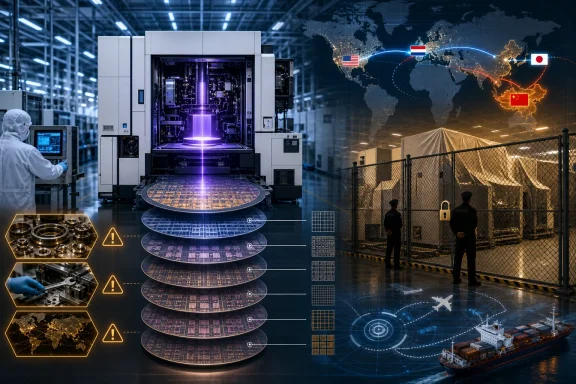 The Gap Is No Longer Just EUV
EUV remains a unique chokepoint: no ASML EUV systems have been shipped to China under the long-running Dutch restrictions. But DUV equipment can produce smaller features through more manufacturing steps, higher cost, more defects, and lower yield.
That makes DUV-based production an unattractive commercial substitute for Taiwan Semiconductor Manufacturing Co.’s leading-edge process nodes. It is nevertheless strategically useful for a state-backed chip industry willing to accept poor economics in return for domestic capacity. The National Interest’s projection of millions of Huawei Ascend accelerators is an estimate from its authors, not a confirmed shipment result, but the direction is clear: older machinery can still support meaningful output.
The constraint is also becoming less durable. Reporting this week indicates China has begun delivering or preparing domestic immersion-DUV tools for local fabs, although their production scale and real-world performance remain uncertain. If those systems become dependable, cutting off ASML service would no longer be the only pressure point.
MATCH Would Move From Sales Controls to Sustained Operations
The Multilateral Alignment of Technology Controls on Hardware Act, introduced in the Senate as S. 4281 in April 2026, would seek to restrict more than new equipment shipments. Its central premise is that advanced fabrication tools depend on continuing supplies of proprietary parts, maintenance, and technical support.
That is the practical change administrators and hardware planners should watch. A ban on new scanner sales slows capacity growth; a service-and-parts restriction could gradually reduce the useful output of tools already installed. The proposal also names Chinese chipmakers including SMIC and Huawei among targeted end users, raising the stakes for tool vendors and allied governments.
The bill’s difficulty is diplomatic as much as technical. ASML reported that customers in China represented 29.1 percent of its 2025 net sales, while Japanese suppliers also have substantial exposure. A unilateral U.S. foreign direct product rule could pressure foreign manufacturers because of U.S.-origin technology inside their equipment, but it could also create friction with the Netherlands and Japan—the partners needed for a durable control regime.
Capacity, Not Node Labels, Is the Real Test
“5nm” does not automatically mean parity with TSMC, Samsung, or Intel. Process-node names are marketing shorthand as well as technical descriptions, and the useful comparison is transistor density, yield, power efficiency, cost, and the number of wafers a fab can produce consistently.
SMIC’s DUV-only progress shows that an EUV denial policy can impose a serious penalty without creating an absolute barrier. The next policy decision is whether Washington and its allies are prepared to target the installed DUV base and its upkeep—or whether China’s expensive workaround is allowed to grow into a durable production pipeline.
