
The announcement, republished by TechPowerUp from Mattel’s release, arrives nearly three months before the original Xbox reaches its actual 25th anniversary in North America. Microsoft’s own launch record puts the console’s debut on November 15, 2001, at $299. Mattel is therefore treating the August 19 reveal as the opening of a broader anniversary season rather than tying the product to the precise launch date.
For Xbox collectors, the practical point is simple: this is a premium display object, not a compact desk toy, and Mattel has yet to provide several of the buying details that matter most. Its announcement says preorders are open through selected global retailers including Amazon, Best Buy, and Mattel Creations, but does not state a ship date, list every participating country, identify purchase limits, or say whether the set will remain a regular retail item after its initial run.
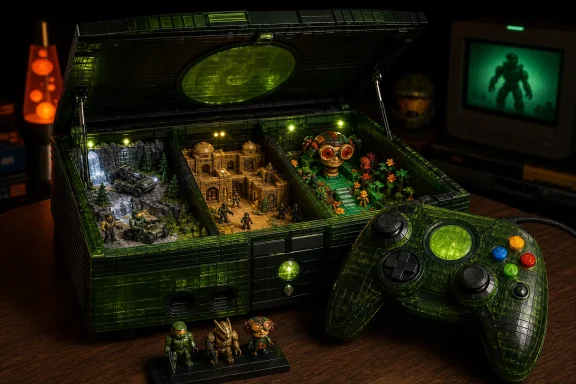 A full-size console, but not a functional one
Mattel says the model is built at 1:1 scale, meaning its exterior is intended to occupy roughly the footprint of the original 2001 machine rather than the much smaller dimensions typically associated with brick-built console replicas. The company is also including a full-size construction of the original oversized Xbox controller, commonly called the Duke.
The controller is central to the set’s gimmick. Pressing its buttons is supposed to trigger lighting and game-specific sound sequences in the hidden modules inside the console. Mattel also says a button combination unlocks another lighting pattern, although it has not explained whether the controller is electrically connected to the console model, uses batteries, or relies on a wireless mechanism.
That omission is more than a technical footnote. Mattel’s previous buildable Xbox 360 replica used button-cell batteries for its lighting, and owners of this new set will want to know the power arrangement before putting it on a shelf or into long-term storage. Battery-powered collectibles can develop corrosion problems if cells are forgotten, while a wired or rechargeable implementation would present a different maintenance tradeoff. Mattel has not yet published an instruction manual or battery specification for this model.
The set is marked for ages 17 and up, reinforcing its intended role as a collector display. Its price also puts it in the territory of large licensed construction kits, rather than the lower-cost Mega and Mattel building sets Xbox fans may remember from the brand’s earlier Halo releases.
The game selection is a more deliberate history lesson
The three featured games make this more than a generic tribute to the translucent green Xbox badge. Halo: Combat Evolved was the defining launch-era game for Microsoft’s console in North America and remains the clearest shorthand for why the original Xbox mattered. Microsoft’s 2001 launch announcement placed Halo at the front of the system’s early lineup, alongside games such as Project Gotham Racing, Oddworld: Munch’s Oddysee, NFL Fever 2002, and Dead or Alive 3.
Morrowind and Psychonauts broaden the story. Both represent the original Xbox’s role as a landing place for ambitious, technically demanding console games, rather than simply a platform for Microsoft-owned franchises. Morrowind helped establish Bethesda Game Studios as a major console developer years before Skyrim, while Psychonauts became a cult favorite whose developer, Double Fine, is now part of Xbox Game Studios.
There is, however, a notable change in the product’s apparent history. Product copy and images circulating in collector communities in 2024 described a planned buildable original Xbox with Halo 2, Morrowind, and Psychonauts dioramas. Mattel’s 2026 announcement names Halo: Combat Evolved instead. The company has not addressed whether that older material represented a cancelled Mega-branded version, an early prototype, or simply a pre-release concept that was revised before the set moved under the newer Mattel Brick Shop label.
The swap makes historical sense. Halo 2 was a major original Xbox title, but Combat Evolved is the title most directly tied to the November 2001 launch and to the original Xbox’s legacy. For a 25th-anniversary product, putting Master Chief’s first Xbox outing at the center is a sharper fit than honoring the 2004 sequel.
Mattel Brick Shop is taking over a project with a long trail
The original Xbox model has been visible in some form for nearly two years. Collector posts and retailer listings surfaced images and descriptions of a large original Xbox construction set during 2024, when Mattel’s building-brick business was still associated more closely with Mega and Mega Construx. The latest version is being sold under Mattel Brick Shop, the premium label Mattel launched in 2025.
That rebranding matters because Brick Shop has been positioned around more expensive, collector-oriented licensed models. Its early identity was built primarily around Hot Wheels vehicles, detailed automotive replicas, metal components, and adult-targeted display kits. Mattel has since expanded the line into entertainment properties, including Masters of the Universe and a recently announced Halo Warthog.
The Xbox console is a stronger test of whether that strategy can carry beyond vehicles. A brick-built Lamborghini offers a miniature version of an object most buyers will never own. An original Xbox is comparatively obtainable on the used market, which makes Mattel’s value proposition dependent on accuracy, nostalgia, the interior dioramas, and the lighting-and-sound mechanism rather than on simple access to the object being modeled.
The $329.99 suggested retail price is also higher than the original console’s $299 North American launch price in nominal dollars. That comparison is not a measure of inflation-adjusted value; a 2001 game console and a 2026 licensed building kit are very different products. But it does underline the challenge: Mattel is asking fans to pay more than Microsoft initially charged for a working Xbox to own a nonfunctional replica.
At roughly 9.4 cents per piece, the set is not automatically outside the range of large licensed construction kits. Piece count is a limited measure, though. It does not show the number of unique elements, the quality of printing, the complexity of the internal mechanism, the build’s structural stability, or whether replacement pieces will be available. Those details will matter far more than the headline count for a model intended to be opened, illuminated, and displayed.
What buyers still need before ordering
Mattel’s announcement provides the major specifications: 3,509 pieces, 12 NanoWorld figures, modular game scenes, interactive lighting and audio, and a $329.99 suggested retail price. It does not provide a complete purchase-and-support picture.
Before committing to a preorder, prospective buyers should look for the final retailer listing and confirm the following:
- The retailer page should show a specific release or shipping date rather than only accepting a preorder.
- The product listing should identify the required batteries, whether they are included, and how the controller communicates with the console model.
- International buyers should confirm whether the sound component, power system, warranty, and replacement-parts support apply in their market.
- Collectors should check whether the model is a limited run, a timed exclusive, or a standard Brick Shop release that may be restocked.
Those are ordinary questions for a $330 electronic collectible, but none is answered in Mattel’s initial announcement. The lack of detail is especially relevant for a product that combines a mechanical build with electronics and licensed audio.
Mattel has chosen the right anniversary window and, with Halo: Combat Evolved, the right flagship game for an original Xbox tribute. But the company is selling the idea before it has supplied the practical particulars. The first meaningful milestone is not the August announcement; it is whether retailer pages add a firm release date, electrical specifications, and regional availability before November 15, 2026, when the original Xbox actually turns 25 in North America.