
For prospective Nova Lake buyers, this removes one of the less visible but consequential obstacles to early Linux adoption. A system can have a kernel driver capable of recognizing a GPU yet still fail to offer ordinary application and game support if the user-space OpenGL and Vulkan drivers refuse to initialize hardware by default. Mesa’s change moves Nova Lake closer to the point where a current Linux installation should simply boot into an accelerated desktop without experimental switches.
The important qualification is that this is driver enablement, not a retail-product readiness declaration. It means Mesa developers consider these device paths mature enough to turn on by default; it does not establish launch dates, final firmware requirements, game performance, or feature parity across every Nova Lake processor.
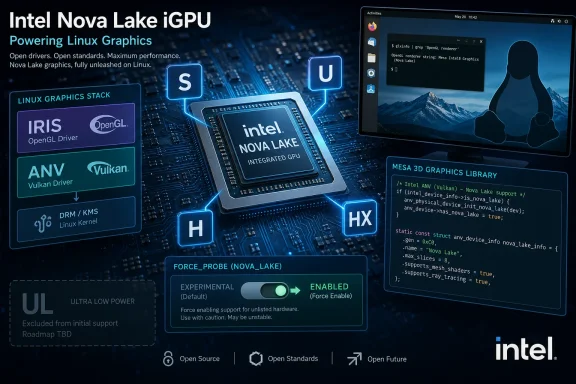 Mesa drops its own experimental gate
Mesa is the open-source graphics implementation that supplies OpenGL and Vulkan support for most Intel integrated graphics systems on Linux. Intel’s Iris Gallium3D driver handles OpenGL, while ANV handles Vulkan. Together, they sit above the kernel’s Intel graphics driver and are responsible for the APIs used by desktop environments, creative applications, browser acceleration, and a large share of Linux games.
When Nova Lake support first appeared in Mesa 26.0 in October 2025, it was explicitly experimental. The code added PCI device IDs for Nova Lake S, U, H, HX, and UL variants, but required users to set an Intel force probe override before the drivers would touch the new hardware. That safeguard exists to prevent unvalidated GPUs from being enabled by accident on systems where the kernel, firmware, or user-space driver may still be incomplete.
The new Mesa commit removes that restriction for Nova Lake S, U, H, and HX. In practical terms, a user running a sufficiently new kernel and Mesa package should no longer have to inject a driver option just to make Iris or ANV expose the GPU.
That is a meaningful change for distributions. Experimental support often makes it into enthusiast-focused rolling releases first, while mainstream distributions avoid it or require manual intervention. Default-on support is much easier for Fedora, Arch-derived distributions, Ubuntu interim releases, and vendor images to ship cleanly once the rest of the software stack is in place.
The kernel and Mesa milestones are related, but not identical
Phoronix ties the Mesa change to Linux 7.3, where Intel’s Xe graphics driver is expected to stop requiring force_probe for Nova Lake graphics. But the public kernel-side record contains a narrower statement than Mesa’s new four-family promotion: the July Linux 7.3 report specifically identified Nova Lake S as stable and enabled by default.
That difference matters. Mesa can mark several PCI IDs stable while kernel enablement lands at a different pace for individual platform families. The current reporting does not establish that Nova Lake U, H, and HX have the same mainline Linux 7.3 status as Nova Lake S. Nor does it identify the exact kernel commits that remove the safeguard for each of those mobile and high-performance variants.
Readers should therefore resist reducing this to “Nova Lake Linux support is finished.” The correct reading is more useful: the Mesa half of the stack has advanced across four named families, while the public kernel reporting has been clearest about Nova Lake S. A laptop buyer will still need the combination of a new enough kernel, Mesa build, firmware package, and OEM BIOS before assuming out-of-the-box graphics support.
The sequencing is normal for Intel graphics enablement. Kernel support provides the low-level memory management, display, scheduling, and device initialization path. Mesa then supplies the API driver layer. Removing the experimental flag from only one layer does not make the other optional.
The backport is the near-term detail Linux users should watch
The most practical detail in the new report is the planned backport to the Mesa 26.2 stable series. Mesa 26.3 is development code, so its presence alone would normally point early adopters toward Git snapshots or distributions willing to ship a pre-release branch. A 26.2 backport could make this enablement available through ordinary package updates much sooner.
Mesa 26.2.1 was released on August 20 with a broad set of fixes, including Intel ANV corrections, but it was published before the Nova Lake stability change reported later that day. In other words, users should not assume that an installed Mesa 26.2.1 package already contains the new default-on Nova Lake policy. The relevant question is whether a later 26.2 point release includes the backport and whether a distribution has packaged it.
For system administrators preparing Linux images or hardware validation labs, that makes a version check more valuable than generic advice to “update Mesa.” Record the precise Mesa build, kernel build, Intel graphics firmware revision, and platform BIOS version used during testing. Nova Lake systems are still pre-launch hardware, and a passing boot test is not the same as validated Vulkan, suspend/resume, external-display, media, and power-management coverage.
Nova Lake UL is the conspicuous omission
The original Mesa enablement work included a fifth Nova Lake category, UL. The new stability change, as described by Phoronix and reflected in the submitted scope, names S, U, H, and HX but does not include Nova Lake UL.
That omission should be treated as an omission, not proof of a product cancellation or a missing GPU. Intel has not publicly explained it in the material tied to this change. But it does mean readers should not extend the stable-by-default claim to every Nova Lake label that appeared in the original Mesa patches.
It also demonstrates why family names matter in driver coverage stories. “Nova Lake support” is an umbrella phrase; actual enablement is often attached to PCI IDs and platform-specific capability flags. A desktop Nova Lake S machine and an ultramobile Nova Lake system can share an architecture name while being on different software validation tracks.
Earlier Mesa code also suggested a hardware-feature split: Nova Lake U and H were marked for ray-tracing capability, while S, HX, and UL were not. The current patch changes the experimental status of driver support; it does not overturn those earlier feature flags. Stable initialization should not be mistaken for a new ray-tracing capability on Nova Lake S or HX integrated graphics.
Windows users should not expect a driver change from this
This update has no direct effect on Intel’s Windows graphics driver releases. Windows systems use Intel’s proprietary Windows driver stack, not Mesa’s Iris and ANV drivers. A Nova Lake PC running Windows will depend on Intel’s Windows driver package, OEM firmware validation, and Windows-specific certification rather than an upstream Mesa commit.
There is still value for Windows enthusiasts in the change. It is a public indicator that Intel’s software teams have moved a generation of integrated graphics out of the experimental stage across multiple desktop and mobile product families. That usually reduces uncertainty for people planning to dual-boot, run Linux in bare-metal development environments, or choose hardware expected to remain usable beyond its original operating-system image.
The next concrete checkpoint is not another headline about “support,” but the first Mesa 26.2 maintenance release containing the backport and the corresponding kernel releases that document which Nova Lake PCI IDs no longer require force_probe. Until those versions are available in distribution repositories and tested on shipping systems, Nova Lake’s Linux graphics story is substantially more prepared than it was last year—but it is not yet something users can validate on retail hardware.