
Prime Minister Narendra Modi inaugurated the Semiconductor Assembly, Test and Packaging facility on February 28, 2026, according to Akashvani News. Micron separately confirmed that the first shipment was presented to Dell Technologies for laptops manufactured in India for the domestic market.
The distinction matters: this is assembly and test, not a leading-edge wafer fabrication plant. Micron will bring advanced DRAM and NAND wafers from its global manufacturing network to Sanand, where they are converted into finished memory and storage products. That still places India inside a critical, capital-intensive part of the semiconductor supply chain rather than merely at the final PC assembly stage.
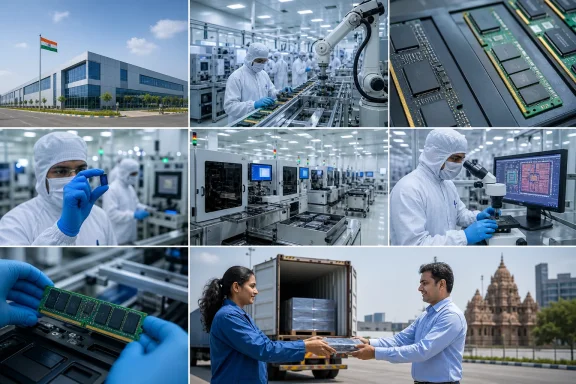 A Memory Plant Built for AI-Era Demand
Micron describes Sanand as a more than 500,000-square-foot cleanroom operation once its first phase is fully ramped, making it one of the company’s largest single-floor assembly-and-test cleanrooms. The project represents roughly $2.75 billion in combined investment by Micron and government partners.
The company expects the site to assemble and test tens of millions of chips during 2026, rising to hundreds of millions in 2027. Those volumes will serve worldwide customers, not just Indian OEMs, as demand for DRAM and NAND remains closely tied to AI servers, data centers, enterprise storage, phones, and PCs.
For Windows users, this does not mean a new retail RAM brand or locally branded SSD lineup will suddenly appear on shelves. The immediate practical effect is more likely to be inside finished systems: Dell’s initial shipment points to memory modules entering locally built notebooks, with other OEM and enterprise supply relationships possible as production ramps.
Dell Gets the First Locally Produced Modules
The initial Dell handoff gives the announcement a concrete endpoint beyond ceremonial production claims. Dell builds systems in India for India, and Micron’s modules could help shorten parts of that particular supply chain while supporting local-content manufacturing goals.
That does not guarantee lower laptop or desktop pricing. Memory prices remain governed by global DRAM and NAND capacity, demand cycles, product mix, currency movements, and OEM purchasing contracts. But regional assembly can reduce logistics exposure and give system vendors another option for qualifying components, particularly when global supply is tight.
Micron’s facility also carries ISO 9001:2015 certification, an important operational detail for OEMs and IT buyers that need consistent quality-control processes across component sources.
India Moves Into Packaging, Not Yet Chip Fabrication
Indian government officials framed the opening as the beginning of commercial semiconductor production in the country. That wording deserves precision: the Sanand site is an ATMP operation, where completed wafers are assembled into chips or modules, tested, marked, and packaged. The underlying memory wafers are made elsewhere in Micron’s global network.
Still, packaging and testing are not peripheral work. They determine whether a die reaches customers as a reliable, validated product, and they require sophisticated cleanrooms, automation, process control, supplier support, and trained technical staff. Building that base is a necessary step if India wants a broader semiconductor ecosystem spanning design, packaging, testing, materials, equipment support, and eventually wafer manufacturing.
Micron said the Sanand expansion complements its planned advanced manufacturing and packaging investments in the United States. For enterprise buyers and Windows hardware enthusiasts, the near-term takeaway is simpler: more Micron memory and storage components will now complete their journey in India before reaching global and Indian PC supply chains.
