
The CMA opened the case on July 27, 2026, and announced it two days later. Its enforcement page says investigators will gather evidence through December, with the next public update due by the end of 2026. No finding has been made, and Microsoft has said it is reviewing the regulator’s claims and will work constructively with the inquiry.
For UK Windows users, the case is a reminder to check an existing Microsoft 365 renewal rather than treating the price on Microsoft’s public store as the only available option. The regulator’s concern is focused on a particular renewal path: subscribers who had Copilot and other features added during their current term, then automatically renewed into the higher-priced bundle unless they actively changed or cancelled their plan.
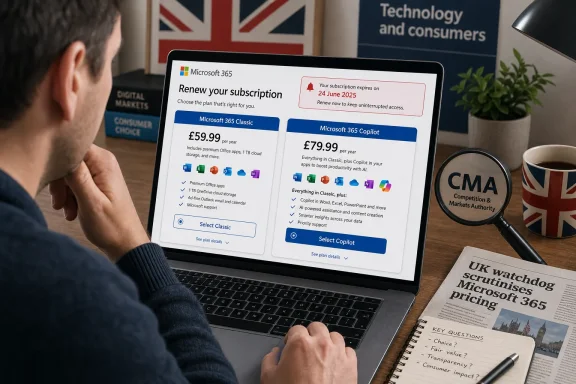 The price difference was clear; the alternative was not
The CMA’s published figures set out the gap at the heart of the investigation. Microsoft 365 Personal Classic was priced at £59.99 a year or £5.99 a month, compared with £84.99 a year or £8.49 a month for the Copilot-inclusive Personal plan. Microsoft 365 Family Classic cost £79.99 annually or £7.99 monthly, while the newer Family plan was £104.99 annually or £10.49 monthly.
That is a £25 annual increase on either consumer plan, or £30 over 12 months for subscribers paying monthly. Which? reported in 2025 that the annual Personal price increase represented roughly 42%, while Family rose roughly 31%. The increase was not hidden in the mathematical sense: Microsoft communicated that prices would rise. The regulatory question is narrower and more consequential: did those messages give subscribers enough information about the lower-cost, no-Copilot route to make a real choice before renewal?
Microsoft’s own January 16, 2025 announcement described the Classic options as available only to existing subscribers with recurring billing enabled, and only “for a limited time.” The company said the plans would retain the previous service level but would not receive certain future innovations. It also described the price change as reflecting benefits added over the preceding 12 years and funding future innovation.
That framing matters. Microsoft presented Copilot integration, Microsoft Designer features, and a broader set of consumer benefits as a package expansion. But it also offered an alternative package that preserved the old price and removed the new AI features. A customer who did not want Copilot therefore was not simply deciding whether to accept a price rise or abandon Word, Excel, PowerPoint, Outlook and OneDrive. They may have had a third option: retain the service they already used.
The CMA is investigating whether that option was adequately surfaced before people made a renewal decision.
A “limited-time” plan is an awkward consumer choice
Microsoft’s UK pricing page currently promotes the standard annual prices of £84.99 for Microsoft 365 Personal and £104.99 for Microsoft 365 Family. It does not present Classic as a normal product that a new customer can select alongside those plans. That does not establish that Classic is unavailable to every eligible existing subscriber; Microsoft controls eligibility and what an account sees. It does show that Classic has never functioned as a straightforward public tier for new buyers.
The limited-time condition creates the practical problem the CMA is now examining. A customer who accepts a higher-priced renewal may lose access to a lower-priced legacy plan. A customer who cancels outright may also lose it. Which? reported that annual subscribers who remain on Classic can continue it as long as recurring billing is maintained, but that cancelling the subscription can mean the option cannot be restored.
In other words, the choice may carry a ratchet effect: once a subscriber renews into the newer bundle or leaves the service, the old price may no longer be recoverable. That makes the clarity and timing of Microsoft’s renewal notices more important than in an ordinary price increase, where a shopper can simply compare publicly listed plans and return later.
The CMA has not yet said whether it believes Microsoft concealed Classic behind a cancellation journey in Britain. Its announcement is more restrained: it says the watchdog will assess whether customers were given the key information about plans and their price differences. But the Australian regulator has already alleged a much more specific version of the same conduct.
Australia has already put the cancellation flow under a microscope
In October 2025, the Australian Competition and Consumer Commission began Federal Court proceedings against Microsoft Australia and Microsoft Corporation over substantially the same Copilot integration and renewal model. The ACCC alleges that about 2.7 million auto-renewing Australian Microsoft 365 Personal and Family subscribers were told they had to accept the more expensive Copilot-integrated plan or cancel.
According to the ACCC, that was misleading because the Classic option existed but was not mentioned in the renewal communications. The regulator says subscribers could see it only after navigating to their Microsoft account’s subscriptions area, selecting “Cancel subscription,” and continuing to a subsequent page.
Australia’s case is an allegation, not a judgment, and it concerns a separate market and different consumer-protection law. Still, it gives the UK inquiry a concrete pattern to test: whether Microsoft’s communications put the price increase at the centre while presenting the cheaper option only after a customer initiated an action that strongly suggests they are leaving.
The ACCC’s public record also explains why this is more than a complaint about an unwanted AI feature. It argues that the older plans retained the existing suite—Office apps, storage and associated services—without the Copilot integration. For consumers who use Microsoft 365 primarily for familiar desktop apps and OneDrive, the relevant comparison was not “AI versus no software.” It was the same core subscription, with or without a paid AI bundle.
Microsoft’s current UK product information adds another wrinkle for Family subscribers: Copilot features in the Microsoft 365 apps are available only to the subscription owner and are not shared across the household. A Family plan can support up to six people, but the added AI benefit is not equally distributed among all six. That does not prove the new pricing was unfair; it does mean the value case for a Family upgrade depends heavily on whether the account holder personally uses the AI tools.
This investigation does not cover Microsoft 365 business tenants
Sysadmins and Microsoft 365 administrators should not mistake this consumer case for the CMA’s separate work on Microsoft’s business software practices. The subscription investigation concerns Microsoft 365 Personal and Family—products intended for home use. It does not address Microsoft 365 Business, Microsoft 365 Enterprise, Office 365 enterprise licensing, Teams, Azure consumption, or commercial Copilot licensing.
That boundary is important because enterprise IT buyers face a different procurement structure. Commercial customers negotiate through direct agreements, cloud solution providers, annual commitments and tenant-level licence assignments; consumer Personal and Family plans are largely sold through automatic billing and individual Microsoft accounts.
The CMA is separately examining whether Microsoft should receive strategic market status in business software under the UK’s digital-markets regime. That is a competition inquiry with a wider focus on market power and software practices. The consumer-protection case is specifically about information presented during a household subscription change.
For businesses that reimburse staff for personal Microsoft 365 subscriptions, the distinction is still useful. A reimbursement policy may be paying for a Family plan whose Copilot entitlement benefits only the named subscription owner, while colleagues or family members receive the traditional productivity and storage benefits. That is a cost-control question, not a legal conclusion from the CMA case.
What existing UK subscribers should verify now
A subscriber facing a Microsoft 365 renewal should first establish what they currently hold, when the next payment is due, whether recurring billing is on, and what exact price Microsoft says it will charge. The important record is the account-level subscription screen and renewal notice, not an assumption based on an old receipt.
Existing customers who do not want Copilot should inspect the available “change” and cancellation-path options before allowing a renewal to take place. They should not assume that disabling Copilot in Word, Excel or PowerPoint reduces the subscription price; it only turns off the feature experience. Nor should they assume a Classic option will appear, because Microsoft has described it as time-limited and account eligibility can vary.
Customers should save renewal emails and take screenshots of the plan options shown in their Microsoft account. Those records are useful if they later seek a refund, ask Microsoft support about a lower-priced plan, or wish to provide evidence to the CMA. The UK regulator’s case page invites information while the investigation is open.
The CMA now has direct consumer-enforcement powers and says a company that infringes consumer-protection law can face a fine of up to 10% of global turnover, though the regulator is a long way from any decision or penalty here. The nearer milestone is more modest: evidence gathering runs through December 2026. For current Microsoft 365 Personal and Family customers, the decision point arrives sooner—at the next renewal date, when the cost of Copilot may become automatic unless the available alternatives are checked first.