
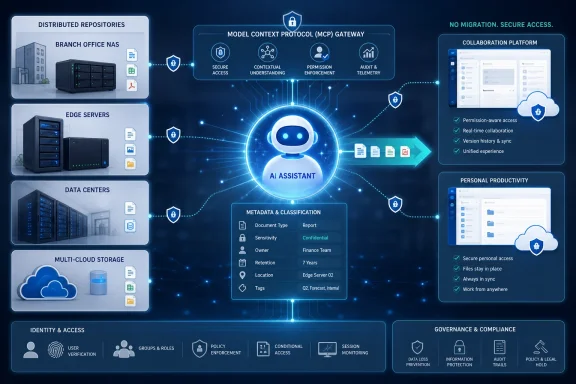
As reported by citybiz, CTERA positions the integration as a way to keep files in edge sites, data centers, and multi-cloud storage while applying existing permissions to Copilot queries. That matters to organizations whose operational data still resides on network-attached storage, branch-office systems, or cloud repositories that are not practical to consolidate into Microsoft 365.
 Copilot’s Data Boundary Gets Wider
Microsoft’s own release notes say federated Copilot connectors using MCP are generally available, enabling Microsoft 365 Copilot to retrieve third-party data in real time. CTERA is using that capability to provide a connector path from Copilot to its global file platform rather than importing content into a separate AI index.
The company says its Classify service can add metadata, semantic context, and classifications to unstructured files before they are surfaced to an AI assistant. In practice, that could improve retrieval for document-heavy environments where filenames and folders alone are poor indicators of a file’s business meaning.
The important qualification is that retrieval is not the same as unrestricted access. CTERA says responses are permission-aware and limited to files a requesting user is authorized to open. Administrators should nevertheless validate those controls with representative accounts, including users with inherited group permissions, external collaboration rights, and stale access assignments.
MCP Adds Capability—and an Administration Task
CTERA’s documentation describes its MCP Server as an OAuth 2.0-protected connection to AI agents. Its server can expose user-authorized file operations through the CTERA SDK, not just search and summarization, although administrator-only actions are excluded.
That means a Copilot deployment should not be treated as a simple search connector. IT teams will need to establish which MCP tools are enabled, which identity provider and OpenID Connect settings govern access, and whether users can trigger write-capable actions such as creating, copying, moving, or renaming files.
For Windows and Microsoft 365 administrators, the rollout checklist is straightforward:
- Confirm that CTERA permissions and Microsoft Entra ID group membership accurately reflect intended access.
- Limit enabled MCP tools to the minimum required for the Copilot use case.
- Test results and actions with least-privileged accounts before broad deployment.
- Review logging, audit retention, classification labels, and incident-response procedures across both the Microsoft 365 and CTERA sides.
A Practical Option for Distributed File Estates
CTERA had already added native MCP support for agents such as Claude, Cursor, and internally built tools. The Microsoft Copilot connection broadens that strategy to companies standardizing on Microsoft’s productivity stack while retaining distributed file services.
The value proposition is strongest where Copilot adoption has outpaced file modernization: users gain a conversational route to existing enterprise content, while storage teams avoid a rushed migration. The unresolved test will be whether permission filtering, classification quality, and operational controls remain reliable once Copilot queries meet years of unevenly governed file data.
Update: Additional details (July 30, 2026)
HPCwire’s report adds that CTERA says Copilot responses can include citations to their underlying source files, while access is delivered through single sign-on in Microsoft 365 Copilot and Teams Copilot. The company also says content is indexed in place rather than migrated outside its existing governance boundary.
CTERA further identifies Search, Classify, and its Experts capability as components used to enrich unstructured content for retrieval. CTO Aron Brand said the same MCP governance architecture is intended to apply across Copilot and other supported AI tools, including Claude and Gemini.
