
Microsoft’s customer-story team describes iSkill as a personal guide layered over Wipro’s AI Academy, which contains 144 role-based learning paths and a large catalogue of AI and cloud courses. When an employee signs in through their Wipro Teams identity, the agent is meant to retrieve only the learning history and recommendations relevant to that person, rather than requiring them to search the academy manually.
That is a sensible use case for Copilot-era enterprise AI. Corporate learning portals routinely accumulate thousands of courses, certifications and partner materials, while employees are left to translate broad job titles into a practical development plan. Wipro’s claim is that iSkill reduces that decision burden by connecting an associate’s role, band, function, skills and completed certifications to the academy’s available material.
But the published account also exposes a distinction that buyers should not overlook: iSkill is not evidence that a general-purpose chatbot can safely or accurately manage talent development on its own. It is a constrained retrieval system whose usefulness depends on the quality of Wipro’s job taxonomy, course metadata, learning records and access controls.
 Wipro’s iSkill is a governed data agent, not an open-ended career coach
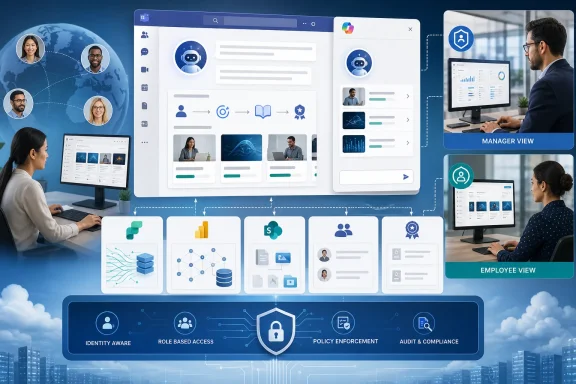
According to Microsoft’s report, iSkill combines two internal Wipro datasets: one with employee role, band, function and skills information, and another recording completed AI and cloud certifications. A Power BI semantic model sits between those sources and the conversational experience, while the academy catalogue is hosted in SharePoint.
Microsoft Fabric Data Agents are designed for this kind of setup. Microsoft’s documentation says they can answer natural-language questions against governed enterprise sources including Power BI semantic models, lakehouses, warehouses, KQL databases and other Fabric resources. In a semantic-model scenario, the agent can query curated measures and business definitions rather than being pointed at a raw operational database.
For Wipro, that design matters more than the chat interface. The semantic model is where the organization can impose a common meaning on terms such as delivery manager, AI Advanced+, certification completed, or a particular skill level. If those definitions are incomplete or inconsistent, an agent can produce polished recommendations that are organizationally wrong. A conversational interface does not solve a taxonomy problem; it makes the existing taxonomy easier to access.
Microsoft’s Fabric guidance makes the limitation explicit in a different context: Copilot responses grounded in semantic models can be inaccurate or misleading if the model, data and user preparation are poor. That warning applies directly to any internal learning agent. Wipro has described the recommendation logic at a high level, but it has not published how it evaluates whether suggested courses improve role readiness, project staffing outcomes, certification success or employee mobility.
The company’s example of a delivery manager preparing for a new project is plausible, but it remains an anecdote supplied by Wipro. No independent reporting or public measurement has established the quality of iSkill’s recommendations, its rate of incorrect responses, or whether employees follow the proposed learning paths after receiving them.
The security model is the strongest part of the published design
Wipro says access to iSkill is limited through a validated security group, with role-based controls in the Power BI model. Its stated rule is that a manager can plan learning for a role but cannot look up a named individual’s learning record. That is a useful boundary in an area where AI tools can easily blur the line between workforce development and employee monitoring.
Microsoft’s Fabric documentation corroborates the technical basis for that claim. Fabric Data Agents honor the permissions attached to the underlying data, including row-level security and column-level security. When a data agent queries a Power BI semantic model, Microsoft says a user needs read permission on the model, and the model’s security rules still apply to the resulting answer.
In practical terms, a manager-facing version of iSkill should query an aggregated or role-filtered view, while an individual user can query their own history. That is a familiar Power BI design pattern, but it becomes more consequential when a chat agent can accept plain-English requests. An agent cannot be treated as safe merely because it appears in a corporate Teams tenant; its answers are only as restricted as the model and source permissions beneath it.
There is also an operational requirement hidden behind Wipro’s description. Microsoft 365 Copilot administrators must explicitly decide which users or groups can access Fabric data through Copilot. Fabric administrators also control whether Fabric metadata is shared with Microsoft 365 services. Those settings are separate from Power BI’s data permissions, so an organization can create a tightly secured semantic model and still expose more discoverability than intended if the administrative rollout is broad.
For sysadmins, the lesson is straightforward: treat a Copilot-connected learning agent as a data-access project before treating it as an HR or L&D project. Validate Entra group membership, Power BI row-level security, semantic-model read permissions, SharePoint catalogue permissions, audit logging and the exact deployment scope in Microsoft 365 Copilot. Test with employee, manager, HR administrator and privileged IT accounts—not only with the account used to build the agent.
Wipro’s completion statistic does not prove iSkill caused adoption
Microsoft’s story says that 96 percent of Wipro’s AI Advanced+ courses were completed between January 2025 and March 2026. That sounds like a strong adoption result, but the reporting places the start of iSkill’s build in December 2025. The completion window therefore covers roughly eleven months before the agent was even under development.
The number may be a legitimate measure of the broader AI Academy’s momentum, but it cannot be presented as evidence that iSkill drove a 96 percent completion rate across that full period. Wipro’s academy predates the agent by about three years, and the company’s own account credits the academy with a substantial collection of persona-based learning paths and partner content before iSkill arrived.
This does not undermine the project. It changes how it should be read. The available evidence supports the claim that Wipro has built an internal learning assistant on a governed Microsoft data stack. It does not yet support a causal claim that iSkill materially increased course completion, reduced time spent searching, improved project readiness, or changed employee retention.
A stronger public case would separate pre-launch and post-launch figures, identify the population that actually used iSkill, disclose recommendation-to-enrollment conversion, and compare completion or skill outcomes against employees who continued using the existing academy search experience. Wipro has not released those numbers.
The distinction is especially important because learning systems can produce deceptively favorable engagement metrics. Employees may open a recommended course, begin a module, or complete mandatory training without gaining a skill that changes their work. A personalized agent needs outcome measures tied to role performance or verified capability, not merely usage.
Microsoft’s deployment requirements create a real adoption threshold
Wipro’s implementation is positioned inside Microsoft 365 Copilot and Teams, but the underlying Fabric Data Agent model has prerequisites that smaller organizations should factor into planning. Microsoft documents requirements including paid Fabric F2-or-higher capacity, or a qualifying Power BI Premium capacity with Fabric enabled, as well as Microsoft 365 Copilot or an eligible Office 365 commercial subscription for the relevant experience.
Microsoft also says that users consuming a Fabric Data Agent in Microsoft 365 Copilot need access to both the agent and its underlying data sources. The Fabric and Microsoft 365 Copilot environments must be in the same tenant and use the same account. Those requirements help preserve identity-based controls, but they complicate the idea of dropping a useful assistant into every Teams environment with minimal preparation.
The Fabric Data Agent connection to Microsoft 365 Copilot is also documented as a preview capability. That matters for change management. Preview features can evolve in behavior, controls, licensing, availability and administrative configuration, which is manageable for a targeted internal pilot but should give enterprises pause before making the workflow their sole learning-discovery channel.
Wipro has not said whether iSkill is available to all associates, which countries or business units are included, what Fabric capacity supports it, or whether every intended user already has the necessary Copilot entitlement. Nor has it explained how recommendations are reviewed when a role changes faster than course descriptions, skills frameworks or project requirements can be updated.
Those omissions are normal for a customer success story, but they are exactly the questions an enterprise deployment team needs answered before replicating the design.
The useful pattern is narrower than the marketing suggests
The most transferable part of Wipro’s work is a pattern: assemble a governed view of employee data and approved learning content, then give employees a conversational way to ask for next steps. A help desk agent could use the same approach for approved runbooks; a security team could use it for role-based incident training; an IT department could use it to guide Windows administrators toward validated change procedures.
The risk is allowing the agent to become an ungoverned answer engine. Wipro’s architecture appears intentionally narrow: it reads structured employee and certification data, searches a controlled academy catalogue, and applies identity-aware restrictions. That is far more defensible than feeding broad HR repositories, project communications and performance information into a general Copilot prompt and hoping policy language will keep the results appropriate.
Wipro has shown that Microsoft 365 Copilot can serve as a front end for individualized enterprise learning without abandoning Power BI’s security model. The next proof will need to come from Wipro’s own operational data: post-launch usage, recommendation quality, measurable learning outcomes, and evidence that its safeguards still hold when thousands of employees ask the system questions in ways its designers did not anticipate.