
The authors take issue with Northeastern University psychologist David DeSteno’s argument that religion cannot make AI moral because religious transformation relies on embodied rituals—fasting, prayer, breathwork—and lived experiences such as compassion and gratitude. That limitation is real. A language model can imitate empathy or summarize ethical traditions, but it does not experience accountability, suffering or moral struggle.
For Windows users and IT professionals, however, the practical concern is less metaphysical. Copilot, ChatGPT, Claude and other assistants are becoming routine interfaces for decisions at work and at home. They can draft sensitive messages, suggest responses to personal crises, explain religious texts, frame workplace conflicts and advise users who may treat a polished answer as informed judgment.
 The Prompt Is Not a Moral Framework
The commentary’s most useful point is that alignment is not a purely engineering exercise. A safety policy, reinforcement-learning target or system prompt inevitably chooses priorities: privacy versus intervention, autonomy versus protection, directness versus deference, and which harms deserve refusal or escalation.
Those choices should be transparent enough to challenge. “AI ethics” cannot mean a proprietary set of rules set behind closed doors by the same vendors shipping models at global scale. Nor does consulting religious leaders automatically solve the problem; faith traditions differ substantially, as do secular moral and legal frameworks.
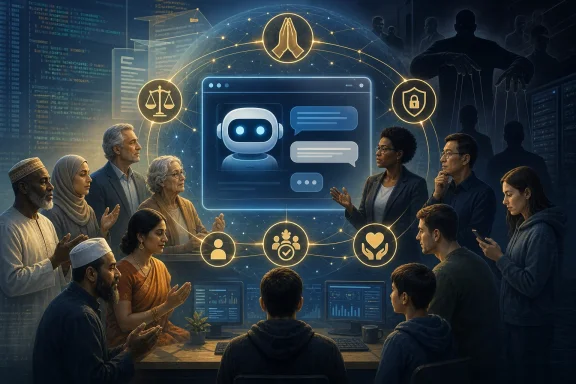
The Associated Press reported in May that OpenAI and Anthropic representatives joined an inaugural Faith-AI Covenant roundtable in New York alongside more than 15 faith groups. The organizers want to develop shared norms and safety mechanisms informed by religious communities, including safeguards against exploitation, radicalization and manipulation. Anthropic has separately said its Claude Constitution drew on religious and ethics leaders.
A Useful Voice, Not a Veto
Faith communities can contribute a long record of moral reasoning, community responsibility and care for vulnerable people. That is particularly relevant where AI products are positioned as companions rather than simple productivity tools. The article’s authors also propose a verified, consensus-based knowledge base spanning religions and languages, intended to reduce inaccurate or harmful machine-generated interpretations.
But the work must extend beyond gathering respected voices. A consensus corpus can become an authority layer that suppresses internal disagreement, minority traditions, nonreligious perspectives, or legitimate debate. It also introduces familiar enterprise governance questions: Who maintains it? Who can audit changes? Which model versions use it? What happens when a chatbot’s safety policy conflicts with local law or a user’s rights?
For organizations deploying Microsoft 365 Copilot or other generative AI tools, this is a reminder that vendor guardrails are not a substitute for governance. Administrators still need clear acceptable-use rules, data controls, human review for consequential decisions, incident reporting and training that explains a basic fact often lost in the marketing: fluent output is not moral judgment.
The Real Test Is Operational
The Faith-AI Covenant’s value will depend on whether its discussions produce measurable changes: published principles, independently testable model behavior, meaningful user controls and disclosure when a system is applying a particular normative framework. Otherwise, “moral AI” risks becoming an attractive label for systems whose real values remain opaque.
AI will not gain wisdom through ritual. But the people deploying it can decide whether its behavior is governed only by optimization and product incentives—or by transparent, contestable commitments to human dignity, agency and accountability.
