

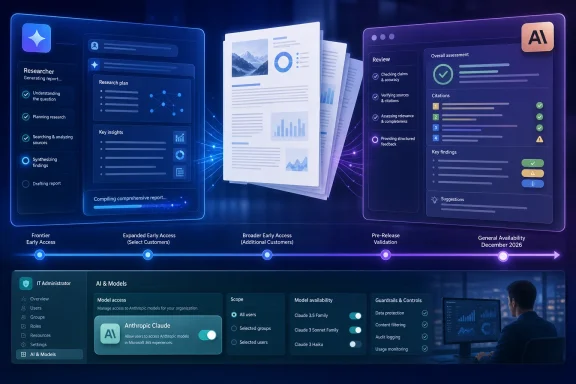
Critique changes how the Researcher agent produces a report. GPT drafts the initial answer, then Anthropic’s Claude performs a second reasoning pass intended to improve accuracy, completeness, structure, and citation grounding before the user sees the result. Microsoft’s roadmap entry, last updated on August 4, lists the item as In development for desktop and web, with a March 2026 preview date and a December 2026 general-availability target in the worldwide standard multi-tenant cloud.
Microsoft’s own support documentation makes the present limitation clearer than the roadmap card: Critique requires a Microsoft 365 Copilot license, the Frontier program, and administrator approval for Anthropic models. Office Watch independently reported in April that the early-access availability did not always line up neatly with Microsoft’s public positioning, observing the related Council option on at least one Microsoft 365 Business tenant. For administrators, the operational conclusion is simple: do not treat the December date as the point when multi-model research first enters the tenant. Treat it as the point at which Microsoft intends to make the experience generally available, subject to its usual roadmap changes.
A second model is reviewing the first one
The basic idea behind Critique is credible and straightforward: avoid asking one model to research, write, evaluate, and approve its own work in one uninterrupted chain. In Microsoft’s implementation, GPT prepares the report and Claude reviews the draft before the response is delivered. Microsoft says the reviewer focuses on reputable sources, whether the report fully answers the prompt, and whether key claims have clear supporting citations.
That is different from Microsoft’s companion Researcher feature, Council. Council has GPT and Claude produce separate reports and compares where the two agree or diverge. Critique instead creates a sequential workflow: draft first, review second. Users selecting the Critique mode are asking for a review stage, not two parallel opinions.
Microsoft has promoted the combined approach as a way to make research outputs more trustworthy. But the product wording needs a precise reading. A Claude review can catch weaknesses in a GPT-produced report; it is not a guarantee that factual errors, misleading sources, or missing context will disappear. Both models can be wrong, can rely on the same poor web material, or can accept a plausible but unsupported claim. Citations remain things a human must open and inspect, especially when a report informs procurement, legal, regulatory, security, or executive decisions.
The practical benefit is likely to be strongest for long, source-heavy assignments where the first draft has enough structure for a reviewing model to challenge gaps: market summaries, policy comparisons, internal briefings, competitive research, and document-grounded analysis. It is less compelling for a quick request where a normal Copilot response is already sufficient and the added reasoning step can increase latency.
The road map says GA; the support page says Frontier
The conspicuous detail in Roadmap ID 558538 is its status. It remains In development even though Microsoft’s Researcher documentation says Critique is available today to Frontier participants. Microsoft’s broader Microsoft 365 roadmap also describes “multi-model intelligence in Researcher” as early access through Frontier and lists Critique alongside Council.
This is not necessarily contradictory. Microsoft uses Frontier for experimental Copilot features and reserves general availability for the larger rollout with a firmer support and availability posture. The roadmap explicitly warns that dates are estimates and can change, while Microsoft’s support page describes Frontier features as subject to change based on feedback. In other words, Critique has been released to an early-access channel, but has not reached the stable release state Microsoft associates with GA.
Still, the Roadmap entry leaves important deployment questions unanswered. It does not say whether the December rollout will reach all paid Microsoft 365 Copilot customers simultaneously, whether it will be staged by tenant or update channel, whether Business and Enterprise plans will receive it on the same schedule, or whether the Frontier requirement will disappear immediately when GA begins. It also does not list a distinct SKU, add-on price, or per-user usage limit for Critique.
Microsoft’s public Support page supplies part of that missing eligibility picture: model choice in the Microsoft 365 Copilot app requires a Microsoft 365 Copilot license and is available in the desktop and web apps. It does not say that the capability is included with ordinary Microsoft 365 subscriptions without the Copilot license. Organizations that have deployed the base productivity suite but declined the Copilot add-on should not read this roadmap item as a feature entitlement.
The administrative switch is the real gate
Critique is also a governance change, not merely a new dropdown option inside Researcher. Microsoft says that an administrator must allow Anthropic AI models in the Microsoft 365 admin center before users can access Critique. The setting is under Copilot settings and Microsoft’s controls for AI providers acting as subprocessors.
Microsoft has placed Anthropic inside its Microsoft Online Services subprocessor framework, meaning use of Claude through these supported Microsoft 365 experiences is governed by Microsoft’s Product Terms and Data Protection Addendum rather than the older model in which a tenant opted into Anthropic’s separate commercial terms. That improves the contractual footing for many customers, but it does not erase the deployment review.
The key regional caveat is specific. Microsoft says Anthropic models are disabled by default for tenants in the European Union, European Free Trade Association countries, and the United Kingdom, and are not available in GCC, GCC High, DoD, or other sovereign clouds. Anthropic-backed capabilities are also outside the Microsoft EU Data Boundary and, where applicable, in-country processing commitments. That makes Critique fundamentally unavailable or administratively sensitive for many public-sector, sovereign, and data-residency-constrained deployments, regardless of the roadmap’s “Worldwide (Standard Multi-Tenant)” label.
For U.S. commercial tenants, Anthropic access is generally enabled by default under Microsoft’s current documentation, although an administrator can disable it. Global administrators should still verify the toggle rather than assuming it is on: Microsoft says the subprocessor rollout has been phased and that individual features can be limited while the rollout completes. Turning the provider off removes users’ ability to use Anthropic-powered options, including Critique where it depends on Claude.
A sensible pre-GA check is short:
- Confirm that the intended pilot users hold Microsoft 365 Copilot licenses rather than only Microsoft 365 application licenses.
- Verify whether the tenant is eligible for Frontier and whether users are assigned to it.
- Review the Anthropic subprocessor setting and any regional data-processing requirements before enabling it.
- Run controlled Researcher prompts against known internal or public source sets, then measure whether Critique improves the result enough to justify the extra model dependency.
- Keep human review in the process for reports that make material claims or decisions.
“Citation integrity” is a quality feature, not an audit trail
The language Microsoft uses for Critique puts “citation integrity” alongside accuracy and completeness. That is useful as a product goal, but it should not be confused with a compliance record. A cited answer can still point to a weak source, misrepresent the cited material, omit a contrary source, or join individually accurate statements into an unsupported conclusion.
Researcher’s access to work content also makes this more consequential than a public-web chatbot. Microsoft describes Researcher as gathering and analyzing information from the web and content that a user is permitted to access at work. Critique can improve the report generated from that material, but it inherits the source selection and permissions boundaries of the Researcher workflow. A second model does not fix overshared SharePoint content, a poorly governed connector, or an employee’s decision to paste sensitive material into a prompt.
IT and security owners should therefore evaluate Critique on two separate tracks. The first is output quality: does the added review pass produce reports that are more accurate, complete, and genuinely better cited in the organization’s real use cases? The second is data governance: is Anthropic model access acceptable for the tenant’s location, compliance commitments, and internal policy? Microsoft’s integration gives customers a defined administrative control, but the decision to activate it remains theirs.
December is the milestone that counts for broad rollout planning
The roadmap’s December 2026 general-availability estimate gives organizations a planning marker, especially those that have avoided Frontier because experimental Copilot features are not an acceptable production dependency. But there is no need for them to wait to understand the operational impact. Microsoft has already published the access conditions, the GPT-plus-Claude workflow, and the administrative dependency that will shape deployment.
For Frontier tenants, Critique is available now only if the user is licensed, enrolled, and permitted to use Anthropic models. For everyone else, the meaningful date is currently December 2026, with no promised day of month and no published assurance yet about exact rollout sequencing, government-cloud support, or data-residency changes.