
For enterprise marketing teams, the immediate issue is not whether the feature exists; Microsoft had already confirmed in June that AI Max would expand from pilot status. The practical issue is that the global rollout appears to have arrived through the campaign interface and a LinkedIn post rather than a detailed public product bulletin, API reference update, or formal support article spelling out the final behavior. That leaves account owners responsible for testing the controls before letting automation rewrite the relationship between their keyword lists, creative approvals, analytics, and landing-page rules.
Microsoft’s June 17 announcement described AI Max as a Search campaign feature designed for expanded query matching, asset personalization, and “smarter URL routing.” Its April product update said the feature was becoming available in open pilot and emphasized that advertisers would be able to opt in. The August rollout reported by PPC Land is therefore the move from staged access to broad availability, rather than a new campaign type akin to Performance Max.
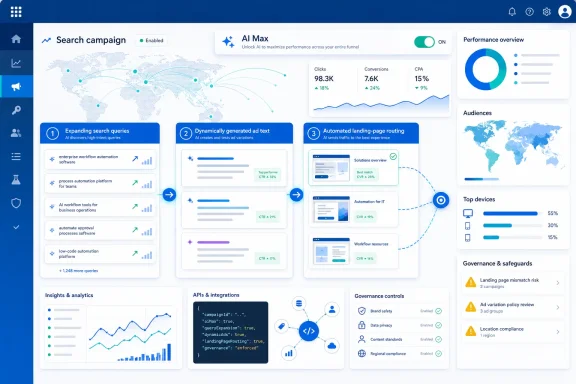 The campaign toggle changes three different control planes
AI Max’s apparent simplicity is deceptive. A single master toggle groups three independent automations that normally belong to different disciplines inside an organization.
Search term matching widens the conditions under which an existing Search campaign can enter an auction. Rather than matching only from the account’s defined keywords and their permitted variants, Microsoft can use material from ads, landing pages, and other contextual signals to find related intent. That makes the setting relevant to teams that have carefully separated products, geographies, regulated services, or branded and non-branded acquisition campaigns.
Text customization is the creative layer. Microsoft says AI Max uses advertiser-supplied assets and website content to adapt ad copy to the search context. A team that has approval workflows for claims, pricing language, trademark use, or legal disclosures should treat this as dynamic creative generation, not as a minor copywriting convenience. The original responsive-search-ad assets may remain approved, while variations assembled at auction can behave differently in the market.
Final URL expansion has the broadest downstream effect because it can alter where a paid click lands. Microsoft’s existing Performance Max documentation describes URL-level reporting and URL rules as mechanisms for assessing and refining automated landing-page selection. For AI Max, PPC Land reports that advertisers can exclude specific URLs from automated routing. That is useful, but it does not replace a review of tracking templates, consent paths, regional pages, inventory status, and conversion tags before the setting is enabled.
A page that performs well organically is not always a valid paid-search destination. It may lack campaign parameters, omit a required disclosure, feed a different conversion action, display out-of-stock inventory, or bypass the form and consent sequence that marketing operations expects. In organizations where different teams own web publishing, analytics, and media buying, final URL expansion needs cross-functional sign-off.
Microsoft has promised controls, but the public documentation is still behind the rollout
The most important discrepancy is between the breadth of the reported launch and the specificity of Microsoft’s public documentation.
In June, Microsoft said AI Max would gain brand inclusions and exclusions, term exclusions for asset optimization, and search-term-to-landing-page reporting. In April, Microsoft similarly framed guardrails and reporting as forthcoming capabilities. PPC Land now reports that brand controls, URL exclusions, and experiments are present in the campaign settings panel as AI Max becomes available globally.
Those claims are plausible and consistent with Microsoft’s earlier direction, but Microsoft has not yet published a public August release note that defines the settings, names the supported markets and campaign requirements, or documents the controls in the same way it has documented Performance Max features. The company’s public help documentation available before this rollout still describes predictive matching as a distinct Search campaign feature that uses a final URL, ad titles, ad text, and existing keywords to find additional relevant queries.
PPC Land reported in late July that Microsoft intends to fold Predictive Matching into AI Max’s search-term matching. The earlier notice reportedly gave advertisers no effective date and said no action was required. The global AI Max rollout makes that transition more consequential: an account may need to determine whether behavior previously understood as a separate matching enhancement is now controlled through the broader AI Max settings pane.
That is an operational documentation gap. A platform can reasonably evolve a pilot into a generally available feature, but large advertisers need an authoritative answer to a basic question: which settings are active for a particular campaign, and how do those settings surface in reporting and bulk management?
Reporting is the deciding factor, not the presence of a toggle
Microsoft has made transparency a selling point. Navah Hopkins wrote on Microsoft’s advertising blog on August 12 that the platform supports full search-term transparency for queries that result in clicks. Microsoft has also added landing-page and search-term reporting to Performance Max, where URL automation makes it especially important to see how traffic is being routed.
But AI Max requires reporting that connects three events: the query that triggered an ad, the asset variation shown, and the final page selected. Without that connection, teams can see an aggregate improvement or decline without knowing which automation caused it.
Microsoft said in June that search term landing page reporting was planned for AI Max. PPC Land reports that reporting is available from day one, but the company has not published a distinct report definition, retention period, availability threshold, or API field list for AI Max. Current Microsoft documentation for Search Terms Insights still says that report is available only for Performance Max campaigns.
That does not mean AI Max lacks reporting. It means the public record does not yet establish what reporting surface administrators can rely on for governance, scheduled exports, or programmatic auditing. For teams that have to explain paid-search decisions to finance, compliance, or clients, that difference is material.
A campaign-side view may be sufficient for a small account. It is not necessarily sufficient for an agency platform, a data warehouse pipeline, or a multinational advertiser that requires repeatable controls across hundreds of accounts.
The REST API deadline turns this into an administration project
The rollout also lands during Microsoft Advertising’s migration from its legacy SOAP API to REST. Microsoft says that, beginning October 1, 2026, all new API features and enhancements will be available only through REST. The SOAP API is scheduled for full retirement on January 31, 2027.
That timeline matters even if AI Max is initially configured only in the web interface. Any organization that manages campaigns through a home-grown tool, third-party workflow platform, or agency automation layer should determine whether that tooling can read and write AI Max settings, exclusions, experiments, and reporting through REST.
Microsoft’s June 30 support response on Learn acknowledged that some keyword performance reports were returning an “AI Optimized” value that was not documented in the reported match-type value set. The response did not provide a precise technical definition of the value. That is a warning sign for report parsers and ETL jobs built around a fixed list of match types: the automation may expose new values before downstream systems have been updated to recognize them.
Administrators should not wait for a production reporting failure to discover this. A new match-type value can break validation, silently be categorized as “unknown,” or disappear from a dashboard that filters only broad, phrase, and exact matches.
Treat AI Max as a controlled experiment, not an account-wide upgrade
Microsoft’s reported decision to allow the three AI Max functions to be tested separately is more valuable than the master switch itself. Query expansion, text generation, and URL selection should not be enabled together if the goal is to learn which one changed performance.
The most defensible first deployment is a limited experiment in a Search campaign with clean conversion tracking, a stable budget, sufficient historical volume, and a narrow group of acceptable landing pages. Keep a control campaign or experiment arm unchanged. Review search terms, conversion quality, destination URLs, rejected or altered assets, and lead outcomes—not only cost per conversion or return on ad spend.
Before enabling the feature in a regulated, brand-sensitive, or technically complicated account, teams should complete these checks:
- Confirm that every page eligible for final URL expansion has the correct analytics tags, consent behavior, conversion definitions, inventory state, and required legal content.
- Build and attach brand exclusions and inclusions where the business needs to protect branded traffic, competitor terms, or product boundaries.
- Review existing tracking templates and redirect behavior so automated URL selection does not send clicks into an unsupported measurement path.
- Validate that reporting pipelines accept any AI-related match-type or asset classifications before using the resulting data for automated bidding or executive reporting.
- Confirm that campaign-management tooling is moving to Microsoft Advertising REST before October 1, rather than assuming a SOAP integration will gain access to future controls.
Microsoft has positioned AI Max as an opt-in feature, and that is a meaningful distinction from an enforced migration. But opt-in does not eliminate governance work. The real test of this rollout will be whether the public documentation, reporting definitions, and REST API support catch up quickly enough for advertisers to prove what the system is doing after the toggle is turned on.