
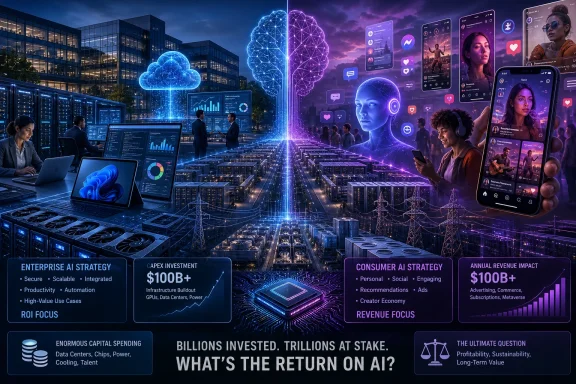
 The April 29 Earnings Moment Has Already Passed
The framing of Microsoft and Meta as companies heading into April 29 earnings is now outdated. Both businesses reported results for the quarter ended March 31, 2026, and those results sharpened the contrast between their AI strategies.
Microsoft reported quarterly revenue of $82.9 billion, up 18% year over year, alongside operating income of $38.4 billion. Its Azure and other cloud services revenue grew 40% on a reported basis, or 39% in constant currency. The company also said its broader AI business had passed a $37 billion annual revenue run rate, a powerful signal that AI is no longer merely an internal investment category or a Copilot marketing story.
Meta reported $56.3 billion in revenue, up 33% year over year, with operating income of $22.9 billion and an operating margin of 41%. Its advertising engine remained central to the story: ad impressions increased 19%, while the average price per ad rose 12%. That combination indicates Meta’s AI investments are already influencing the part of the company that pays the bills.
Both reports delivered evidence of AI momentum. They also made the cost of the race impossible to ignore.
Overview: Two AI Strategies Built on Very Different Foundations
Microsoft and Meta share several important characteristics:
- Both possess enormous cash-generating core businesses.
- Both control large-scale global infrastructure.
- Both have access to vast quantities of proprietary data and user signals.
- Both can afford to fund multiyear AI research and data-center construction programs.
- Both have a direct need to keep pace with rivals including Alphabet, Amazon, Anthropic, OpenAI, Nvidia, and a growing field of open-model competitors.
The similarities end quickly when examining how each company expects AI to create durable economic value.
Microsoft is pursuing a layered enterprise strategy. At the bottom sits Azure, where the company sells compute, storage, networking, model services, security tools, databases, and AI infrastructure. Above that are developer products such as GitHub, business applications such as Dynamics 365, and collaboration and productivity tools including Microsoft 365. At the top are Copilot and agent experiences intended to become embedded in daily knowledge work.
Meta’s model is more concentrated. It uses AI to improve recommendations, ranking, targeting, creative generation, messaging, and advertising measurement across Facebook, Instagram, WhatsApp, Messenger, and Threads. This is a massive opportunity because a small improvement in relevance can improve engagement, ad inventory, advertiser outcomes, and price per ad across a user base measured in billions.
The result is a fundamental difference in risk profile. Microsoft must prove that AI becomes a recurring paid enterprise capability across many product lines. Meta must prove that extraordinary infrastructure spending produces incremental advertising efficiency and eventually supports entirely new consumer AI products.
Microsoft’s Advantage: AI Fits the Existing Enterprise Stack
Microsoft’s strongest AI advantage is not simply Azure scale or its model partnerships. It is the company’s ability to put AI into software that organizations already use for email, documents, spreadsheets, presentations, meetings, identity, security, databases, development, and business operations.
For Windows users and IT administrators, that integration matters more than a flashy chatbot demo. Microsoft has a practical route to making AI feel less like a standalone tool and more like a built-in part of the workplace.
Copilot Is Microsoft’s Distribution Engine
Microsoft’s Copilot brand spans a complicated and rapidly changing portfolio, but its strategic purpose is clear. Copilot is the interface through which Microsoft wants organizations to consume AI across its ecosystem.
That includes AI features associated with:
- Microsoft 365 productivity workloads
- Teams collaboration and meeting workflows
- Windows and endpoint experiences
- GitHub developer tools
- Dynamics 365 business applications
- Power Platform automation and low-code development
- Security operations and threat analysis
- Azure cloud management and application development
This gives Microsoft a distribution advantage few companies can match. A business that already licenses Microsoft 365, runs Windows endpoints, hosts workloads on Azure, uses GitHub, and relies on Microsoft identity services does not need to adopt an entirely separate ecosystem to test AI-assisted workflows.
The opportunity is especially significant in environments where compliance, permissions, governance, retention, and auditability matter. Enterprises do not merely want a model that can write a paragraph or summarize a meeting. They need AI that respects access controls, draws from approved business data, integrates with existing workflows, and can be managed by IT.
Azure Turns AI Demand Into Infrastructure Revenue
Azure is the other half of Microsoft’s AI strategy. The company does not only sell AI-enabled productivity tools; it also sells the cloud foundation needed to build, host, fine-tune, secure, and operate AI applications.
Azure’s 40% reported growth in the March quarter demonstrates that cloud demand remains strong, even at a much larger revenue base than many competitors. The more important point is that AI demand is increasingly intertwined with the company’s core cloud business.
This creates a powerful flywheel:
- Customers use Azure infrastructure to train or run AI workloads.
- They adopt higher-level services for data, security, integration, and model development.
- They build business applications that need additional compute and storage.
- They purchase Copilot, agent, or developer subscriptions for employees.
- Their growing usage creates more demand for Azure capacity.
The flywheel is compelling, but it is not frictionless. Enterprise AI adoption often moves through security reviews, procurement processes, data-cleansing projects, and internal governance committees. Microsoft can benefit from that complexity because it already sells to enterprise IT, yet the same complexity can slow the pace at which experimental AI usage turns into material recurring revenue.
Contract Backlog Offers Visibility—Not a Blank Check
Microsoft’s commercial remaining performance obligation rose to $627 billion during the quarter, a remarkable figure that signals deep enterprise demand and substantial contracted revenue. However, investors and IT leaders should be careful not to treat the entire backlog as immediate AI revenue.
A backlog is a visibility tool, not a direct measure of AI product profitability. Revenue is recognized over time, and the duration of contracts matters. Some capacity commitments can also be tied to large cloud customers whose spending patterns may fluctuate as infrastructure supply, model efficiency, and competitive pricing change.
Still, the scale of Microsoft’s contracted business gives it an unusual advantage in the AI race. It can finance capacity expansion against a broad base of established customer relationships rather than relying exclusively on a new, unproven consumer product category.
Meta’s Advantage: AI Is Already Improving the Advertising Machine
Meta’s AI strategy looks very different, but it has a major strength that Microsoft cannot replicate: a direct feedback loop between AI quality and advertising revenue.
Meta’s services are driven by engagement. Better recommendation systems can surface more compelling short-form video, posts, communities, messages, and ads. Better ad systems can help advertisers target more relevant audiences, generate creative variations, optimize campaign budgets, and measure results.
When that system works, the benefits compound rapidly.
Recommendation AI Has Become Core Infrastructure
Meta has spent years refining its ranking and recommendation systems. The shift toward AI-driven discovery is especially important because social platforms are no longer defined solely by content from accounts people deliberately follow.
Instagram Reels, Facebook video feeds, suggested posts, and AI-assisted recommendations increasingly operate as content-discovery engines. That gives Meta a powerful reason to invest in compute: better models can increase time spent, improve the relevance of content, and create more opportunities to show ads.
The March-quarter performance offered concrete evidence that this system continues to deliver. Meta reported 3.56 billion family daily active people, despite disruptions affecting some regions, and its advertising metrics showed simultaneous gains in impressions and pricing.
That does not prove every dollar of AI infrastructure spending will earn an attractive return. It does show that Meta’s core business has an established mechanism for converting better AI into measurable commercial outcomes.
Generative AI Could Transform Ad Creation
Meta’s next major opportunity is not merely showing the right ad to the right person. It is helping advertisers create the ad itself.
Generative AI can potentially produce copy variations, images, videos, product backgrounds, translations, audience-specific creative, and campaign configurations at a scale previously reserved for large marketing teams. If smaller businesses can create higher-quality campaigns more easily, Meta may increase advertiser participation and advertising intensity.
This is a strategically important difference between Meta and many AI companies. Meta does not need to persuade every consumer to pay a monthly subscription before it can monetize generative AI. It can use AI to make advertising more effective, then capture value through the existing auction system.
That approach may be less visible to end users than a premium AI assistant. It may also be economically more powerful.
The Personal Superintelligence Bet Is Far Less Proven
Meta’s longer-term ambition is more difficult to evaluate. The company has positioned its superintelligence efforts around building highly capable personal AI experiences for billions of users. This could involve assistants, creator tools, messaging experiences, wearable devices, social interaction, and future computing platforms.
The upside is enormous if Meta creates a consumer AI product with daily utility and deep integration into its family of apps. A highly capable assistant connected to communication, content creation, discovery, commerce, and devices could become a major new platform.
The risk is equally obvious. There is no settled consumer business model for personal superintelligence, and the market may not support unlimited spending simply because a company labels its goal transformational. The path from frontier-model research to a product billions of people trust, use regularly, and monetize predictably remains uncertain.
Capital Expenditure Is the Real Battlefield
The headline numbers tell the story. Microsoft expects to invest roughly $190 billion in capital expenditures during calendar 2026, including the effect of higher component pricing. Meta expects 2026 capital expenditures, including principal payments on finance leases, of $125 billion to $145 billion.
These figures are too large to describe as normal expansion spending. They represent an attempt to secure scarce AI capacity before competitors do.
Why the Spending Is So High
Modern AI infrastructure requires far more than graphics processors. A serious deployment also demands:
- Data-center buildings and land
- Power generation and grid connections
- Cooling systems
- High-speed networking
- Storage infrastructure
- Specialized chips and servers
- Networking switches and optical equipment
- Data-center operations staff
- Model researchers, systems engineers, and security specialists
- Software for orchestration, observability, reliability, and governance
Costs are also rising because demand is colliding with supply constraints. Advanced accelerators, memory, networking components, power equipment, and data-center construction capacity are all strategic bottlenecks.
For Microsoft and Meta, the most immediate challenge is not whether AI will matter. It is whether they can deploy enough capacity quickly enough—and whether the capacity earns sufficient returns once deployed.
Microsoft’s CapEx Case: Capacity Supports a Revenue Pipeline
Microsoft reported $31.9 billion in capital expenditures during its March quarter, while cash paid for property, plant, and equipment reached $30.9 billion. The company explained that a significant share of spending was directed toward shorter-lived assets such as GPUs and CPUs, while the remaining portion supported longer-lived data-center assets.
This distinction matters. GPUs and CPUs can produce revenue relatively quickly if customer demand is already waiting. Buildings, land, and long-term data-center infrastructure must be evaluated over a much longer economic horizon.
Microsoft’s investment case rests on the argument that demand already exceeds available supply. If that remains true, new capacity can be absorbed by Azure consumption, enterprise AI services, and expanding Copilot usage. If demand weakens, capacity is delayed, or lower-cost models reduce compute needs faster than expected, the company could face margin pressure and lower returns on invested capital.
Meta’s CapEx Case: The Ad Business Must Carry More Weight
Meta spent $19.8 billion on capital expenditures and finance-lease principal payments in the March quarter. It still generated $32.2 billion in operating cash flow and $12.4 billion in free cash flow, which underscores the extraordinary earning power of its advertising business.
But the annual outlook remains aggressive. A $125 billion to $145 billion capital expenditure range requires investors to accept that Meta’s future ad platform, consumer AI products, and infrastructure position justify an investment cycle far larger than its historical norms.
Meta has emphasized component pricing and future data-center requirements as important reasons for the higher forecast. That explanation is plausible, but it does not eliminate execution risk. Hardware inflation is still a cost. Every additional dollar spent must eventually be supported by higher engagement, more valuable advertising, or entirely new revenue streams.
The Margin Question: Both Companies Are Strong, Neither Is Immune
Microsoft and Meta are starting this investment cycle from positions of exceptional profitability. That is why they can undertake AI spending programs that would be impossible for most rivals.
Microsoft’s operating margin reached roughly 46% in its March quarter. Meta’s operating margin held at 41%. Those are enviable numbers even before considering the strategic flexibility provided by their large cash flows.
Yet investors should watch margins closely because AI changes the economics of software and internet services.
Traditional software can be highly scalable once developed. AI inference can incur an ongoing cost each time a user runs a query, generates content, invokes an agent, or processes documents. AI infrastructure is therefore not a one-time research expense. It can become a permanent cost of delivering the service.
The Cost of “Free” AI Features
This issue is particularly relevant for Windows, Microsoft 365, and consumer AI experiences. A feature bundled into an existing subscription may increase product value, reduce churn, and support higher pricing. But if usage rises faster than monetization, the cost of serving that feature can become material.
Microsoft’s answer is likely to be segmentation: free or lightly limited features for broad adoption, premium Copilot tiers for high-value users, consumption-based services for organizations, and Azure usage for developers building their own applications.
Meta faces a related challenge. AI may improve user experience and ads without charging users directly, but the compute cost still exists. Its economic model works if each unit of AI-driven engagement produces enough advertising value to exceed the infrastructure expense. That calculation can change rapidly if ad demand softens or if AI features become much more expensive to serve than anticipated.
Regulatory and Governance Risks Remain Material
AI competition is not happening in a regulatory vacuum. Microsoft and Meta face distinct risk categories that could affect their strategies.
Microsoft: Enterprise Trust, Competition, and Platform Power
Microsoft’s enterprise position creates opportunity, but it also invites scrutiny. Customers will demand clear answers about:
- Where their data is processed
- Whether sensitive information is used to train models
- How permissions are enforced
- How AI outputs are audited
- Whether agents can take actions safely
- How regulatory obligations are met across jurisdictions
- What happens when AI-generated output is incorrect
The company also faces the longstanding risk that its platform breadth may draw competition concerns. Bundling AI tools into Windows, Microsoft 365, Azure, and security offerings can be attractive to customers, but rivals may argue that it makes the market harder for independent vendors to contest.
Meta: Privacy, Youth Safety, Antitrust, and Advertising Dependence
Meta’s regulatory risks are more visible and arguably more binary. The company remains exposed to privacy rules, content and safety requirements, youth-related litigation, advertising restrictions, platform-policy changes, and antitrust scrutiny.
A forced structural change involving major apps would be far more consequential than a routine compliance cost. Meta’s business benefits from the integration of its social graph, advertising systems, messaging products, and cross-app data signals. Any regulatory action that limits that integration could alter the economics of its AI and advertising strategy.
Meta also depends heavily on advertising. Microsoft is diversified across cloud, productivity, operating systems, gaming, business applications, and developer tools. Meta has a phenomenally profitable core business, but it remains more sensitive to changes in advertiser demand and consumer attention.
What Windows Users and IT Pros Should Watch
For the Windows community, Microsoft’s AI strategy will matter most when it becomes operationally useful rather than merely more visible.
The key test is whether Copilot and agent capabilities reduce repetitive work without introducing security gaps, confusing licensing, unexpected consumption costs, or unreliable automation. The successful AI products will be those that fit into the management models organizations already use.
Practical Indicators of Microsoft AI Success
IT professionals should pay close attention to several signals:
- Copilot adoption that persists after pilot programs
- Clear licensing and consumption models
- Improvements in Microsoft 365 and Windows productivity workflows
- Azure capacity availability and pricing
- Security and identity controls for agents
- Auditing, data residency, retention, and compliance capabilities
- Developer adoption of GitHub and Azure AI tooling
- Evidence that AI can reduce help-desk, documentation, coding, and analysis workloads
Microsoft’s broad portfolio can be an advantage, but only if its products become easier to deploy together. If customers need separate tools, separate governance models, and separate bills for every AI feature, the company risks turning a platform advantage into administrative friction.
Which Company Is Better Positioned?
There is no universal winner because Microsoft and Meta are solving different problems with AI.
Microsoft has the more diversified and enterprise-ready AI business. Its advantage lies in owning a stack that runs from infrastructure to applications to endpoints. Azure growth, commercial contract backlog, Microsoft 365 distribution, and a large AI revenue run rate suggest that AI monetization is already meaningful. Its primary challenge is demonstrating that massive capacity spending yields durable, high-margin revenue rather than simply supporting a costly competitive race.
Meta has the more immediate AI-to-revenue feedback loop. Its recommendation and advertising systems can translate better models into higher engagement, more impressions, improved targeting, and stronger ad pricing. The March-quarter results showed that this engine remains potent. Its larger challenge is proving that the next phase of infrastructure spending creates returns beyond the advertising business and does not become an open-ended subsidy for increasingly expensive AI research.
For investors, Microsoft may appear to be the steadier AI compounder because it monetizes cloud and software across a broad enterprise base. Meta may offer the sharper operational leverage if AI continues improving ad performance at scale. But Meta also carries greater concentration and regulatory risk, while Microsoft must navigate the difficult economics of enterprise AI infrastructure and usage-based services.
Conclusion: The AI Arms Race Is Becoming an ROI Test
The most important development is not that Microsoft and Meta are spending unprecedented sums on AI. It is that both companies have moved beyond the stage where AI can be judged solely by product demos, model benchmarks, or ambitious executive language.
Microsoft’s test is whether Azure, Copilot, GitHub, Windows, and enterprise agents become a coherent, profitable AI platform that organizations adopt at scale. Meta’s test is whether its giant compute buildout continues to improve advertising economics while creating a credible next-generation consumer AI business.
Both companies have the resources to remain central players in the AI era. Both have already demonstrated real commercial benefits from AI. But the market is no longer rewarding investment on promise alone. The next phase of the AI arms race will be decided by utilization, pricing power, free cash flow, security, and proof that the world’s most expensive data centers are creating products people and businesses will keep paying to use.
Update: Microsoft’s AI monetization gains contrast sharply with Meta’s cash-flow pressure (July 30, 2026)
New earnings reports have intensified the divide described above. International Business Times reports that Microsoft’s revenue rose 18% to $90 billion, with Azure revenue up 43% year over year and paid Microsoft 365 Copilot seats increasing from 20 million to 30 million since April. Despite its enormous fiscal-2026 AI infrastructure budget, Microsoft generated $19.6 billion in free cash flow.
The market reaction was immediate: Microsoft shares rose about 10% after the results, as investors treated Azure growth and accelerating Copilot adoption as evidence that its data-center expansion is translating into commercial demand.
Meta, by contrast, reported 28% revenue growth to $60.8 billion, but free cash flow fell 91% year over year to $784 million amid rapidly rising spending on chips, data centers, and power capacity. The company also raised the bottom end of its 2026 capital-expenditure outlook to $130 billion, while retaining a $145 billion upper bound.
According to the report, analysts pressed Meta executives for a clearer timetable and mechanism for AI returns. The difference is especially relevant to enterprise IT: Microsoft can sell AI capacity, Copilot subscriptions, and related cloud services directly into existing business relationships, while Meta still must demonstrate that its larger consumer-focused AI buildout can produce a similarly visible revenue stream.
Update: Microsoft projects faster Azure growth and revises data-center accounting (July 30, 2026)
As reported by Rolling Out, Microsoft said Azure revenue has surpassed $100 billion for the first time and forecast roughly 45% Azure growth in the first quarter of fiscal 2027. That outlook goes beyond the already strong quarterly result, suggesting enterprise cloud and AI demand may continue accelerating into the next reporting period.
Microsoft also disclosed that Microsoft 365 Copilot has exceeded 30 million paid seats, reinforcing the view that AI adoption is extending beyond pilot programs. For IT leaders, the key implication is that Copilot licensing and Azure AI capacity are increasingly becoming mainstream budget and deployment considerations rather than experimental projects.
The report also says Microsoft will extend the estimated useful life of data centers and office buildings from 15 to 25 years. The accounting change is intended to spread depreciation costs over a longer period, helping the company manage the reported financial impact of its infrastructure expansion while continuing major AI investment.
Update: Microsoft highlights capacity expansion and enterprise agent adoption (July 31, 2026)
Futurum Research reports that Microsoft added 31 data centers across five continents during the quarter, bringing its fiscal-2026 total to 88, alongside another gigawatt of capacity. The company says customer demand still exceeds available Azure supply, making infrastructure delivery speed and GPU/CPU utilization central constraints on near-term growth.
The report also adds detail on Microsoft’s enterprise AI platform beyond Copilot. Foundry now has 100,000 customers and more than doubled revenue year over year, while Fabric has surpassed 40,000 paid customers. Agent 365 reportedly reached nearly 40 million registered agents across tens of thousands of organizations within two months of launch.
For IT professionals, this points to Microsoft’s next AI push being centered on governed agents, business context, and workflow integration—not just chatbot licensing. Microsoft expects quarterly capital expenditures to exceed $50 billion in the first quarter of fiscal 2027 as it expands capacity to meet that demand.
Update: Microsoft’s contracted backlog widens the AI-demand gap (July 31, 2026)
24/7 Wall St. reports that Microsoft’s commercial remaining performance obligation reached $678 billion, up 84% year over year. That is a new concrete demand indicator beyond Azure growth and Copilot seat counts, suggesting customers have committed substantial future spending across Microsoft’s cloud and enterprise portfolio.
The same report adds that Meta’s quarterly operating margin fell to 31%, from 43% a year earlier, affected by AI infrastructure costs as well as a $2.4 billion legal charge and $1.18 billion in severance tied to an 8,000-person reduction. Meta’s advertising revenue still rose 27%, but the new expense details underline why revenue growth has not prevented cash-flow and margin pressure.
Microsoft’s earnings comparison also needs qualification: its EPS beat was helped by a reported $3.2 billion Anthropic-related gain. Even so, the larger RPO figure strengthens the case that Microsoft has more contracted enterprise demand supporting its AI capacity buildout, while Meta remains dependent on proving that greater AI spending translates into sustained advertising yield and new products.
