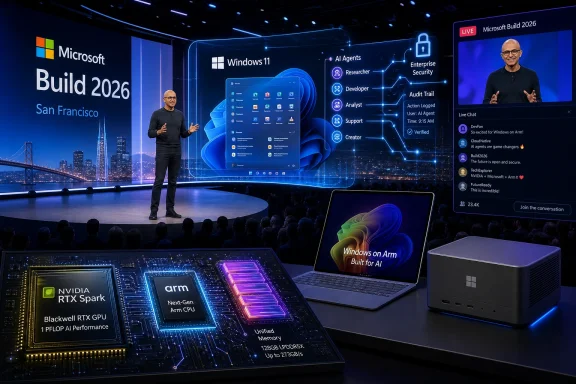
Microsoft used Build 2026 in San Francisco this week to put Windows back at the center of its developer story, pairing Windows 11 with Nvidia’s RTX Spark silicon, new Surface hardware, local AI workloads, and a broader platform push for agent-first computing. That is the factual headline; the strategic one is sharper. Microsoft is trying to make the PC feel necessary again by arguing that the next phase of AI will not live entirely in rented cloud compute. It is a familiar Windows maneuver with a modern twist: turn a platform anxiety into an ecosystem opportunity.
For years, Windows has looked less like Microsoft’s future than its inheritance. Azure carried the growth story, Office became Microsoft 365, GitHub gave the company developer credibility, and Copilot became the brand plastered across everything from Edge to Excel. Windows remained enormous, profitable, and unavoidable, but rarely glamorous. Build 2026 changed the staging: Satya Nadella opened with Windows, and Microsoft’s message was that the operating system still matters because the
edge matters.
 Microsoft Recasts the PC as an AI Workhorse, Not a Copilot Accessory
The first wave of Copilot+ PCs was supposed to make local AI feel tangible. In practice, it often felt like a category waiting for software. The hardware arrived with neural processing units, the branding arrived with confidence, and the demos arrived with the usual smoothness, but the daily reason to care remained uneven for many Windows users.
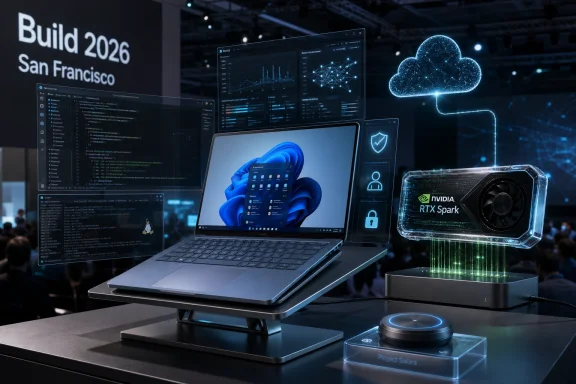
RTX Spark gives Microsoft a cleaner pitch. Instead of asking users to value a thin layer of AI features sprinkled across the shell, Microsoft and Nvidia are describing a machine that can run serious models locally, support developer workflows, and hand work to the cloud only when needed. That is a more compelling argument because it attaches AI to compute capacity rather than to a button on the keyboard.
The numbers are part of the theater, but they also matter. Microsoft says Surface Laptop Ultra combines an Nvidia Blackwell RTX GPU, up to 128GB of unified memory, full CUDA support, one petaflop of AI compute, and the ability to run up to 120-billion-parameter models locally. Whether those claims translate into quiet, reliable, battery-sensible machines under real workloads is the question reviewers will eventually answer. But as a developer story, it is far stronger than “here is another laptop with a chatbot shortcut.”
There is also a financial subtext Microsoft is happy to surface. Cloud AI is powerful, but it is metered, capacity-constrained, and expensive at scale. A local AI workstation reframes the PC as owned infrastructure: not a replacement for Azure, but a pressure valve for workloads that do not need to pay rent every time they run.
Nadella’s Old Mission Statement Gets an AI Rewrite
Microsoft’s original PC-era ambition was famously about putting a computer on every desk and in every home. Nadella’s Build framing updated that into a world of “unmetered intelligence” on every desk and in every home. The phrase is corporate poetry, but the business logic underneath is plain.
If AI remains primarily a cloud service, Microsoft wins through Azure, OpenAI partnerships, Microsoft 365, and enterprise subscriptions. If AI becomes hybrid, Microsoft can also win through Windows. That second route is what Build 2026 tried to revive: the idea that Windows is not merely where users consume AI features, but where developers build, test, run, contain, and manage AI agents.
That is why Nvidia’s return to Windows on Arm matters beyond the Surface spec sheet. Windows on Arm has repeatedly promised more than it delivered, in part because software compatibility, performance perception, and hardware availability never lined up neatly enough. Nvidia brings a developer constituency Microsoft badly wants: CUDA users, AI builders, creators, simulation workloads, and workstation buyers who think in GPUs before they think in operating systems.
The Surface RTX Spark Dev Box makes the intent even more explicit. This is not Microsoft pretending every office worker needs local frontier-model inference on their desk. It is Microsoft courting the people who build the tools, test the workflows, and influence platform gravity. If those users decide Windows is the best place to run local AI agents, the rest of the ecosystem has a reason to follow.
Windows 11 Is Being Repaired While Microsoft Talks About the Future
The uncomfortable part of Microsoft’s Windows revival is that Windows 11 still needs repair work. Users have spent years complaining about performance regressions, shell friction, hardware requirements, Start menu changes, taskbar limitations, unwanted promotion inside the operating system, and the general feeling that Windows 11 sometimes cares more about Microsoft’s services than the user’s flow.
Microsoft appears to know this. Windows chief Pavan Davuluri has recently emphasized performance, reliability, and overall experience as priorities, and Build reportedly included side-by-side demonstrations of faster Start menu and taskbar behavior. That is not glamorous, but it is the kind of work Windows needs if Microsoft wants developers to believe the platform is being treated as a product again rather than a billboard.
This is where the Build message becomes both promising and risky. Microsoft wants to talk about AI agents, local models, and hybrid compute, but many Windows users still want the operating system to feel calmer, faster, and less cluttered. A developer laptop with 128GB of unified memory does not excuse a sluggish context menu on a mainstream machine.
The company’s strongest argument is that these are not separate projects. A Windows platform good enough for local agents needs better containment, stronger identity controls, predictable performance, and less background chaos. If Microsoft follows that logic seriously, AI could become a forcing function for a better Windows. If it does not, AI will become another layer of noise on top of old grievances.
The Windows 12 Escape Hatch Looks Less Useful Than It Once Did
It is tempting to ask why Microsoft does not simply call the next push Windows 12. The company has used version resets before to draw a line under unpopular releases. Windows 7 cleaned up Vista’s reputation. Windows 10 washed away much of the Windows 8 era’s confusion. A Windows 12 launch could, in theory, let Microsoft present a tidier AI-native operating system without carrying Windows 11’s baggage.
But the market has changed. Windows is no longer sold primarily as a shrink-wrapped upgrade with a clean psychological break. It is a serviced platform, a compatibility promise, an enterprise estate, and a channel for cloud-connected features. For corporate IT, a new version number is not just a marketing opportunity; it is a testing burden.
That makes Davuluri’s reluctance to center the label understandable. Microsoft may eventually ship a Windows 12, but the more important question is whether the operating system’s behavior actually improves. Calling the next thing Windows 12 would not magically fix app compatibility, performance consistency, privacy concerns, update trust, or the uneasy balance between user control and Microsoft promotion.
There is also a strategic reason to avoid making the number the story. Microsoft wants developers to think of Windows as a continuously improving AI platform, not as a once-every-few-years migration event. For AI agents, identity boundaries, local inference stacks, and hybrid execution models, the platform layer matters more than the retail name on the box.
Nvidia Gives Windows a Workstation Story Apple Cannot Easily Copy
Apple’s Mac comeback has been built on a brutally effective message: integrated silicon, long battery life, quiet performance, and developer-friendly Unix foundations in elegant hardware. Microsoft has struggled to answer that at the high end. Intel and AMD Windows laptops can be powerful, but the experience varies wildly by OEM, thermals, drivers, firmware, and preload decisions.
Surface Laptop Ultra is Microsoft trying to make a more coherent Windows flagship for people who previously looked at MacBook Pro and saw fewer compromises. The inclusion of HDMI, USB-C, USB-A, SD card support, and a headphone jack is not a small detail. It is Microsoft acknowledging that creators and technical users do not want a purity test; they want the ports that keep them from living in dongle hell.
Nvidia’s role changes the comparison. Apple owns the vertical stack, but Nvidia owns much of the AI developer mindshare. CUDA remains a gravitational force, and Windows machines with strong CUDA support can speak directly to workflows that macOS cannot replicate in the same way. For developers building or testing AI pipelines, that may matter more than the elegance of the chassis.
Still, Microsoft has to prove the machine is more than a keynote object. Windows on Arm has to run the apps people need. Emulation has to be good enough when native support is absent. Drivers, games, creative tools, security software, and enterprise agents all have to behave. The Surface Laptop Ultra can be a symbol, but the ecosystem has to be the product.
The Developer Pitch Finally Sounds Like Windows Again
One of the quieter Build signals was Microsoft’s continued effort to make Windows more comfortable for developers who live across operating systems. WSL has already changed the psychology of Windows development by giving Linux workflows a home inside Microsoft’s desktop OS. Additions such as Coreutils and WSL containers may not produce keynote fireworks, but they matter to the people Microsoft wants to win over.
This is a long overdue admission that developers do not want platform patriotism. They want tools that work. They want shells, containers, package managers, GPU access, editors, debuggers, and reproducible environments. If Windows can host those workflows while also offering the best local AI hardware, Microsoft has a serious argument.
The irony is that Microsoft’s developer credibility has often improved when Windows stopped insisting on being the only universe. WSL worked because it respected Linux. Visual Studio Code worked because it was cross-platform. GitHub worked because Microsoft did not immediately smother it with Windows-first assumptions. Project Solara may follow the same pattern in hardware: Microsoft is more willing to win the platform layer even when Windows is not the only OS in the device.
That pragmatism is healthier than nostalgia. The Windows of the 1990s won by being the default place software happened. The Windows of the AI era will have to win by being a practical place for local and hybrid computation, not by assuming developers owe it loyalty.
Project Solara Shows Microsoft No Longer Believes Windows Must Be Everywhere
The most revealing announcement around Build may not be Surface Laptop Ultra at all. Project Solara is Microsoft’s platform for agent-first devices, including concepts such as smart badges and ambient desk hardware. The twist is that Solara’s device layer is based on an Android-derived foundation rather than Windows.
A more insecure Microsoft might have treated that as heresy. A modern Microsoft treats it as architecture. If the device is a badge, a small display, a workplace sensor, or an ambient assistant, Windows may be too heavy, too legacy-shaped, or simply the wrong tool. Microsoft would rather provide the agent platform, identity, management, cloud integration, and developer model than force every new form factor to boot Windows.
That does not weaken the Windows story as much as it clarifies it. Windows is being positioned as the heavyweight local compute environment: the desk, the laptop, the workstation, the development box, the managed enterprise endpoint. Solara is the lighter agent fabric for devices that do not need the full PC inheritance.
The risk is fragmentation. If Microsoft’s AI agent future spans Windows 11, Windows 365, Android-derived Solara devices, Azure services, Microsoft 365 agents, GitHub tooling, and partner hardware, the company must make the experience coherent. Microsoft has often been better at assembling platforms than simplifying them. Agent-first computing will punish that weakness if users cannot understand what is running where, what has access to what, and who is responsible when an agent acts badly.
Local AI Makes Security a First-Class Windows Problem Again
Running AI locally sounds comforting because it suggests privacy, ownership, and lower marginal cost. But local agents also create new security and management problems. An agent that can read files, summarize meetings, manipulate apps, and act across workflows is not just another background process. It is a privileged actor with fuzzy boundaries.
Microsoft is already talking about OS-enforced identity, containment, visibility, and manageability for agents on Windows. That language matters. The history of Windows is full of moments when capability arrived before control, and administrators were left to clean up the mess. If agents become common, IT departments will need policy frameworks that are more precise than “allow Copilot” or “block Copilot.”
The enterprise questions are immediate. Which local models are approved? What data can they index? Can an agent see regulated documents? Can it invoke scripts? Can it interact with line-of-business apps? Are its actions logged in a way that auditors can understand? What happens when a cloud handoff moves sensitive context outside the machine?
This is where Microsoft’s Windows advantage could be real. Windows is already deeply entangled with Entra identity, Intune management, Defender, Purview, Windows 365, and enterprise compliance tooling. If Microsoft can make AI agents manageable through familiar policy surfaces, it can turn a security headache into a platform moat.
The Cloud Is Still the Business, Even When the Demo Is Local
Microsoft and Nvidia’s local AI pitch should not be mistaken for an anti-cloud turn. Microsoft is not trying to reduce Azure’s importance. It is trying to make Azure part of a hybrid loop in which local devices do as much as they can and cloud models handle what they must.
That is a sensible technical model. Many workloads do not require the biggest model available. Some need low latency, privacy, offline operation, or predictable cost more than maximum reasoning power. Others need cloud-scale inference, retrieval, coordination, or access to data that does not live on one machine. A smart platform routes between those modes without making users think about it constantly.
The business tension is that “free when local” is only partly true. The user still pays for expensive hardware, power, support, lifecycle management, and developer time. Local compute shifts cost; it does not abolish it. For consumers, that may be a hard sell unless local AI produces obvious everyday value. For developers and enterprises, the math may be more attractive, especially when usage-based API bills become difficult to forecast.
Microsoft’s challenge is to avoid overselling local AI as liberation from the cloud. The better argument is control. Local compute gives users and organizations another place to run work, another lever for cost, another boundary for data, and another way to keep latency down. In a world of AI abundance, placement becomes strategy.
Windows Cannot Afford Another Feature That Users Learn to Disable
There is a consumer trust issue running underneath all of this. Windows users have become conditioned to treat some Microsoft features as things to remove, ignore, or work around. Widgets, search promotions, Edge prompts, account nudges, default app friction, and various Copilot placements have taught many power users to approach new Windows experiences defensively.
That is dangerous for Microsoft’s agent ambitions. An AI agent needs permission, context, and trust. If users suspect the agent exists mainly to steer them toward Microsoft services, they will disable it. If administrators suspect it creates compliance exposure, they will block it. If developers suspect it is another layer of abstraction that breaks under serious work, they will route around it.
The antidote is restraint. Microsoft has to make Windows AI features legible, controllable, and removable where appropriate. It has to let local agents prove value before demanding attention. It has to treat privacy controls as product features rather than legal disclosures.
This is why the performance-and-reliability work matters so much. A faster Start menu will not headline the AI revolution, but it signals whether Microsoft still respects the basics. Users are more willing to trust ambitious new capabilities when the ordinary parts of the system feel cared for.
The RTX Spark Bet Turns Windows Into a Hardware Coalition
One reason Microsoft’s announcement carries weight is that it is not limited to Surface. Microsoft says RTX Spark systems are coming from partners including ASUS, Dell, HP, Lenovo, and MSI, alongside Surface machines. That is the classic Windows playbook: establish a reference story, then let OEM variety do the scaling.
The challenge is that OEM variety is both Windows’ strength and its curse. Apple ships a narrow set of machines and controls the entire experience. Windows vendors ship a sprawling market of devices with different thermals, screens, firmware, drivers, support quality, and preinstalled software. The best Windows laptops are excellent; the median experience is less predictable.
For RTX Spark to mean something, Microsoft and Nvidia need tighter standards than the usual badge program. AI developers will not tolerate flaky GPU support, inconsistent power behavior, or half-optimized toolchains. Creators will not be impressed by theoretical TOPS if the fans scream, the battery collapses, or their plug-ins misbehave.
The upside is enormous if Microsoft gets it right. Windows could become the broadest local AI hardware platform, spanning thin laptops, creator notebooks, mini PCs, dev boxes, and workstation-class systems. That would give developers a continuum Apple cannot match and Linux vendors cannot easily coordinate at consumer scale.
The Forum Reader’s Short Version Belongs in the Hardware Lab, Not the Hype Reel
The practical meaning of Build 2026 is not that every Windows user should wait for Surface Laptop Ultra or believe every AI agent demo. It is that Microsoft has finally found a Windows story that connects hardware, developer tooling, cloud economics, and operating system architecture in a way that feels strategically coherent.
- Microsoft is positioning Windows as a hybrid AI platform where local RTX Spark hardware handles serious workloads and Azure remains available for larger jobs.
- Surface Laptop Ultra and Surface RTX Spark Dev Box are aimed first at developers, creators, and AI builders, not ordinary office users shopping for a basic PC.
- Windows 11 still has to earn back goodwill through performance, reliability, and a less intrusive user experience.
- Project Solara shows Microsoft is willing to build agent-first devices on non-Windows foundations when the form factor calls for it.
- The success of RTX Spark on Windows will depend less on keynote specifications than on native app support, CUDA workflows, thermals, battery life, drivers, and enterprise manageability.
- Local AI may reduce some cloud dependence, but it also raises new security, governance, and lifecycle questions for IT departments.
Microsoft’s Real Test Is Whether Windows Becomes Quieter as It Gets Smarter
The most optimistic reading of Build 2026 is that Microsoft has rediscovered Windows as a product with a future, not just an installed base with a monetization plan. The company is talking about performance again. It is courting developers with real compute rather than slogans. It is acknowledging that AI will run across local devices, cloud infrastructure, and dedicated agent hardware rather than inside one magical interface.
The skeptical reading is equally fair. Microsoft has often used Windows as a delivery vehicle for corporate priorities users did not ask for. AI agents could become another wave of prompts, subscriptions, background services, and policy exceptions. Expensive RTX Spark machines could impress developers while doing little for the mainstream Windows experience. Solara could become yet another Microsoft platform experiment that sounds cleaner in a keynote than it feels in deployment.
The difference this time is that Microsoft’s AI ambitions require Windows to be better at being Windows. Agents need trust. Local models need performance. Hybrid compute needs policy. Developers need reliable tooling. Enterprises need auditability. Users need control. If Microsoft follows those requirements honestly, Windows could become central to the AI era not because it was forced back onto the menu, but because it once again becomes the place where serious personal computing happens.

 Microsoft Moves Build to the Center of the PC Fight
