
The important change is not that Microsoft is promoting account features. It has long done that. The change reported here is that the guest chat itself may no longer be available through several of Copilot’s most visible entry points. A July Microsoft Community Hub thread and a more recent Edge user report on Reddit describe the same outcome: Copilot opens a sign-in prompt instead of an anonymous conversation, including in private browsing.
Microsoft has not published a consumer-facing announcement saying it has ended guest access, nor has it supplied a rollout schedule, affected-version list, regional scope, or a statement on whether the behavior is intentional. That leaves the current evidence pointing to a staged service-side change rather than a documented product-policy change.
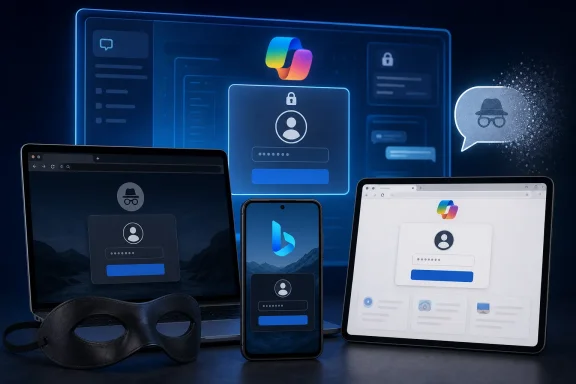 Edge InPrivate no longer separates the Copilot session
Windows Report’s most consequential observation is the sign-in requirement in Edge’s InPrivate mode. InPrivate prevents Edge from retaining local browsing data after the private session closes; it does not make online activity anonymous. Still, the mode gave users a practical way to run a one-off Copilot query without tying the session to their Microsoft account or preserving chat history.
That use case is what appears to be closing. According to Windows Report, an unsigned Edge profile still displays the Copilot button, but selecting it opens a “Let’s get you signed in” page. The page advertises file uploads, unrestricted Voice use, and memory across conversations, then offers Microsoft account sign-in.
A Microsoft Community Hub post from July independently described the same prompt when Copilot was opened in an Edge for Android InPrivate tab. Community posts are not official confirmation and cannot establish the full scope of a rollout, but they do undermine the idea that Windows Report encountered a one-device failure or an isolated browser-profile problem.
For anyone using InPrivate specifically to avoid creating an account-associated AI transcript, the distinction is immediate. An account sign-in changes the relationship from a temporary browser session to one that Microsoft can associate with that account, subject to the user’s account and Copilot settings. Closing the InPrivate window may erase local cookies and history, but it does not erase content that has been submitted while authenticated.
Microsoft’s own support page still says guest use is allowed
Microsoft’s published documentation has not caught up with the reported behavior. A Microsoft Support page updated in February 2026 says that sign-in is not required for Microsoft Copilot and describes an unsigned free experience capable of chat, web-based answers, and Copilot features in Edge. The same page says sign-in adds chat history, image creation, longer conversations, voice interactions, and other account-based features.
That is directly at odds with an unsigned user being unable to reach chat at all. Microsoft’s separate “Getting started with Microsoft Copilot” support documentation likewise frames signing in as a way to receive more history, image creation, longer chats, and greater Voice use—not as a prerequisite for every chat.
The contradiction does not prove that Microsoft has made a final policy decision. Consumer AI services regularly use server-side experiments, so the experience can change without an Edge, Bing, or Android app update. It does establish something more useful for users and administrators: Microsoft’s support guidance can no longer be relied upon as a description of the Copilot screen every unsigned user will receive on August 18, 2026.
The prompt language also reveals the likely product rationale. Memory, extended voice sessions, uploads, and persistent chat history all require a stable identity or a durable identifier. Microsoft can provide limited guest sessions technically, as it did before, but identity makes usage limits, personalisation, safety enforcement, retention, and cross-device continuity simpler to operate. Those are operational incentives, not a public explanation; Microsoft has not said why guest access appears to be restricted.
Bing, Edge, and Copilot are converging on the same account gate
The scope reported by Windows Report matters because it reaches beyond the standalone Copilot site. Edge desktop, Edge Android, the Bing Android app, and copilot.com are separate front ends, but they increasingly act as routes into the same consumer Copilot service.
On Android, Windows Report found the Bing and Edge apps using “Sign in for the full experience” language, emphasizing Copilot Voice and photo sharing. On the web, it found a “Sign in to chat” screen that offered Microsoft, Apple, and Google as identity providers. The page reportedly displayed a “Maybe later” option, but choosing it simply brought back the sign-in screen instead of opening Copilot.
The Apple and Google buttons are worth noting. The reported change is not strictly a requirement to create or use a Microsoft Account in every consumer entry point. It is a requirement to authenticate with an supported identity provider. In Edge’s own sidebar, Windows Report saw a Microsoft-account sign-in route; on the Copilot web app, the available choices were broader.
That difference may reflect separate authentication flows rather than a coherent promise about which accounts work everywhere. It is another area where Microsoft has not published clear answers: whether a Google- or Apple-authenticated Copilot identity can use all features in Edge, how those identities relate to Microsoft 365 subscriptions, and whether this is a temporary web-only alternative or the planned consumer model.
Enterprise Copilot was already a signed-in service
IT administrators should avoid reading this as a change to Microsoft 365 Copilot Chat’s authentication model. Microsoft’s enterprise documentation already expects a user to be signed in to Edge with a Microsoft Entra work or school account before using Copilot Chat through the Edge sidebar. Enterprise data protection, work-grounded chat, tenant controls, and auditing depend on that identity context.
For managed Windows estates, the consumer change is more likely to create a support issue than a configuration change. An employee opening the consumer Copilot button in an unsigned Edge profile may now meet a sign-in screen and assume a personal Microsoft account is required for work. Conversely, users who relied on guest Copilot to avoid crossing personal and work account contexts will have fewer obvious options if the gate becomes permanent.
Admins should make the intended path explicit:
- Users who need organization-protected Copilot Chat should use their Entra work or school account and the Microsoft 365 Copilot experience approved by the tenant.
- Organizations that do not want employees authenticating personal accounts in Edge should verify their existing Edge sign-in, profile, and Copilot policies rather than treating the new prompt as an enterprise licensing error.
- Help-desk documentation should stop promising that InPrivate or an unsigned Edge profile provides a usable guest Copilot session until Microsoft clarifies the rollout.
This does not change the fact that a browser’s private mode and an enterprise data-protection boundary are different things. InPrivate is a local browsing feature. It is not a substitute for tenant controls, and an authenticated consumer Copilot session is not automatically protected by an organization’s Microsoft 365 Copilot safeguards.
The unanswered question is whether “full experience” means any experience
Microsoft’s wording leaves room for a narrower interpretation: perhaps guest chat remains available only in some locations, regions, browser builds, or service cohorts, while signed-in features are being foregrounded elsewhere. But Windows Report’s testing says the “Maybe later” control did not lead to a reduced guest service, and the reports from Edge users describe a complete block rather than a feature cap.
Microsoft needs to resolve the ambiguity publicly. A meaningful notice would state whether guest chat is being retired, which Copilot endpoints and countries are included, whether Edge InPrivate is deliberately affected, and whether guest conversations have a transition period. It should also update the February support page that still says a sign-in is unnecessary.
Until then, unsigned users should assume that Copilot availability is no longer predictable across Edge, Bing, Android, and the web. The practical consequence is simple: a private browser window may still be private on the device, but it is no longer a dependable way to use Copilot without an identity.
