
The initiative was detailed by DepEd and Microsoft in an August 26 partnership announcement, then reported by InsiderPH. It builds on a teacher-training drive around Microsoft Copilot Chat and pairs the generative-AI push with Microsoft Reading Progress and Reading Coach, tools being used in DepEd’s Academic Recovery and Accessible Learning, or ARAL, program.
For Windows and Microsoft 365 administrators, the most important word in the announcement is not “AI.” It is Copilot — because Microsoft now uses that name for products with substantially different data access, administration, capability, and licensing requirements.
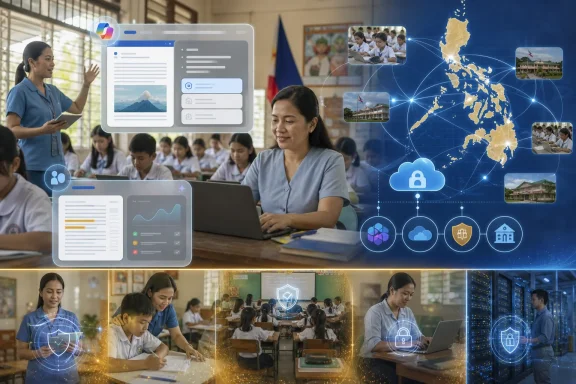 “Copilot” does not identify the capability being deployed
DepEd says one million teachers will gain access to Microsoft Copilot, while its earlier training program specifically focused on Microsoft Copilot Chat. Those are related services, but they are not interchangeable.
Microsoft’s current product documentation divides the service into web-based Copilot Chat and work-based chat. Web-based Copilot Chat can be available at no extra cost to users with eligible Microsoft 365 education subscriptions and signed-in Microsoft Entra accounts. It is grounded in public-web results, with teachers able to explicitly paste, upload, or select files for a conversation.
Work-based Copilot, by contrast, can reason over organizational content a user is authorized to access through Microsoft 365. Microsoft says that mode requires a Microsoft Copilot license. It is the difference between asking an AI assistant to help draft a lesson plan from a prompt and having an assistant retrieve or summarize material held in a teacher’s school account.
That distinction has direct budget and governance consequences. The public announcement does not say whether the one million teachers will receive the included Copilot Chat experience, paid work-based Copilot licenses, a mix of both, or access only through a web portal. It also does not disclose which Microsoft 365 education license tiers DepEd holds across its nationwide tenant environment.
The omission matters because “one million teachers have Copilot” could describe a widely available, web-grounded chat service — useful, but limited — or a licensed Microsoft 365 deployment with deeper integration into Word, PowerPoint, Teams, Outlook, OneDrive, and organizational content. Those are very different projects to provision, secure, support, and measure.
Microsoft’s documentation does establish one baseline protection for Copilot Chat accessed with a work or school account: prompts and responses receive enterprise data protection and are not used to train the underlying foundation models. But that does not remove the administrative work. Microsoft also says prompts and responses are logged, retained, and available to compliance and audit tooling, subject to the subscription plan and tenant configuration.
DepEd’s statement emphasizes responsible use and teacher judgment. It does not yet state who will set tenant-wide policies for web search, file uploads, retention, personal-account sign-in, or the use of external Copilot agents. Those settings are where a national AI policy becomes a workable school IT policy.
Training demand is real; completion and classroom use remain unmeasured
The strongest confirmed signal in the announcement is teacher interest. DepEd and Microsoft say nearly 75,000 educators attended the flagship Copilot Chat training live and more than 175,000 registered. DepEd’s National Educators’ Academy of the Philippines extended the program with asynchronous material for registered participants.
Those figures show demand for training, but they do not yet show that 175,000 teachers completed it, retained the material, or deployed AI safely in classes. Registration, attendance, completion, and sustained use are distinct measures — particularly in a system serving schools with uneven connectivity, device availability, and local IT capacity.
DepEd has already been preparing teachers for this use case through regional and division-level training. A May 2026 memorandum circulated by the DepEd Schools Division Office of Dasmariñas instructed participants to use Copilot Chat for lesson planning, assessment preparation, administration, and teaching support while observing ethical, responsible, and privacy-conscious practices. That makes the August announcement an expansion of an existing program rather than a sudden first introduction of AI into public schools.
The practical test will be whether training includes the less glamorous work administrators know is essential: identifying hallucinated content, checking citations and curriculum alignment, avoiding input of personally identifiable student information, setting acceptable-use rules for assessments, and documenting when AI-generated material has been substantially edited by a teacher.
AI can shorten the first-draft stage for classroom materials. It cannot establish whether an output matches a local curriculum, has age-appropriate examples, avoids factual errors, or accommodates a learner’s specific circumstances. DepEd’s own language that the technology should support — rather than replace — professional judgment is the correct framing, but that safeguard has to be reflected in teacher guidance and assessment policy, not simply in an event presentation.
Reading Progress has a clearer classroom case, but not a causal result
The second part of the partnership is more concrete: Microsoft Reading Progress and Reading Coach are being used to help teachers conduct and review oral-reading practice. The tools flag word-recognition errors, omissions, mispronunciations, and reading pace, giving educators more frequent signals between formal Philippine Informal Reading Inventory, or Phil-IRI, assessments.
For a teacher managing a large class, that is a specific workflow improvement. Rather than manually reviewing every reading attempt at the same cadence as a formal assessment, the teacher receives an automated first pass and can focus attention on pupils who may need intervention. The tools can complement Phil-IRI; they do not replace it, because the formal reading inventory includes structured word-recognition and comprehension criteria.
DepEd and Microsoft report that a 21-week ARAL pilot reached 3,431 students in eight regions, analyzed 8,381 reading submissions, and found progress among 780 reassessed students. Of those pupils, 319 moved between Phil-IRI bands and 461 improved within their existing band.
Those are encouraging pilot indicators, but the announcement does not provide the number of reassessed students overall, a comparison group, the starting distribution of reading levels, or a breakdown by region, language, grade, device access, and intervention time. Without those figures, the program has demonstrated activity and observed progress, not that Microsoft’s tools alone caused the gains.
There is also a small reporting discrepancy worth resolving before the results are treated as a fixed national benchmark. InsiderPH and the August 26 partnership release say more than 2,100 teachers were trained in the 21-week reading initiative. A Microsoft Philippines article published August 10 reported 2,002 teachers trained for the same campaign, alongside the identical student count, regional scope, submission count, and 91.5 percent teacher-satisfaction figure. The difference may reflect a later update, but neither account explains it.
That is not a reason to dismiss the pilot. It is a reason for DepEd to publish a consistent evaluation record before scaling its reported outcome figures into a national technology case study.
The rollout will depend on basic Microsoft 365 administration
The scale announced by DepEd — one million teachers — shifts the challenge from enthusiasm to operations. Copilot Chat eligibility depends on eligible Microsoft 365 licenses and on each user having a Microsoft Entra identity. Access also requires functioning accounts, network connectivity, and a support path when a teacher cannot sign in or is routed into a consumer Microsoft account instead of the protected work-and-school environment.
Microsoft advises organizations to direct staff toward Copilot Chat through the Microsoft 365 Copilot app or web experience while signed in with their Entra account. For public schools, that instruction needs to be paired with practical controls: multifactor authentication where feasible, clear identity recovery procedures, restrictions on personal-account use in managed apps, and guidance on sharing files or student work with AI services.
DepEd’s public materials show that Microsoft 365 is already embedded in the department’s technology planning. A 2026 procurement document said one office canceled a planned ChatGPT Pro subscription because it intended to use Microsoft Copilot integrated into the department’s existing Microsoft 365 environment, citing workflow integration and data security. That is an understandable consolidation decision, but integration does not automatically equal safe deployment. Permissions, audit retention, sensitive-data labeling, and device management must be configured and monitored at the tenant level.
The upcoming rollout is therefore more than an education partnership announcement. It is a nationwide identity, training, support, privacy, and change-management project conducted through Microsoft’s cloud stack.
What DepEd still needs to publish
The core promise — more time for teachers and more frequent support for students — is plausible. The next public disclosure should make that promise auditable rather than aspirational.
DepEd and Microsoft should clarify the following before schools are expected to treat the announcement as a completed deployment:
- The agencies should name the exact Copilot offerings available to teachers and state whether work-based Microsoft 365 Copilot licenses are included.
- They should publish the rollout timetable, covered teacher categories, regional sequence, licensing duration, and the source of recurring subscription and support funding.
- They should issue a national policy on student data, uploaded files, web search, retention, prompt logging, personal Microsoft accounts, and AI-assisted assessment materials.
- They should report training completion and active-use measures separately from registrations and event attendance.
- They should release a fuller ARAL evaluation, including the reassessment denominator and a reconciled teacher-training count.
Until then, the most defensible reading is that DepEd has committed to broad AI access and already has evidence of strong teacher demand, while the actual level of Copilot capability and governance remains unspecified. For one million educators, those implementation details will determine whether the program reduces routine workload or adds another platform that teachers must learn to manage.
