
That is a pointed message for Windows-centric IT teams, where the rush to enable Microsoft Copilot, Azure AI services, Power Platform automation, and third-party assistants can make deployment look like the finish line. It is not. The software may be available in Microsoft 365 or Windows, but turning it into measurable output requires decisions about data access, governance, workflow ownership, support, and employee adoption.
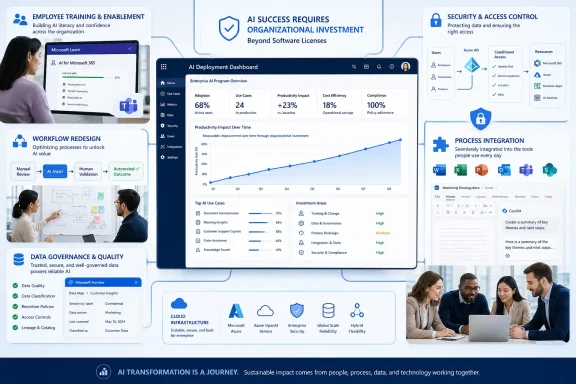 The Software License Is the Cheap Part
CFR’s central warning is that AI-enabled productivity will not arrive cheaply or immediately. Companies must spend on the technology itself, but also on organizational changes and workforce preparation; some workers will resist new tools, while others will use them only superficially.
For enterprise IT, that makes the familiar per-user AI license calculation incomplete. A Copilot rollout may also require information classification, SharePoint and OneDrive permission cleanup, endpoint management, identity controls, prompt training, help-desk preparation, and policies governing sensitive data. The technology can reveal years of accumulated access-control debt before it creates a single productivity gain.
The implication is especially important for small and midsize firms. CFR notes that resource constraints may prevent many organizations from making substantial AI investments at all. A large enterprise can absorb pilot failures, buy consulting help, and assign dedicated change-management teams; a smaller company may be forced to wait, use narrow tools, or accept modest gains from incremental deployments.
Adoption Will Separate the Winners From the Buyers
The Council on Foreign Relations also argues that firms may delay investment because the technology is changing so quickly. That hesitation is rational: committing to a tool, model provider, or workflow before standards settle can create lock-in and retraining costs.
But delay has its own cost. Organizations that do nothing may miss the opportunity to build the internal skills needed to evaluate AI output, automate repetitive work safely, and redesign processes around human review. The distinction is not between “using AI” and “not using AI”; it is between building institutional capability and merely switching on features.
For Windows administrators, the practical response is likely to be a narrower, more disciplined rollout rather than a blanket mandate. Start with workflows where quality can be checked, the data boundary is clear, and employees can explain whether the tool saved time or simply moved work elsewhere. Drafting internal summaries, searching approved knowledge bases, generating first-pass scripts, and handling routine service-desk material are more measurable than vague promises of “AI transformation.”
Productivity Will Be a Change-Management Metric
CFR’s analysis pushes back on the assumption that increasingly capable models will automatically translate into rapid economy-wide gains. Even when the models improve, businesses still need to change how work is assigned, reviewed, and measured.
That leaves a concrete test for IT leaders rolling out AI across Windows estates: can the organization identify a process that became faster, cheaper, more accurate, or easier to support after accounting for training, security controls, and rework? If the answer remains unclear, the issue may not be the model. It may be that the organization has bought AI before it has built the operating model needed to benefit from it.
