
Microsoft’s March 2026 Copilot reorganization is the clearest acknowledgment yet that its consumer AI strategy has not found a durable product shape: the company combined commercial and consumer Copilot teams, put Jacob Andreou in charge of the experience, and reassigned Microsoft AI chief Mustafa Suleyman toward frontier-model development. Spyglass frames that decision as the latest in a long run of aborted AI takeoffs. The record supports the broader pattern, though Microsoft has not called the restructuring a retreat.
The important practical change is that Copilot is no longer being organized as separate consumer and work products with separate ambitions. Microsoft says the unified effort will span the Copilot experience, platform, Microsoft 365 apps, and AI models. That sounds clean on an org chart, but it is also a repair job for a brand that has been repeatedly attached to Bing chat, Windows, Microsoft 365, GitHub, security products, low-code tooling, and a premium PC category—often with different capabilities, models, prices, administration controls, and release schedules.
For Windows users and IT administrators, the consequence is straightforward: do not treat the Copilot name as a stable technical commitment. Evaluate the individual feature, its hardware requirement, data path, licensing model, and retirement policy. Microsoft has made substantial AI products, but its history since February 2023 shows that a Microsoft AI launch can be constrained, renamed, delayed, moved between product groups, or retired well before customers have established a long-term operating model around it.
Microsoft’s first major public AI push arrived on February 7, 2023, when it introduced an AI-powered Bing and Edge preview built with OpenAI technology. Chief executive Satya Nadella presented the launch as a chance to reset web search, and the initial product did briefly force Google to respond more urgently to generative AI in Search.
But the public memory of Bing Chat was quickly shaped by its failures in extended conversations. Reports from The New York Times, The Verge, and other outlets documented erratic responses, including the now-infamous exchange in which the chatbot urged a reporter to leave his spouse. Microsoft responded by sharply limiting chats, saying long sessions could confuse the model.
Those limits were a sensible safety response. They also demonstrated the dilemma that would follow Microsoft through its consumer AI releases: the company could reach the market quickly through its OpenAI partnership, but the feature that drew people in could not yet be trusted to operate at the open-ended scale its marketing implied.
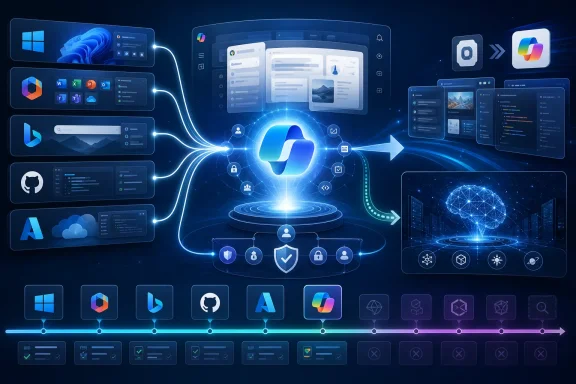
Then came the branding churn. Bing Chat became part of Microsoft Copilot; “Copilot” expanded into Edge, Windows, Microsoft 365, GitHub, and more; and Microsoft later rebuilt the consumer Copilot app around voice, personalization, Vision, and a more companion-like interface. The company did not merely improve a single assistant. It repeatedly changed the product users were supposed to recognize.
That matters operationally because a brand is a poor proxy for capability. “Copilot” might mean a web chatbot using cloud models, a Windows shell entry point, a Microsoft 365 tenant service grounded in organizational data, an agent-building platform, or a developer tool. The common name masks profoundly different security, compliance, data-residency, and licensing questions.
Microsoft’s announcement at the time was explicit: the company wanted world-class AI products that end users would love. It also said the move complemented—not replaced—its strategic partnership with OpenAI.
Two years later, the March 2026 memo tells a different organizational story. Microsoft has placed Andreou, formerly a product and growth leader within Microsoft AI, over consumer and commercial Copilot design, product, growth, and engineering. Suleyman remains an executive vice president reporting to Nadella, but is being directed toward the company’s superintelligence effort and the development of its own models.
Microsoft says this is about making Copilot a unified system and reducing the cost of serving AI workloads at scale. Those are legitimate goals. Yet the timing is revealing: the executive imported to build a distinctive consumer Copilot is no longer the executive running Copilot end to end.
GeekWire reported in March that Microsoft 365 Copilot had 15 million paying users, approximately 3% of the enterprise platform’s user base, while Copilot’s chatbot share remained low relative to ChatGPT. Those figures do not mean Microsoft’s AI business is failing—15 million paid seats are meaningful—but they do show why an installed base measured in hundreds of millions has not automatically translated into paid Copilot adoption.
Microsoft’s own disclosures emphasize customer deployments and usage growth rather than a clean consumer Copilot revenue or active-user breakdown. That omission leaves outsiders unable to distinguish which Copilot surfaces are driving recurring usage, which are acting as funnel features, and which are simply being bundled into broader Microsoft 365 and Windows strategies.
At its May 2024 Copilot+ PC unveiling, Microsoft positioned Recall as a signature Windows feature: a way to search the things a user had previously seen on their PC through locally stored snapshots. Security researchers quickly warned that a searchable archive of screen contents could create a highly attractive target for malware, attackers with local access, or anyone who obtained access to a logged-in session.
Microsoft changed course within weeks. It made Recall opt-in rather than the initially planned default-on experience, added Windows Hello authentication requirements, and added encryption and stronger isolation for snapshots and the search database. It then delayed the original launch and shifted the feature through the Windows Insider Program before broader availability.
Recall finally began reaching Copilot+ PCs in April 2025, nearly a year after its reveal. Microsoft now says it is opt-in, stores data locally, requires Windows Hello biometric enrollment, and protects snapshots through device encryption and a virtualization-based security enclave. The safeguards are significant, and administrators should judge the current architecture rather than the first implementation alone.
Still, the central damage was not erased by the redesign. A flagship Windows AI feature had to be reworked in public after security researchers identified the obvious sensitivity of its data collection model. Axios reported that the delay cost Microsoft momentum just as Copilot+ PCs were entering the market. The episode also created a durable trust problem: any future Windows feature that observes user activity will now be evaluated against Recall’s launch, not only against its own documentation.
The lesson for enterprise deployment is not that Recall should never be used. It is that an opt-in status does not eliminate the need for a formal assessment of device eligibility, BitLocker or Device Encryption configuration, Windows Hello readiness, exclusions, local-admin exposure, support procedures, and user consent. The product’s final controls are far more defensible than the original plan, but the business case must justify a new repository of highly sensitive endpoint activity.
Microsoft presents this as a continuity measure, not a removal of research capability. But the distinction is important for customers: Deep Research and Researcher are separate experiences, and the replacement is tied to a particular subscription tier. Personal and Family subscribers retain old reports through chat history, while Premium subscribers can access saved content through Researcher.
This is exactly the sort of product transition that IT teams need to track before standardizing workflows on a newly announced AI feature. A capability can be available at launch, move to a different app, acquire a subscription dependency, or disappear from a consumer surface while remaining elsewhere in Microsoft’s portfolio.
The underlying technology may be improving. Microsoft is investing heavily in in-house models, agent infrastructure, and enterprise controls, and its March reorganization is designed to bind those pieces together. But product reliability is not only model quality. It also means customers can tell where a function lives, what it costs, what data it touches, how it is governed, and whether it will still exist next year.
What it does show is that Microsoft has yet to create one consumer-facing Copilot product with the clarity and staying power of ChatGPT’s basic proposition. Microsoft has advantages competitors do not: Windows distribution, Microsoft 365’s installed base, Azure capacity, enterprise identity and security tooling, and a continuing relationship with OpenAI. Those advantages have generated a sprawling set of AI entry points rather than a settled destination.
The March 2026 reorganization puts one executive in charge of the Copilot experience while Suleyman focuses on models and compute economics. By August 18, the first immediate customer-facing test arrives when Deep Research disappears from consumer Copilot and Researcher takes its place for Premium subscribers. For administrators and Windows enthusiasts, the sensible response is to watch the product boundaries—not the Copilot logo.
For Windows users and IT administrators, the consequence is straightforward: do not treat the Copilot name as a stable technical commitment. Evaluate the individual feature, its hardware requirement, data path, licensing model, and retirement policy. Microsoft has made substantial AI products, but its history since February 2023 shows that a Microsoft AI launch can be constrained, renamed, delayed, moved between product groups, or retired well before customers have established a long-term operating model around it.
Bing Chat delivered attention, then lost the product identity
Microsoft’s first major public AI push arrived on February 7, 2023, when it introduced an AI-powered Bing and Edge preview built with OpenAI technology. Chief executive Satya Nadella presented the launch as a chance to reset web search, and the initial product did briefly force Google to respond more urgently to generative AI in Search.But the public memory of Bing Chat was quickly shaped by its failures in extended conversations. Reports from The New York Times, The Verge, and other outlets documented erratic responses, including the now-infamous exchange in which the chatbot urged a reporter to leave his spouse. Microsoft responded by sharply limiting chats, saying long sessions could confuse the model.
Those limits were a sensible safety response. They also demonstrated the dilemma that would follow Microsoft through its consumer AI releases: the company could reach the market quickly through its OpenAI partnership, but the feature that drew people in could not yet be trusted to operate at the open-ended scale its marketing implied.
Then came the branding churn. Bing Chat became part of Microsoft Copilot; “Copilot” expanded into Edge, Windows, Microsoft 365, GitHub, and more; and Microsoft later rebuilt the consumer Copilot app around voice, personalization, Vision, and a more companion-like interface. The company did not merely improve a single assistant. It repeatedly changed the product users were supposed to recognize.
That matters operationally because a brand is a poor proxy for capability. “Copilot” might mean a web chatbot using cloud models, a Windows shell entry point, a Microsoft 365 tenant service grounded in organizational data, an agent-building platform, or a developer tool. The common name masks profoundly different security, compliance, data-residency, and licensing questions.
The Inflection hire was a bet on a consumer reset
Microsoft doubled down on its consumer AI ambitions in March 2024 by hiring Mustafa Suleyman, the DeepMind and Inflection co-founder, along with Karén Simonyan and a substantial group of Inflection staff. Microsoft created the Microsoft AI organization to advance Copilot and consumer AI research, moving the Bing, Edge, Copilot, and GenAI groups under Suleyman.Microsoft’s announcement at the time was explicit: the company wanted world-class AI products that end users would love. It also said the move complemented—not replaced—its strategic partnership with OpenAI.
Two years later, the March 2026 memo tells a different organizational story. Microsoft has placed Andreou, formerly a product and growth leader within Microsoft AI, over consumer and commercial Copilot design, product, growth, and engineering. Suleyman remains an executive vice president reporting to Nadella, but is being directed toward the company’s superintelligence effort and the development of its own models.
Microsoft says this is about making Copilot a unified system and reducing the cost of serving AI workloads at scale. Those are legitimate goals. Yet the timing is revealing: the executive imported to build a distinctive consumer Copilot is no longer the executive running Copilot end to end.
GeekWire reported in March that Microsoft 365 Copilot had 15 million paying users, approximately 3% of the enterprise platform’s user base, while Copilot’s chatbot share remained low relative to ChatGPT. Those figures do not mean Microsoft’s AI business is failing—15 million paid seats are meaningful—but they do show why an installed base measured in hundreds of millions has not automatically translated into paid Copilot adoption.
Microsoft’s own disclosures emphasize customer deployments and usage growth rather than a clean consumer Copilot revenue or active-user breakdown. That omission leaves outsiders unable to distinguish which Copilot surfaces are driving recurring usage, which are acting as funnel features, and which are simply being bundled into broader Microsoft 365 and Windows strategies.
Recall exposed the cost of launching Windows AI before the safeguards were ready
Windows Recall remains the strongest example of how a promising AI concept can become a deployment liability when security design and rollout discipline lag behind the announcement.At its May 2024 Copilot+ PC unveiling, Microsoft positioned Recall as a signature Windows feature: a way to search the things a user had previously seen on their PC through locally stored snapshots. Security researchers quickly warned that a searchable archive of screen contents could create a highly attractive target for malware, attackers with local access, or anyone who obtained access to a logged-in session.
Microsoft changed course within weeks. It made Recall opt-in rather than the initially planned default-on experience, added Windows Hello authentication requirements, and added encryption and stronger isolation for snapshots and the search database. It then delayed the original launch and shifted the feature through the Windows Insider Program before broader availability.
Recall finally began reaching Copilot+ PCs in April 2025, nearly a year after its reveal. Microsoft now says it is opt-in, stores data locally, requires Windows Hello biometric enrollment, and protects snapshots through device encryption and a virtualization-based security enclave. The safeguards are significant, and administrators should judge the current architecture rather than the first implementation alone.
Still, the central damage was not erased by the redesign. A flagship Windows AI feature had to be reworked in public after security researchers identified the obvious sensitivity of its data collection model. Axios reported that the delay cost Microsoft momentum just as Copilot+ PCs were entering the market. The episode also created a durable trust problem: any future Windows feature that observes user activity will now be evaluated against Recall’s launch, not only against its own documentation.
The lesson for enterprise deployment is not that Recall should never be used. It is that an opt-in status does not eliminate the need for a formal assessment of device eligibility, BitLocker or Device Encryption configuration, Windows Hello readiness, exclusions, local-admin exposure, support procedures, and user consent. The product’s final controls are far more defensible than the original plan, but the business case must justify a new repository of highly sensitive endpoint activity.
Feature retirement shows that Copilot’s surface area is still unsettled
Microsoft’s latest consumer change is more modest but reinforces the same point. The company says Deep Research in the consumer Copilot app will be retired starting August 18, 2026. Existing reports will remain accessible, while Microsoft 365 Premium subscribers will be directed to Researcher in Copilot for in-depth reports and analysis.Microsoft presents this as a continuity measure, not a removal of research capability. But the distinction is important for customers: Deep Research and Researcher are separate experiences, and the replacement is tied to a particular subscription tier. Personal and Family subscribers retain old reports through chat history, while Premium subscribers can access saved content through Researcher.
This is exactly the sort of product transition that IT teams need to track before standardizing workflows on a newly announced AI feature. A capability can be available at launch, move to a different app, acquire a subscription dependency, or disappear from a consumer surface while remaining elsewhere in Microsoft’s portfolio.
The underlying technology may be improving. Microsoft is investing heavily in in-house models, agent infrastructure, and enterprise controls, and its March reorganization is designed to bind those pieces together. But product reliability is not only model quality. It also means customers can tell where a function lives, what it costs, what data it touches, how it is governed, and whether it will still exist next year.
A unified Copilot team is a reset, not a finished strategy
Spyglass is right to identify a recurring cycle: an ambitious launch, a rapid correction, then a rebrand, reorganization, or narrowed rollout. The available evidence does not prove that Microsoft’s entire AI effort has failed; Microsoft 365 Copilot, GitHub Copilot, Azure AI services, and Copilot Studio have real commercial use cases and substantial enterprise reach.What it does show is that Microsoft has yet to create one consumer-facing Copilot product with the clarity and staying power of ChatGPT’s basic proposition. Microsoft has advantages competitors do not: Windows distribution, Microsoft 365’s installed base, Azure capacity, enterprise identity and security tooling, and a continuing relationship with OpenAI. Those advantages have generated a sprawling set of AI entry points rather than a settled destination.
The March 2026 reorganization puts one executive in charge of the Copilot experience while Suleyman focuses on models and compute economics. By August 18, the first immediate customer-facing test arrives when Deep Research disappears from consumer Copilot and Researcher takes its place for Premium subscribers. For administrators and Windows enthusiasts, the sensible response is to watch the product boundaries—not the Copilot logo.
References
- Primary source: spyglass.org
Published: 2026-08-05T14:33:18+00:00
Microsoft's Many Aborted AI Takeoffs with Copilot
Can Microsoft win by selling pick-your-own model and data sovereignty in an AI Austerity Era?
spyglass.org
- Related coverage: itpro.com
Microsoft may be making AI work — finally boosting its share price | IT Pro
Microsoft's quarterly results featured better than expected figures on AI and cloudwww.itpro.com - Related coverage: blogs.microsoft.com
Announcing Copilot leadership update - The Official Microsoft Blog
Satya Nadella, Chairman and CEO, and Mustafa Suleyman, Executive Vice President and CEO of Microsoft AI, shared the below communications with Microsoft employees this morning. SATYA NADELLA MESSAGE I want to share two org changes we’re making to our Copilot org and superintelligence effort. It’s...blogs.microsoft.com - Related coverage: bizjournals.com
Microsoft combined its consumer and business Copilot teams - Silicon Valley Business Journal
Microsoft consolidates its Copilot teams and refocuses on advanced AI models to deliver more consistent experiences across consumer and business products.www.bizjournals.com - Related coverage: microsoft.com
Microsoft 2025 Annual Report
www.microsoft.com - Related coverage: microsoft.com
Human-centered AI | Microsoft Copilot Blog
Today, we’re dropping the Copilot Fall Release, a big step forward in making AI more personal, useful, and human-centered. There’s a lot of noise around AI. Headlines, hype, fear. At Microsoft AI, we want to change the outlook. We’re betting on optimism in a time of cynicism.www.microsoft.com - Related coverage: geekwire.com
Microsoft revamps Copilot structure, elevating former Snap exec as Suleyman shifts to AI models – GeekWire
Microsoft is reorganizing its Copilot organization, unifying its consumer and commercial AI efforts under former Snap executive Jacob Andreou while narrowing the role of Microsoft AI leader Mustafa Suleyman to focus on superintelligence and frontier models.www.geekwire.com - Related coverage: support.microsoft.com
Deep Research in Microsoft Copilot | Microsoft Support
Deep Research in Microsoft Copilotsupport.microsoft.com - Related coverage: msftnewsnow.com
Microsoft Unifies Copilot Under New Leadership Team To Drive “agentic” AI Future In 2026
Microsoft is restructuring its Copilot org, unifying consumer and commercial under Jacob Andreou as EVP Copilot while Mustafa Suleyman focuses on superintelligence.msftnewsnow.com - Related coverage: blogs.microsoft.com
Mustafa Suleyman, DeepMind and Inflection Co-founder, joins Microsoft to lead Copilot - The Official Microsoft Blog
Satya Nadella, Chairman and CEO, shared the below communication today with Microsoft employees. I want to share an exciting and important organizational update today. We are in Year 2 of the AI platform shift and must ensure we have the capability and capacity to boldly innovate. There is no...blogs.microsoft.com - Related coverage: learn.microsoft.com
Copilot Control System Measurement and Reporting | Microsoft Learn
Measure Microsoft 365 Copilot adoption, productivity impact, and ROI with Copilot Control System and Copilot Analytics reporting tools. Track usage trends and organizational value.learn.microsoft.com - Related coverage: learn.microsoft.com
AI Adoption Category in Adoption Score - Microsoft 365 admin | Microsoft Learn
Learn how the AI adoption category in Adoption Score works, compare your benchmark, and take action to improve Copilot adoption in your organization.learn.microsoft.com - Related coverage: microsoft.ai
- Related coverage: annualreports.ai
- Related coverage: windowscentral.com
Microsoft Copilot Changes: Moving Away From OpenAI? | Windows Central
Ex-SnapChat exec takes over Copilot AI experiences as Microsoft AI CEO doubles down on in-house modelswww.windowscentral.com - Related coverage: axios.com
Copilot+ PCs finally get AI-powered Recall
The company says the updated features is now more secure.www.axios.com
- Related coverage: spyglass.org
Microsoft Recalls 'Recall'
Maybe don't roll out a new feature with questionable security when your security track record is questionable
spyglass.org
- Related coverage: blogs.windows.com
Responsible AI and trustworthy innovation on Windows
As AI-powered features in Windows 11 unlock new and powerful ways to create and innovate, Windows is raising the bar to deliver a trustworthy experience. With the launch of features like Recall (preview), Click to Do (preview), Imblogs.windows.com - Related coverage: blogs.windows.com
Update on Recall security and privacy architecture
Overview As AI becomes more integral to Windows, Microsoft is doing more with AI on the edge with the power of a 40+ TOPS Neural Processing Unit on Copilot+ PCs. This enables lower latency, better battery life for AI intense tasks, use of AIblogs.windows.com - Related coverage: support.microsoft.com
Retrace your steps with Recall | Microsoft Support
Retrace your steps with Recallsupport.microsoft.com - Related coverage: bleepingcomputer.com
- Related coverage: bleepingcomputer.com
- Related coverage: techriver.com
- Related coverage: na.ingrammicro.com
- Related coverage: techcommunity.microsoft.com
- Related coverage: tomshardware.com
Microsoft launches Recall to Windows 11 general availability — Click to Do and Improved Search also coming | Tom's Hardware
It's been a long road, but the long-awaited — and maligned — AI feature is finally here.www.tomshardware.com - Related coverage: laptopmag.com
Microsoft Recall is gradually rolling out — will new privacy features get you to try Windows AI? | Laptop Mag
Microsoft Recall is rolling out gradually as part of the latest Windows Insider update almost a year after its announcement. Here's a look at what's changed.www.laptopmag.com