
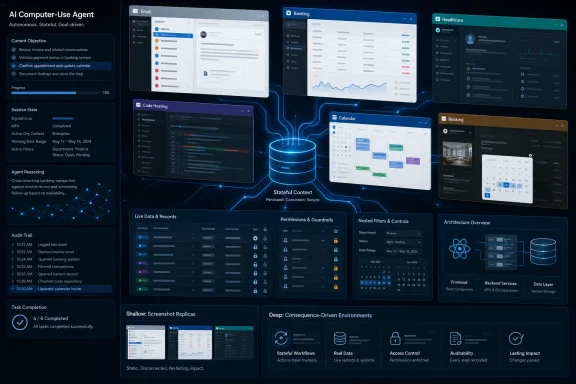
As detailed by the Microsoft Research blog, Echoverse is built around a simple premise: an agent needs to experience the consequences of its clicks. In a real email system, developer portal, bank dashboard, or health-record workflow, an action changes state, affects other users, triggers permissions, or fails for a meaningful reason. Those are precisely the conditions that shallow UI replicas tend to omit.
For Windows administrators and IT teams assessing where desktop and browser agents are heading, that distinction matters. A system that merely recognizes controls is not yet capable of safely handling multi-step operational work. An agent needs to understand when a change persisted, when access is denied, when a workflow is incomplete, and when a task has affected another part of the application.
 Microsoft’s Training Worlds Put State Ahead of Screenshots
Echoverse contains ten broader domain environments, including synthetic mail, calendar, chat, banking, healthcare, code-hosting, forum, travel, and media applications. Microsoft says these are not static page mockups: each environment includes a React front end, FastAPI and SQLite back end, seeded records, permissions, and workflows that carry consequences across screens.
That lets the project grade an agent against underlying database state rather than visual appearance. An agent that claims to have closed a ticket, for example, only succeeds if the relevant record actually changed. A booking only counts if availability and payment state reflect the completed workflow.
This is a meaningful departure from the common pattern of asking a separate model to judge whether a final screenshot looks correct. Microsoft’s approach is intended to make the reward signal harder to game—and more useful for reinforcement learning.
Depth Was More Important Than Environment Count
Microsoft’s central finding is that high-fidelity environments produced better transfer than shallow simulations. In tests using Allrecipes and Hugging Face domains from the WebVoyager benchmark, a 9-billion-parameter model trained on shallow replicas declined from 80% to 75% on Allrecipes and remained flat on Hugging Face. Training on deeper versions improved both results, reaching 85% on Allrecipes and 65% on Hugging Face.
The company argues that a shallow environment can unintentionally train bad habits: repeated clicks, unnecessary actions, and false assumptions that every control works without side effects. A deeper environment introduces dependencies, failures, shared state, and verification that reward an agent for reaching the actual goal rather than merely performing plausible-looking steps.
That is an important operational distinction. In enterprise systems, the hard part is often not locating a button. It is knowing whether an operation is authorized, whether it changes a downstream workflow, and whether it should be reversed.
Date Pickers and Filters Became Dedicated Training Targets
Echoverse also separates reusable UI skills from business domains. Microsoft created dedicated environments for date pickers and nested filters, varying the controls across many layouts, contexts, and constraints.
The date-picker environment includes tasks such as resolving relative dates and business-day offsets, while the filter environment tests compound filtering logic across different widget families. Microsoft reports that targeted training raised held-out nested-filter performance from 62.8% to 84.1%, while date-picker performance improved both on familiar controls and unseen layouts.
The practical lesson is that computer-use agents may benefit from training on recurring interaction patterns rather than treating every website as a wholly separate problem. For Windows-based line-of-business apps, where custom controls and legacy UI patterns remain widespread, that could be more consequential than another benchmark centered on consumer web navigation.
A Smaller Model Closed Much of the Gap
Across Echoverse’s 14 environments, Microsoft says its Qwen3.5-9B-based agent rose from a 36.5% baseline to 67.1% after training on the synthetic corpus. Microsoft positions GPT-5.4 as a frontier reference at 80.7% across the same environments, putting the smaller model within 14 points on average.
The model reportedly matched or exceeded the larger reference in EchoMail, EchoBank, and nested-filter tasks. It also improved on external web-agent benchmarks, although the gains were more modest: WebVoyager rose from 66.5% to 71.5%, while Online-Mind2Web increased from 40.5% to 43.4% under Microsoft’s BrowserBase-based evaluation setup.
That does not make Echoverse a proof that synthetic training replaces live-web testing. Instead, it reinforces the idea that controlled, inspectable worlds can teach skills that transfer, particularly where public benchmarks cannot expose the permissions, writes, histories, and shared records that define enterprise work.
The Release Points Toward Safer Agent Training Loops
Microsoft also used five Echoverse environments for reinforcement learning after supervised fine-tuning. Its held-out score rose from 58% to 69%, with the company attributing part of the gain to better recovery behavior and fewer wasted steps.
The more interesting long-term claim is the project’s co-evolution loop. Agent failures are not automatically treated as model defects; they can expose broken UI controls, impossible tasks, stale verifiers, or incomplete environment logic. Microsoft cites fixes to its EchoStay booking controls, EchoForum front end, EchoChat verifier, and EchoForge UI as examples of repairing the training world before turning a failure into curriculum.
For enterprise IT, that is likely the durable takeaway. Training agents for consequential computer use will require more than larger models and more screenshots. It will require environments where permissions, data integrity, rollback, auditability, and task outcomes are real enough to teach the agent when an action actually worked.
