
As detailed in Microsoft’s roadmap entry and Edge management documentation, admins will be able to set a minimum severity threshold. When Microsoft releases an Edge update containing security fixes at or above that level, the management service will generate an alert—including for zero-day fixes.
 Alerts Move Edge Patching Toward Triage
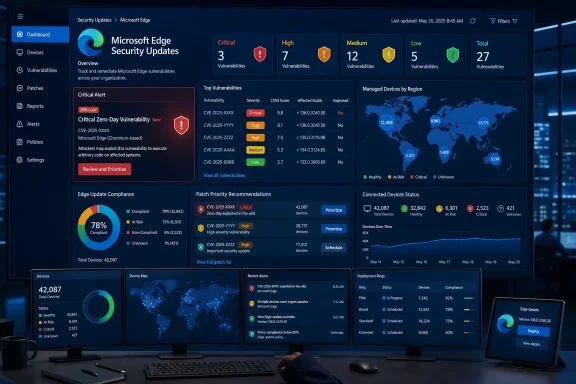
The feature appears in the Edge management service’s monitoring dashboard rather than as another endpoint policy. Each alert is expected to show the Edge release, security severity, addressed vulnerabilities, and the managed devices that may still need to update.
That matters for organizations managing large Windows fleets where Edge updates arrive frequently and routine Chromium security maintenance can otherwise blur together. A threshold lets teams reserve immediate escalation for critical or high-severity releases while still leaving normal browser patching on its established cadence.
Microsoft’s Edge security release notes have repeatedly documented fixes for vulnerabilities reported as exploited in the wild during 2026. The new alerting layer does not replace the existing release notes or Microsoft Security Update Guide; it is designed to surface the operational impact inside the same console used to watch managed-browser update posture.
Preview Access Still Requires Targeted Release
Microsoft’s documentation says the experience is currently in public preview for tenants enrolled in targeted release through the Microsoft 365 admin center. The roadmap lists the feature for both Preview and General Availability rings, worldwide for standard multi-tenant cloud customers.
For IT teams, the practical preparation is straightforward:
- Review who receives and acts on Edge security notifications before enabling a low severity threshold.
- Confirm that Edge update policies allow affected clients to move promptly to the recommended version.
- Treat the alert as a prioritization signal, then validate device exposure and rollout status in the monitoring dashboard.
The important limitation is that an alert will identify an update worth attention; it will not by itself remediate devices that are pinned, offline, blocked by policy, or unable to update. When general availability arrives in August, the value will depend on whether organizations have connected those alerts to a real browser-patching response process.
