
That is an important shift in emphasis. AI red teaming has often been discussed through the narrow lens of jailbreak prompts, unsafe model answers, and attempts to circumvent content filters. Those are still significant issues, but modern AI systems increasingly sit inside broader workflows: searching private knowledge bases, reading email and documents, invoking tools, generating code, interacting with cloud services, and eventually taking actions through semi-autonomous agents. Security testing must therefore evaluate not only what a model says, but what an AI-enabled application can be induced to do.
For Windows and enterprise IT professionals, EXTRA is notable not because it is a new consumer-facing Microsoft product, but because it signals how the company sees the emerging AI threat model. The security boundary is no longer limited to the model provider, the prompt, or even the application developer. It now extends across data sources, tool permissions, local regulations, languages, organizational practices, and the human expertise needed to recognize a dangerous failure mode in context.
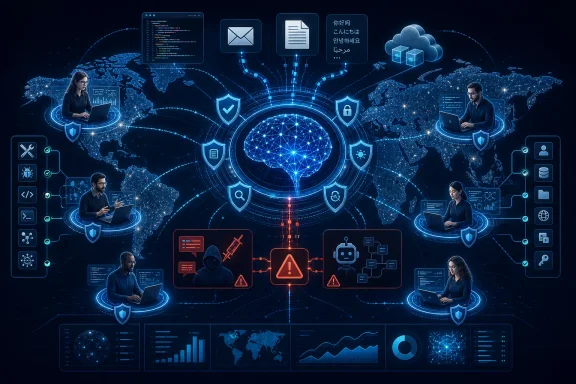 Overview: Why Global AI Red Teaming Matters
The core argument behind EXTRA is straightforward: the most meaningful AI failures are not uniformly distributed across the world, industries, or languages. A test suite written by an English-speaking security team in one region may be effective at identifying some prompt-injection patterns, but it can miss culturally specific coercion, multilingual ambiguity, local misinformation vectors, regional fraud patterns, or domain misuse scenarios.
Microsoft describes AI red teaming as increasingly concerned with security operations, misuse, alignment failures, multilingual harms, and domain-specific abuse rather than solely prompt injection and content-safety edge cases. The company’s EXTRA announcement argues that this broader attack surface requires participation beyond traditional internal security teams.
That argument aligns with Microsoft’s own earlier guidance for large language model testing. Its red-teaming documentation recommends assembling a diverse group of participants with different areas of expertise, demographics, and disciplinary backgrounds, particularly when an AI system is deployed in a specialized field such as health care. It also emphasizes that red teaming helps identify the risk surface but does not replace formal measurement, mitigation, or ongoing operational controls. Microsoft’s planning guidance for LLM red teaming makes the point clearly: discovery of individual failure cases is valuable, but a collection of examples should not automatically be mistaken for a statistical measure of how prevalent a risk is.
That distinction is critical. A red team can demonstrate that a system can fail; it cannot, by itself, prove how often that failure will occur in production or how severe the resulting business impact will be. Good AI security programs need both:
- Exploratory adversarial testing to reveal unknown or hard-to-predict failure modes.
- Repeatable measurement to quantify known risks across models, versions, scenarios, and mitigations.
- Engineering controls to limit what a compromised or mistaken system can access or execute.
- Post-deployment monitoring to identify behavior that did not surface during testing.
EXTRA’s promise is not that a larger red team will solve every AI safety problem. Its real value lies in expanding the set of people who can recognize failures that conventional testing teams may never think to investigate.
The Two Parts of Microsoft’s EXTRA Initiative
Microsoft has structured EXTRA around two complementary components: support for independent academic research and a more operational network of external specialists.
Unrestricted support for university research
The first half is a research network. Microsoft says its AI Red Team has given unrestricted gifts to 18 university labs spanning six continents. The stated purpose is deliberately broad: enable researchers already investigating difficult AI safety and security questions to continue doing so independently, rather than tying their work to specific Microsoft product requirements or narrowly defined deliverables. Microsoft’s announcement identifies institutions including Carnegie Mellon University’s CyLab, Howard University’s Research Institute for Tactical Autonomy, IIT Madras’s Centre for Responsible AI, the University of Melbourne’s Artificial Intelligence Assurance Lab, the University of Pretoria’s Data Science for Social Impact group, the University of São Paulo’s Center for Artificial Intelligence, and the University of Toronto’s CleverHans Lab.
The unrestricted nature of the gifts is one of the stronger elements of the program. Funding that requires a lab to demonstrate a near-term product benefit can be useful for applied engineering, but it can also discourage inconvenient research questions. AI safety work frequently needs space for longer-term inquiry: novel attack techniques, evaluation shortcomings, societal harms, model manipulation, benchmark design, or security failures with no easy commercial fix.
The academic model can also help strengthen an AI security field that needs more than vendor-specific tooling. Microsoft has publicly collected guidance, methodology, open-source tools, threat-modeling resources, and testing practices under its Microsoft AI Red Team resource hub. EXTRA could help extend that ecosystem by supporting research that may challenge or improve prevailing assumptions about how AI systems are evaluated.
A distributed operational red team
The second half is more immediate and potentially more consequential for real-world AI deployments. Microsoft is building a distributed network of researchers, practitioners, and regional specialists who can take part directly in red teaming where highly specific expertise is required. Microsoft says this could include people with knowledge of particular attack classes, languages, cultural contexts, or technical domains that may not be sufficiently represented by an internal team.
This moves EXTRA closer to the mature cybersecurity model of external expertise. Traditional software security has long depended on independent researchers, coordinated vulnerability disclosure, bug-bounty programs, security conferences, academic analysis, and open threat intelligence. A vendor’s own engineers have deep product knowledge, but external researchers bring different incentives, different mental models, and often a more adversarial perspective.
AI systems need the same intellectual diversity, perhaps even more urgently. A model can appear robust under ordinary evaluation and still fail when exposed to a new combination of language, social engineering, tool permissions, data retrieval, and domain-specific instructions. An outside specialist may understand not just how an attack works technically, but why it would be persuasive to a particular population, how it could be operationalized by a fraud actor, or where it conflicts with real workplace practice.
AI Red Teaming Has Outgrown the “Bad Prompt” Model
A major strength of EXTRA is that it treats AI red teaming as a systems-security discipline, not as a contest to produce clever prompts.
The traditional cybersecurity meaning of red teaming is adversarial testing: skilled testers act like opponents to uncover weaknesses in people, processes, applications, infrastructure, and defenses. Generative AI adds a different class of problems because the system can be manipulated through natural language, exposed to untrusted content, connected to external tools, and deployed in contexts where ambiguity is part of the attack surface.
Microsoft’s documentation defines AI red teaming as adversarial probing intended to surface both content and security risks in generative AI systems. Its AI Red Teaming Agent documentation describes the practice as simulating users attempting to make systems misbehave, while noting that modern evaluation needs to span models, applications, agents, tools, and the results of those interactions.
Prompt injection remains a problem—but it is not the whole problem
Prompt injection is the best-known AI application attack because it is intuitive. An attacker tries to override the model’s instructions by submitting a hostile prompt, often attempting to reveal hidden instructions, circumvent safety controls, or redirect the system toward an unintended goal.
Yet in agentic systems, the more serious variant is often indirect prompt injection. Here, hostile instructions do not arrive directly from the user. They can be embedded in documents, emails, web pages, support tickets, code repositories, or other data an AI agent retrieves while performing an apparently legitimate task.
Microsoft’s red-teaming documentation specifically describes indirect prompt-injection testing as evaluating whether an agent can be manipulated by malicious instructions hidden in external data sources accessed through tools. The evaluation checks whether the agent then carries out an unintended or unsafe action, leaks data, violates task constraints, or ignores policy. Microsoft’s guidance is particularly important because it recognizes that the attack is no longer about text generation alone; it is about how a model interprets untrusted context while holding access to tools and data.
A global red-team network can contribute here because prompt-injection techniques will not remain static. Attackers can exploit local language conventions, encoding tricks, social-engineering idioms, culturally trusted forms of communication, and mixed-language content that generic English-focused testing may overlook.
Tool use turns errors into actions
The risk level rises when an AI system can do more than answer a question. An agent that can search a company repository, create a calendar event, send an email, alter a record, run code, trigger a workflow, or access sensitive documents has a larger blast radius than a chat interface with no connected capabilities.
That makes task adherence, permission control, and action validation central red-team targets. Microsoft’s Foundry guidance identifies agent-specific areas including prohibited actions, sensitive-data leakage, and whether an agent completes tasks while respecting constraints and required procedures. The documentation also notes that high-risk actions such as financial transactions or medical decisions need explicit human authorization, while irreversible actions such as file deletions or system resets require disclosure and confirmation.
This is a useful framework for enterprise administrators. A well-aligned model can still create operational risk if the application grants it unnecessary authority. Conversely, a model that makes a poor judgment may be prevented from causing material harm if the surrounding system enforces least privilege, restricts available tools, requires approval for consequential actions, and validates inputs and outputs deterministically.
In other words, AI safety controls and conventional security controls must work together. Red teaming should test both.
Why Multilingual and Regional Expertise Is a Security Control
The global dimension of EXTRA should not be mistaken for a public-relations flourish. It addresses a genuine security gap: AI systems are deployed into environments where language, norms, regulatory expectations, and abuse patterns differ substantially.
A model’s behavior can change when instructions are translated, localized, mixed across languages, written in slang, encoded with visually similar Unicode characters, or framed through a regionally specific scenario. The same applies to fraud, disinformation, harassment, cyber misuse, and influence operations. The underlying model may be global, but the way it is used—and abused—is always contextual.
Microsoft’s testing tools already acknowledge that adversarial techniques can involve obfuscation through character substitutions, Unicode confusables, encoded content, multi-turn escalation, indirect jailbreaks, and other variations. Its AI Red Teaming Agent documentation lists attack strategies ranging from Base64 and ROT13 transformations to Unicode substitution, indirect prompt injection, and multi-turn “crescendo” attacks.
However, automated techniques alone cannot capture every issue. A technically successful test might be socially implausible. A technically modest result might be highly dangerous in a particular domain or country. A locally informed red teamer can identify whether a response reinforces a known scam pattern, misinterprets a sensitive cultural reference, creates a dangerous translation, or enables an abuse scenario with consequences that are invisible to outsiders.
That is where EXTRA’s emphasis on regional specialists and six-continent participation becomes meaningful. The program recognizes that context is part of the attack surface.
The Research Agenda: AI as Both Target and Defender
Microsoft says EXTRA-backed research will examine two broad but connected areas: the security implications of AI systems themselves, and the ways AI can improve defensive cyber operations. The company’s announcement describes the first as investigating how models can be attacked, manipulated, or misused in operational environments, while the second explores how AI might assist defenders.
Securing AI systems
Security research on AI systems must examine multiple layers:
- Model-layer weaknesses, such as jailbreaks, unintended capability exposure, manipulation, or unsafe output.
- Application-layer vulnerabilities, including insecure prompt handling, weak retrieval pipelines, unsafe file processing, and vulnerable generated code.
- Agent-layer failures, where a model selects or misuses tools, follows malicious retrieved instructions, or ignores workflow constraints.
- Data-layer risks, including sensitive-data exposure, poisoning, unauthorized access, and untrusted inputs.
- Identity and access risks, where agents inherit privileges that exceed their task requirements.
- Human and organizational risks, where users over-trust an AI system, misinterpret confidence as correctness, or use it outside approved boundaries.
The MITRE ATT&CK framework transformed conventional security operations by providing a common language for adversary behavior. Its AI-focused counterpart, MITRE ATLAS, serves a similar purpose by organizing adversarial tactics and techniques against AI-enabled systems based on real-world observations and realistic demonstrations from security groups and AI red teams. MITRE ATLAS is valuable because it helps defenders think beyond isolated vulnerabilities and instead model an attack chain: reconnaissance, initial access, evasion, persistence, impact, and the AI-specific techniques that may support those stages.
EXTRA could be particularly useful if its researchers produce reproducible test cases, new evaluation methodologies, and shared terminology that can feed into this broader ecosystem. AI safety needs the equivalent of reliable vulnerability classes, common weakness patterns, practical mitigations, and repeatable tests.
Using AI to help defenders
The inverse question is equally important: how can AI assist cyber defenders without becoming a new source of risk?
AI tools can help analysts summarize alerts, correlate incident evidence, explain code, draft detection logic, prioritize cases, and accelerate investigations. But those benefits must be tested with the same adversarial rigor. A defensive copilot that invents evidence, exposes investigation data, recommends unsafe remediation, or follows malicious instructions embedded in a ticket could degrade rather than improve security operations.
The correct objective is not “more automation” in the abstract. It is bounded, auditable, and appropriately authorized automation. AI can reduce the manual burden on defenders, but it should not bypass the judgment, review, and access-control requirements that protect high-impact systems.
EXTRA’s Strongest Features
Microsoft’s initiative has several notable strengths.
1. It acknowledges the limits of internal testing
The most valuable statement in the announcement is also the most candid: no single internal team can fully reproduce the expertise required to evaluate every high-risk failure mode. Microsoft’s EXTRA post identifies deep domain knowledge, multilingual understanding, and regional context as gaps that internal teams may not be able to close alone.
That is a realistic foundation for an AI safety strategy. It does not presume that scale, proprietary data, or internal expertise automatically produces complete coverage.
2. It supports independence through unrestricted gifts
Unrestricted funding is preferable to narrowly controlled vendor-sponsored research when the goal is to strengthen independent evaluation capacity. It allows researchers to investigate difficult or commercially inconvenient questions without being locked into a predefined product roadmap.
The effectiveness of that model will depend on transparency and academic freedom in practice, but the structure is directionally sound.
3. It combines research with operational engagement
Academic research and live security testing are often treated as separate worlds. EXTRA attempts to connect them: researchers can explore foundational questions, while practitioners and specialists can contribute to immediate testing in high-risk technical or regional areas.
That combination may help shorten the path between discovering an AI failure mode and improving operational defenses.
4. It treats continuous testing as necessary
AI systems change rapidly. Models are updated, prompts are revised, retrieval sources evolve, tools are added, user behavior shifts, and attackers adapt. A one-time assessment is useful but insufficient.
Microsoft’s own tooling guidance recommends red teaming during design, development, pre-deployment, and post-deployment stages, including scheduled ongoing runs using synthetic adversarial data. The company’s AI Red Teaming Agent documentation supports the broader principle: AI risk management must be iterative, not a checkbox completed before launch.
Risks, Limitations, and Questions That EXTRA Must Address
The program is promising, but it is not immune to the structural challenges of global AI safety collaboration.
Access can determine the quality of testing
The most capable external researchers still need meaningful access to the systems they are evaluating. If external participation is limited to heavily constrained demos, sanitized interfaces, or generic endpoints, researchers may be unable to test the real conditions in which failures occur: enterprise data connectors, tool permissions, agent workflows, policy hierarchies, or production-like scale.
Safe access is difficult because frontier models, sensitive datasets, and operational environments cannot simply be opened without safeguards. But overly limited access can turn red teaming into theater. The success of EXTRA will partly depend on whether participants can examine realistic systems in secure, controlled environments.
Independence must be visible, not merely stated
Unrestricted funding is a positive start, yet public trust will also depend on clarity about governance. Researchers should be able to publish findings, describe methodological limitations, and report uncomfortable results without undue pressure. At the same time, serious vulnerabilities may require coordinated disclosure to avoid unnecessary harm.
A workable balance would include clear disclosure processes, published research expectations, and transparency about when results cannot be fully released for security reasons.
Evaluation results need careful interpretation
Automated red teaming can scale adversarial probing, but metrics such as Attack Success Rate are not final measures of security. Microsoft explicitly warns that its automated evaluations use generative models, can be non-deterministic and non-predictive, may create false positives, and should be reviewed by humans before mitigations are chosen. Its documentation also notes limitations around synthetic data, incomplete sandboxing, and the gap between test distributions and real-world behavior.
That caution should extend to all AI safety reporting. A low attack-success rate can hide a rare but catastrophic weakness. A high rate can reflect a low-severity test condition. Metrics are useful only when connected to a defined threat model, impact analysis, reproducibility, and a practical remediation plan.
Global participation needs more than geographic representation
A network spanning six continents sounds comprehensive, but geography alone does not guarantee diversity of perspective. Effective coverage also requires expertise across:
- Languages and dialects.
- Accessibility and disability contexts.
- High-risk sectors such as health care, finance, public services, education, and critical infrastructure.
- Civil-society and human-rights perspectives.
- Security engineering, machine learning, social science, law, and incident response.
- Low-resource settings where infrastructure and local risk conditions differ substantially.
The goal should not be a map with pins. It should be a network that makes AI security testing more capable of detecting the failures ordinary corporate processes systematically miss.
What Enterprise IT Teams Should Take From EXTRA
EXTRA is aimed at a global ecosystem, but its lessons are immediately applicable to organizations deploying Copilot-style assistants, retrieval-augmented generation applications, custom models, and AI agents.
The first lesson is that AI red teaming must be specific to the application. A base model may perform well in general evaluations while becoming risky once connected to proprietary documents, line-of-business systems, workflow automation, or privileged tool access. Microsoft’s LLM guidance recommends testing the base model and the finished application separately, both before and after mitigations are added. That planning guidance reflects a practical reality: the application architecture often creates the most consequential risk.
The second lesson is to combine automation with skilled human review. Automated scanners can repeatedly test known classes of harmful behavior, measure regressions after updates, and generate a baseline. Human red teamers, meanwhile, are better at novel abuse paths, domain context, unusual language, social engineering, and multi-step attacks that do not fit a predetermined template.
The third lesson is to treat identity, permissions, and tool access as first-class AI safety controls. An agent should not receive broad access merely because it is useful. Apply least privilege, use explicit approval gates for high-impact or irreversible actions, isolate environments, limit tool allowlists, and maintain logs that support investigations.
Finally, enterprises should make AI red teaming an operational loop:
- Map the system: models, prompts, retrieval sources, tools, identities, data, users, and external dependencies.
- Define realistic harms: security compromise, data leakage, unsafe automation, legal exposure, harmful content, financial loss, or workflow failure.
- Test adversarially: include direct and indirect prompt injection, multilingual inputs, authorization failures, tool misuse, and business-process abuse.
- Measure and prioritize: assess exploitability, impact, detectability, and the efficacy of mitigations.
- Fix the surrounding system: do not rely solely on prompts or model refusals when access controls, validation, or workflow design can reduce risk.
- Retest continuously: every model update, tool integration, policy change, and retrieval-data change can alter the security posture.
A Practical Evolution of AI Security
Microsoft’s External Red Team Alliance is best understood as an acknowledgment that AI security is becoming a shared, global discipline. The emerging risks are too varied for any one organization, language group, or technical specialty to handle alone. The company’s plan to support independent academic work while building an operational network of external testers reflects the way mature cybersecurity programs have long evolved: through structured collaboration between vendors, researchers, defenders, and communities that see different parts of the threat landscape.
The initiative will be judged by execution—especially by how much meaningful access external experts receive, how independently they can publish, how findings are translated into engineering changes, and whether the program reaches beyond symbolic geographic representation. Those are substantial challenges.
Still, the underlying premise is sound. Trustworthy AI will not emerge from internal safeguards alone. It will require continuous adversarial testing, context-aware expertise, rigorous measurement, strong security architecture, and global collaboration capable of exposing the failures that centralized teams are least likely to see.
