

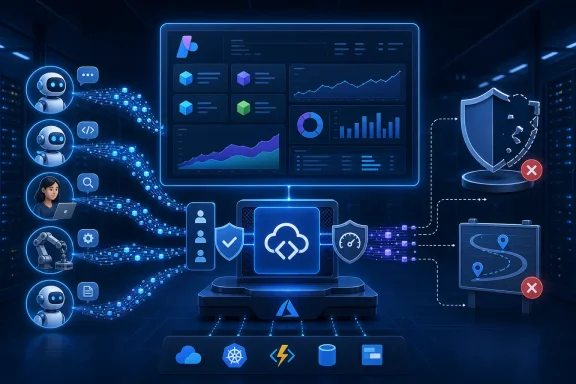
The August 12 Microsoft Azure blog post frames AI FinOps as a move from buying model access to operating “a managed investment system.” Its diagnosis is sound: an agent’s cost is determined by far more than the advertised per-token price of a model. System prompts, conversation history, retrieved documents, tool definitions, retries, model-routing decisions and the agent’s own workflow can all expand consumption before a user sees a final answer.
But the practical takeaway for Windows and Azure administrators is narrower. Microsoft Foundry now offers several real ways to reduce token use and restrain spikes, while the financial-control plane remains split across Foundry, Azure API Management and Azure Cost Management. Organizations should plan around that architecture rather than assume Foundry has become a single console for AI budgeting and ROI.
Microsoft says more than 100,000 organizations are building on Foundry and cites an IDC survey, commissioned by Microsoft, in which 71% of business leaders said they expected to increase AI budgets. Those figures demonstrate Microsoft’s commercial argument, but they do not establish that those organizations have production-grade allocation or return-on-investment reporting. The vendor has not published the methodology behind the 100,000-organization figure in the post, and IDC’s survey result is still sponsored research.
Cost reporting stops short of the agent level
Microsoft’s current Foundry cost-management documentation directs administrators to Azure Cost Management, where costs can be viewed by Foundry resource, model deployment and billing meter. That is a usable starting point for identifying a high-cost deployment or separating input from output charges. It is not the same as showing which business process, agent configuration, customer session or internal department created the spend.
Microsoft’s blog acknowledges this limitation directly, saying Foundry has model- and deployment-level reporting today while “richer attribution” down to individual agents and sessions is planned. That distinction should shape an enterprise deployment from the beginning.
A chargeback model needs stable ownership metadata. If five teams share a Foundry project or point multiple agents at one model deployment, the Azure invoice will not itself identify who consumed the tokens or whether the spend produced a useful business result. Resource groups, subscriptions, deployment names, tags, gateway identities and application telemetry must carry that attribution before costs are aggregated.
The same constraint applies to a common executive request: calculate cost per resolved support ticket, claim processed, sales-qualified lead or developer task completed. Azure Cost Management can provide the cost side of that equation, but it does not know whether an agent’s response was accepted, useful or completed a business transaction. The FinOps Foundation’s guidance on unit economics makes the missing piece clear: technology cost data must be joined to business-demand and value data. Foundry does not eliminate that integration work.
The controls Microsoft lists are real, but several are previews
The blog’s strongest material is its inventory of levers that can reduce agent costs before billing data reaches finance. Microsoft Learn documentation confirms that the Foundry model router can choose an underlying model in cost, balanced or quality modes. In principle, that allows a short classification or extraction task to avoid an expensive reasoning model while preserving access to higher-capability models for harder requests.
The operational caveat is that routing is not a fixed-price promise. Model router’s effective context window is limited by the smallest model in its underlying set, and its prompt-cache benefit depends on the router selecting the same compatible model for requests with overlapping prefixes. Administrators also need to explicitly manage the model subset if data residency, provider choice, safety review or performance requirements rule out particular models.
Tool selection can be a more immediate source of savings than model selection. Microsoft’s documentation for Foundry tool search describes the problem plainly: sending every tool definition to a model on every turn increases token use, fills the context window and can cause the agent to select the wrong tool. A toolbox that exposes only relevant tools can reduce prompt overhead and improve accuracy at the same time.
Yet teams should be precise about maturity. Microsoft Learn labels tool search as preview. It also labels Foundry Agent Service memory as preview, despite the blog positioning memory as a way to avoid resending full histories. Memory may be valuable for continuity across sessions, but it introduces retention, access-scope and deletion decisions that security and privacy teams must test before treating it as a low-risk cost optimization.
Agent Optimizer is also in preview. Microsoft documents that it can evaluate and modify instructions, reusable skills, tool descriptions and model choice, but it requires a supplied evaluation dataset and evaluators. This is not a button that independently proves an agent has become cheaper or better. An optimizer can find a configuration that scores well against its test criteria; it cannot rescue weak tests, missing edge cases, or an evaluation that measures tone while ignoring task completion and cost.
Azure API Management is the current enforcement layer
The most consequential practical point in Microsoft’s post is its description of Azure API Management as the AI Gateway layer in front of Foundry endpoints. This is where organizations can currently apply token rate limits, quotas and caching rather than merely receive a budget alert after spend has occurred.
Microsoft’s Foundry cost guidance states that Azure OpenAI does not currently offer hard budget limits comparable to an option available from OpenAI. Azure budgets can send alerts, and teams can trigger automation through action groups, but automatic cutoffs require custom work. The new AI Gateway tier in Azure API Management adds a more specialized managed boundary for AI models and tools, though Microsoft currently labels that tier preview as well.
API Management’s token policies are useful, but they should not be mistaken for an accounting system. Microsoft’s own AI Gateway guidance says token usage should be reconciled with provider billing or Azure Cost Management for financial reporting. Its policy documentation adds two constraints that matter in production:
- Token counts are tracked independently at each gateway, so deployments spanning multiple regions or gateways do not automatically provide a single aggregate counter.
- Concurrent calls can temporarily exceed a configured token limit because the final token count is known only after a model response is received.
In other words, a token policy is a brake, not a ledger. It can stop a single application, identity or API consumer from taking all available throughput, but it cannot by itself establish an enterprise-wide monthly budget or prove a department stayed below its allocated spend.
For a Windows or Azure administrator, the immediate design pattern is straightforward: issue separate gateway identities or keys per application and environment; enforce token and request ceilings at that boundary; tag Foundry resources consistently; export billed cost data; and correlate it with application telemetry. That creates a defensible record while Microsoft develops the promised native controls.
Measure the workflow, not only the model
Microsoft’s post correctly argues that agent behavior can dominate cost. A conventional chat completion may involve one model request. An agent may retrieve documents, make planning calls, select tools, retry failed actions, invoke external systems and summarize results. A minor workflow change can therefore have a larger cost effect than moving from one model SKU to another.
The oversight problem is that cost reduction can damage usefulness. Aggressively truncating retrieval context may lower input-token charges while increasing hallucinations. Substituting a smaller model can reduce cost per request but create more retries or human escalations. Cached responses can save money but return outdated or incorrectly scoped information if cache keys and identity boundaries are poorly designed.
A sound internal scorecard needs at least four linked measures:
- Cost per completed business outcome, rather than cost per prompt or total tokens alone.
- Task-quality and safety measurements that reflect real production failure modes.
- Retry, tool-call and escalation rates, which reveal whether an apparent token saving simply moved work elsewhere.
- Attribution by owner, environment and agent version so that a deployment change can be connected to both its bill and its outcome.
Foundry’s tracing and evaluation tools can contribute to that record, but Microsoft has not claimed that they deliver complete ROI measurement out of the box. The “managed investment system” remains a process involving application owners, finance teams, security teams and platform administrators—not a product setting.
Native Foundry limits remain a roadmap item
Microsoft says in-platform budgets and enforcement are “available soon,” without publishing a release date, pricing model, supported regions, enforcement behavior or migration path from API Management policies. It likewise says Microsoft Agent 365 will extend controls across Microsoft and third-party agents, but the post does not specify how its departmental chargeback data will reconcile with the Azure bill.
Those omissions matter because native enforcement can mean very different things: an alert, a deployment-level spending cap, a per-agent block, an organization-wide policy, or a soft limit that allows in-flight work to finish. Each carries different risks for a business process that depends on an agent at scale.
For now, Microsoft Foundry gives enterprises credible technical options to reduce unnecessary token use, route requests by capability, narrow tool context and evaluate agent configurations. It does not yet collapse cost allocation, budget enforcement and ROI accounting into one finished Foundry service. Teams that build their own attribution and gateway controls now will be in a better position to use Microsoft’s future features; teams that wait for a single AI FinOps dashboard will keep discovering their costs after the invoice arrives.