

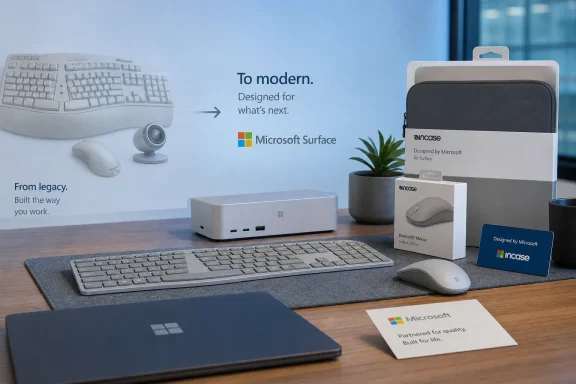
That was a branding and portfolio decision, not a declaration that keyboards, mice, webcams and headsets had become obsolete. Microsoft continues to sell and service Surface-branded accessories, including Surface keyboards, pens, docks and mice. Its current Surface accessory lifecycle documentation still lists support dates extending as far as 2031 for certain products.
For people who used the company’s inexpensive desktop peripherals—or depended on the distinctive ergonomics of the Sculpt and Microsoft Ergonomic Keyboard—the practical impact was real: once store inventory was gone, Microsoft itself was no longer the manufacturer, seller or warranty contact for replacements.
The more accurate short answer, then, is that Microsoft exited the broad, standalone peripheral market in favor of Surface-aligned hardware. It did not leave every legacy design behind, but it handed much of that catalog to another company under a licensing arrangement.
Microsoft shifted from general PC peripherals to Surface accessories
Microsoft’s original peripheral business was unusually broad. It sold wired office keyboards, wireless desktop bundles, basic mice for schools and offices, high-end mice, ergonomic keyboards, webcams, headsets and speakers. Those products worked with nearly any Windows PC and often competed on price with Logitech, HP, Dell and a long tail of accessory suppliers.
Surface accessories have a different role. A Surface Pro keyboard cover, Surface Slim Pen, Surface Dock or Surface Arc Mouse helps define Microsoft’s own PC hardware and gives it a more cohesive premium package. Microsoft’s April 2023 statement framed the move around prioritizing that Surface portfolio rather than developing the general-purpose Microsoft accessory line.
The important distinction is easy to miss because Surface is also a Microsoft brand. A Surface Mouse or Surface Keyboard is still a Microsoft product. The older “Microsoft” desktop range was the one retired. That includes products whose names sounded generic enough to be mistaken for current Windows accessories, such as the Microsoft Ergonomic Keyboard, Microsoft Bluetooth Mouse and Modern Webcam.
Microsoft did not publicly disclose sales figures, margins, manufacturing costs or a product-by-product rationale for the exit. So claims that it abandoned the line because of poor sales, AI PCs, declining demand for physical input devices, or a looming keyboard-free future go beyond the evidence. The company’s documented explanation was narrower: more focus on Surface-branded accessories.
That leaves a notable omission in the original announcement. Microsoft had spent decades building its reputation in ergonomic desktop hardware, yet it did not lay out a long-term replacement plan for organizations and users standardized on products such as the Sculpt Ergonomic Desktop. The Surface lineup had ergonomic options, but it did not simply replicate every lower-priced keyboard-and-mouse set Microsoft had removed.
Incase inherited designs and branding rights, not Microsoft Hardware itself
The apparent reversal arrived in January 2024, when Incase announced that parent company Onward Brands had licensed rights and associated intellectual property from Microsoft’s accessory portfolio. Incase said it would manufacture and distribute keyboards, mice, webcams, headsets and speakers under the label “Incase Designed by Microsoft.”
That wording is legally and practically significant. These are not newly manufactured Microsoft-branded peripherals. Microsoft licensed designs and technology; Incase is the company building, selling, distributing and supporting the resulting products. Packaging may carry “Designed by Microsoft,” but the retail transaction, warranty process and support channel are Incase’s.
Ars Technica and PCWorld both reported on the initial agreement as a revival of much of the discontinued catalog, while Incase’s own announcement said the arrangement covered well-known Microsoft accessory designs. Incase initially indicated that the comeback would begin in 2024, and a September 2024 update placed the broader relaunch in the fourth quarter of that year.
The arrangement was therefore less a return to the old Microsoft Hardware business than a licensing handoff. Microsoft retained a way for familiar designs to remain on the market without resuming the operational burden of running a broad peripheral division under its own name. Incase gained recognizable industrial designs and a ready audience, particularly among people who had few direct replacements for Microsoft’s split ergonomic models.
For Windows users, the result is more useful than a clean discontinuation—but it also changes what “the same product” means. A device can retain an old Microsoft design, model family and feature set while still belong to a separate vendor’s manufacturing, inventory and support system.
The comeback is real, but the catalog is not a complete restoration
Incase’s current “Designed by Microsoft” catalog lists 19 products, including Bluetooth and mobile mice, desktop bundles, webcams, headsets and wired keyboards. The Modern Mobile Mouse, Bluetooth Mouse, Bluetooth Ergonomic Mouse, Wireless Mobile Mouse 1850, Wireless Desktop 850 and Wired Desktop 600 are among the designs being offered through the Incase storefront.
The company has also listed the products most likely to matter to longtime Microsoft ergonomic keyboard users: the Sculpt Ergonomic Keyboard, Sculpt Ergonomic Desktop, wired Ergonomic Keyboard and Compact Ergonomic Keyboard. But as of early August 2026, Incase’s own listings marked several of those keyboards—including the Sculpt Ergonomic Keyboard and wired Ergonomic Keyboard—as “Coming Soon,” despite giving them product pages, prices and stock-keeping units.
That is the part missing from broad summaries that say Incase simply brought Microsoft’s keyboards and mice back. The return has been selective and uneven. The catalog exists, and many products are purchasable, but the headline ergonomic models have not all had consistently available retail status.
That distinction matters for IT buyers. A product page is not a reliable procurement commitment. If an organization needs 50 replacement ergonomic keyboards for a standard workstation setup, it should confirm availability, regional layout, support terms and lead time with Incase or a distributor before treating a listed Microsoft-era model as an active standard.
There is also no indication that every historically important Microsoft peripheral is returning. The Incase range emphasizes office and productivity devices. Microsoft’s gaming-oriented SideWinder history and models such as the Pro IntelliMouse are not equivalent to a promise that the entire legacy catalog will reappear.
Microsoft’s old configuration software is the practical casualty
The biggest functional difference is not necessarily the logo on the box. Incase explicitly says several of its “Designed by Microsoft” products are incompatible with Microsoft Mouse and Keyboard Center and Microsoft Accessory Center.
That limitation affects users who relied on Microsoft’s older software to remap buttons, change shortcut assignments, alter scroll behavior or configure device-specific features. Windows 10 and Windows 11 can still handle ordinary keyboard and mouse input without those utilities, and many standard settings remain available through Windows Settings. But device-specific customization is no longer assured simply because the hardware descends from a Microsoft design.
Microsoft’s own support documentation continues to describe Mouse and Keyboard Center as the tool for personalizing compatible Microsoft keyboards and mice. Incase’s product notices make clear that compatibility does not transfer automatically to hardware it now sells under its own brand. A familiar chassis and key layout should not be mistaken for a fully identical software experience.
That is particularly relevant for the ergonomic line. An employee replacing an older Microsoft Ergonomic Keyboard may receive something physically similar, but custom shortcut workflows that depended on Microsoft’s utility may need to be rebuilt with Windows settings, PowerToys Keyboard Manager, application-specific hotkeys or third-party remapping tools. Those alternatives can be effective, but they are not a drop-in continuation of Microsoft’s supported accessory software.
The licensing arrangement also means firmware updates, warranty claims and documentation should be sourced from Incase, not assumed to come through Microsoft’s normal Surface support channels. That is a manageable change for home users, but it is a real support boundary for organizations with established Microsoft hardware policies.
The legacy matters because Microsoft served a niche others did not
Microsoft’s Natural Keyboard, introduced in 1994, became one of the company’s best-known hardware designs because it normalized a split, curved layout at mainstream pricing. Later Sculpt products continued that approach with separated number pads, domed key fields, wrist rests and reverse-tilt positioning.
Ergonomic claims should be treated carefully: a keyboard alone cannot prevent repetitive strain injury, and workstation posture, desk height, chair position, pointing-device use and break habits matter. But the attraction of these products was never just a marketing label. Many users had developed long-term habits around a layout that mainstream laptop makers and commodity keyboard vendors do not routinely reproduce.
Microsoft’s withdrawal created a gap precisely because the company had made that specialized form factor ordinary enough for offices to buy in volume. Incase’s licensed lineup addresses part of that gap, but the incomplete availability of the most recognizable ergonomic models means the transition remains less seamless than the “Designed by Microsoft” branding suggests.
Microsoft has not resumed its old peripheral business. It has preserved a portion of its design legacy through Incase while keeping its own hardware effort focused on Surface. For buyers who need a straightforward mouse or keyboard, that may be a cosmetic distinction. For anyone replacing a Sculpt setup, managing standardized desktop hardware, or relying on Microsoft’s configuration utilities, it is the difference between a familiar product name and a different supplier relationship.