

That distinction matters. DataOne says the generators are being used for construction, a category that can qualify for a temporary-equipment exemption under New Jersey rules. Regulators were still seeking information needed for a full compliance determination. Until the equipment’s purpose, installation dates, mobility and regulatory classification are established, claims of a confirmed federal violation go beyond what the public record supports.
What has been established at the Vineland site
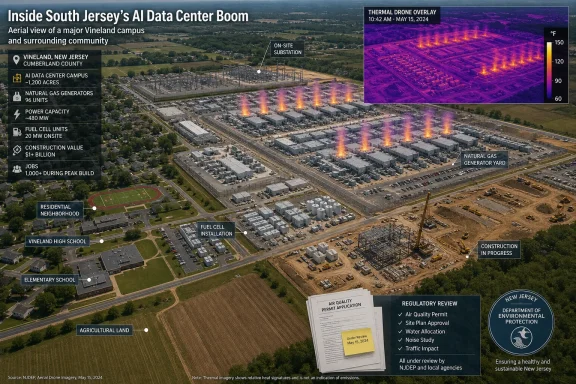
A thermal-drone investigation conducted in mid-August found at least 45 of the site’s 62 generator units operating. That is significant evidence of extensive generator activity, but thermal imagery alone cannot determine why each unit was running, what it powered or whether its operation required a permit.
New Jersey Department of Environmental Protection inspectors provide a separate and stronger piece of evidence about the equipment itself. During a July 29, 2026 inspection, they observed natural-gas power-generating equipment at the site. The department also said that it had issued no permits and had no permit applications under review for power generators at DataOne.
Those findings create an obvious regulatory question. They do not automatically answer it. New Jersey’s air-permitting guidance says covered equipment needs a permit when it falls within a regulated category and does not qualify for an exemption. Determining whether the Vineland generators were covered therefore requires more than confirming that they existed and were operating.
NJDEP had not completed that determination when the reporting was published. It was awaiting additional information before reaching a full compliance conclusion. No supplied evidence establishes that the agency had issued a violation notice, fine, shutdown direction or other enforcement order over the 62 generators.
Why the construction explanation matters
DataOne publicly characterizes the generators as construction equipment. This is not merely a public-relations distinction, because New Jersey regulations exempt certain portable equipment used for construction, repair or maintenance when it remains at a site for no longer than one year.
If the units meet all the conditions of that exemption, the lack of ordinary preconstruction generator permits might not prove unlawful activity. If they have been used to supply an operating data center, are not genuinely portable, or have remained in place beyond the applicable limit, the analysis could be different.
Federal EPA guidance adds another threshold. A portable nonroad engine generally becomes stationary after staying at one location for more than 12 months. But the public evidence does not establish when each Vineland generator arrived, whether units were moved, or how regulators would classify the particular installation.
Several technical facts that would normally drive such a decision also remain unavailable: the generators’ makes and models, rated output, emissions controls, actual loads, running hours and precise function. It is similarly unresolved whether all 62 units form one coordinated power installation or serve separate construction tasks.
DataOne’s statement is therefore a potentially material defense or explanation, not proof that every unit qualifies for the exemption. Conversely, the absence of permit applications is a warning sign that warrants investigation, not proof by itself that a permit was legally required.
An operating data hall does not settle the generator question
A federal proposed class-action complaint filed by nearby residents says that at least three data rooms were operating when the case was filed. The plaintiffs allege that noise from the development has affected the surrounding community.
These are allegations in a complaint, not adjudicated findings. Even if data rooms were operating, that would not by itself prove that the disputed generators supplied them. A large construction site can contain operational facilities while temporary equipment supports continuing work elsewhere.
At the same time, evidence of operating data rooms makes a blanket construction-only narrative worthy of close scrutiny. Regulators need to establish the electrical relationship between the generators, construction machinery, completed data rooms and the grid. The critical issue is not simply whether the campus had begun operating, but what load the generators actually served and under what conditions.
The noise case should also be kept analytically separate from the air-permit dispute. Residents’ allegations may indicate a wider conflict over the project’s local effects, but the supplied evidence does not identify how much noise came from generators rather than cooling systems, construction machinery or other equipment. It also does not establish the lawsuit’s current procedural status or that a proposed class has been certified.
“Federal violation” is an allegation, not an agency finding
Air regulation can involve federal standards administered through state permitting programs. NJDEP is the immediate permitting authority identified for this site, while federal Clean Air Act requirements may be implemented through that state process. That structure helps explain why reporting may refer to possible federal-law consequences even though the state department is conducting the immediate review.
It does not eliminate the need for a regulatory determination. To substantiate a violation, authorities would need to decide which rules apply, whether an exemption covers the equipment, and whether the generators should be treated as portable, nonroad or stationary engines. More extensive permitting questions could depend on the installation’s combined characteristics and emissions, none of which have been publicly established in the supplied record.
The defensible conclusion is narrow: substantial generator operation occurred at a site for which NJDEP said it had neither issued generator permits nor received applications. Whether that combination was unlawful remains unresolved.
This is more than semantic caution. Treating an allegation as a concluded violation can misinform residents and investors. Treating the construction explanation as conclusive can minimize legitimate environmental and enforcement questions. Both mistakes bypass the technical facts regulators still need.
Microsoft’s connection is commercial, not proven operational control
The Vineland project is relevant to Microsoft because Nebius contracted to provide the company with dedicated GPU infrastructure from the data center. The disclosed agreement has a value of approximately $17.4 billion through 2031 and could rise to about $19.4 billion if additional capacity is added.
That relationship explains why the dispute is being described as involving a Microsoft-backed or Microsoft-linked facility. It does not establish that Microsoft owns the site, operates its generators or made its permitting decisions. The supplied record identifies Microsoft as the customer for dedicated GPU infrastructure, not as the party responsible for the generator installation.
Microsoft declined to comment on the reported generator findings. Nebius did not respond before that report was published. Silence does not establish responsibility or wrongdoing, but it leaves unanswered questions about what environmental and permitting assurances a major infrastructure customer requires from its suppliers.
There is also no evidence here that the Vineland site currently powers Windows, Copilot or any particular Microsoft consumer service. Connecting this dispute directly to a named Windows feature would therefore be speculation.
What the dispute means for Windows and cloud customers
For most Windows users, there is no demonstrated immediate effect. The supplied evidence does not show a service interruption, capacity reduction or change to Microsoft software. The significance is instead upstream: modern AI products rely on physical data centers whose power, cooling and permitting constraints can affect when computing capacity becomes available.
Enterprise customers evaluating AI platforms should consequently look beyond benchmark results and software integration. Relevant procurement questions include whether promised GPU capacity depends on temporary generation, whether required environmental approvals are in place, and what contractual alternatives exist if a facility is delayed or forced to change its power arrangements.
None of those risks can be quantified from the present evidence. The regulator may ultimately conclude that the generators qualified for an exemption. It could instead determine that some or all required permits, controls or operating restrictions were missing. Either outcome would materially change the interpretation of the same basic observation: dozens of generators were running.
The dispute also illustrates a broader public-policy tension created by rapid AI infrastructure construction. Developers and technology customers want large amounts of computing power on aggressive schedules. Residents and regulators need reliable information about emissions, noise and the transition from construction to normal operation. Temporary-equipment exemptions serve a legitimate purpose, but their boundaries become especially important when construction occurs alongside an increasingly operational computing campus.
What would resolve the central question
A well-supported compliance decision requires facts that are not yet public. The most important include each generator’s arrival date, physical mobility, engine classification, rated capacity, fuel, operating hours and emissions controls. Authorities also need records showing whether the units powered construction loads, operational data rooms or both.
NJDEP’s eventual determination should carry more weight than competing characterizations from the developer or its critics. If the department finds the construction exemption applicable, reporting should reflect that the absence of permits was not necessarily improper. If it finds that stationary or operational generation occurred without required approval, the federal-law allegation would have a much firmer foundation.
For now, the site presents a credible regulatory concern rather than a proven violation. The strongest evidence supports continued scrutiny, but it also supports restraint in describing the legal outcome before the responsible agency reaches one.