

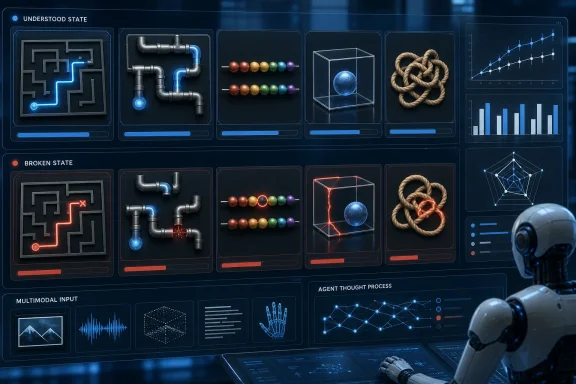
Microsoft’s August 12 announcement frames the result as a gap between reasoning about a rendered scene and planning through an interactive one. The benchmark’s own leaderboard supplies the missing numbers: its highest-scoring tested model, GPT-5.5, reached 54.13% overall, compared with a 97.4% human reference score. The result is less a verdict on conversational AI than a warning about treating visual recognition as proof that an agent understands a changing world.
MindTopo also arrives with an important limitation for practitioners evaluating the claim: its project page says the paper, code, and dataset are “soon.” The authors have published a leaderboard and task descriptions, but third parties cannot yet independently rerun the suite, inspect the prompts and scoring pipeline, or determine how well its results transfer to production agents.
MindTopo Tests Properties That Must Survive a Change
Most spatial benchmarks concentrate on Euclidean relationships: whether an object is nearer, larger, left of another object, or facing a certain direction. MindTopo instead tests topology — relationships that remain true while objects bend, stretch, or move without being cut or passed through one another.
The benchmark divides that idea into five categories: continuity, separation, order, enclosure, and knots. A route can remain connected or become blocked; components can be one object or several; beads can change their order along a string; a boundary can put an object inside or outside; and a rope can be genuinely knotted rather than merely looking tangled.
Those are not exotic mathematical edge cases when an AI is expected to act. A desktop automation agent moving items around a diagram may need to preserve group membership and containment. An accessibility assistant interpreting a seating chart, workflow map, or floor plan needs to distinguish a barrier from a visual line. A robotics system cannot “solve” an untangling task by imagining a rope passing through itself.
Microsoft says MindTopo uses controlled simulators that provide exact ground truth and adjustable difficulty. That matters because it separates two very different failure modes: failing to see a wall or opening in the first place, and correctly seeing it but later acting as if it no longer exists.
The suite contains eight static reasoning tasks and five interactive planning tasks. The static set includes two- and three-dimensional mazes, questions about object assembly, bead ordering, enclosure, and knots. The interactive environments ask a model to rotate pipes, draw separating lines, swap ordered objects, trap an agent by closing off space, or untangle a rope while obeying the simulator’s physical rules.
The Published Scores Show a Larger Problem Than a Single Average
Microsoft’s blog says proprietary and open-weight multimodal models perform better on static reasoning than planning, and the leaderboard bears that out. But the score table adds needed nuance: the size of the planning gap varies sharply by model and by task.
GPT-5.5, the best overall entry in the published table, scored 57.74% on static reasoning and 48.33% on planning. Gemini 3.1 Pro recorded 60.00% on reasoning and 43.20% on planning. GPT-5.4 mini fell from 35.20% to 9.90%, while NVIDIA’s Nemotron Nano 12B v2 VL went from 31.63% to 6.34%.
Those averages can make the situation look better than several individual planning environments actually are. Gemini 3.1 Pro scored 26.56% in the Pipe task and 29.43% in One Stroke. GPT-5.5 reached 21.67% in Pipe and 25.00% in One Stroke, despite scoring 100% in the Swap task. Several models scored zero in particular planning tasks.
That unevenness is the practical finding. “Planning” is not one capability. A model may manage an ordering operation while failing a task that requires preserving connectivity or separation. An agent designer cannot safely infer that strong performance on a single drag-and-drop, map, or manipulation demo carries over to another visual workflow merely because both have multiple steps.
The benchmark’s human reference row also exposes how far this category remains from dependable automation. Human participants scored 95.77% on static reasoning and 100% on planning in the reported aggregate. The model gap is therefore not a narrow contest among frontier systems; it is a large difference in whether the system can retain structural constraints while it acts.
The Failure Is Often State Tracking, Not Initial Perception
Microsoft’s most consequential observation is that planning failures often appeared after a model had correctly interpreted the initial scene. The models could choose a locally reasonable next action, then fail to account for what that action would make impossible later. They also proposed moves that violated the environment’s rules.
For software teams, that points away from a simplistic “use a better vision model” response. Higher-resolution screenshots, stronger OCR, or more detailed image captions may improve the first step, but they do not by themselves give an agent a durable representation of a path, boundary, ordering relationship, or knot state.
The distinction resembles a common failure in browser and desktop automation. An agent can identify buttons, fields, files, and dialog boxes in a screenshot, then lose track of which permission boundary, tab state, dependency chain, or workflow branch it changed three actions ago. The visual environment is different from MindTopo’s mazes and ropes, but the engineering risk is similar: local observations are mistaken for a persistent world model.
Microsoft tested whether image and video generation could provide that persistence. Its researchers found that image generation could sometimes help when the key relationship was visible in one frame, but it was unreliable across multi-step crossings or movements. Video rollouts, according to Microsoft, frequently changed the topology or violated the simulation’s dynamics.
That result should cool expectations around “imagination” loops used as a substitute for explicit state management. A generated visual rollout can be useful for proposing possibilities, but it cannot serve as a trusted simulator unless it preserves the same constraints the task requires. If an agent’s imagined next frame subtly opens a barrier, swaps an order, or lets two strands intersect impossibly, later reasoning is built on a false state.
What Developers Should Take From the Benchmark
MindTopo is not a test of Microsoft Copilot, Windows automation, or a specific Azure AI offering. Microsoft has not announced it as a product certification suite, and the benchmark page does not yet offer its code or dataset for independent evaluation. It is a research diagnostic, not a deployment-ready assurance program.
Still, it supplies a useful design rule: when an agent changes a structured visual environment, represent the constraints outside the model’s running conversation. Keep an authoritative state machine, scene graph, graph of connected components, ordering list, or simulator-backed action log where the application can verify whether an action is legal before committing it.
For production workflows, the safer pattern is to let a multimodal model propose an action while deterministic tooling checks the invariants that matter. A diagram editor can verify containment and connector endpoints. A workflow agent can validate dependencies and permission boundaries. A robotics stack can reject impossible collision or topology changes. The model remains valuable for perception and flexible planning, but it should not be the sole keeper of system state.
MindTopo’s strongest contribution is therefore its refusal to accept a correct answer about a still image as evidence of interactive competence. Until the benchmark materials are released and independently reproduced, its exact rankings should be treated as the authors’ reported measurement rather than settled industry fact. The central engineering lesson is already clear: an AI agent that cannot preserve structure over time needs guardrails before it is trusted to alter a real one.