
Microsoft’s August 3 announcement describes Orchard Env as the common layer beneath Orchard-SWE, Orchard-GUI, and Orchard-Claw. The public GitHub repository confirms that the project includes a Kubernetes service, Python SDK, REST API, a vendored RL training stack, and released trajectory datasets. The repository is not a conceptual paper with an eventual code promise; it contains deployment documentation and the underlying environment implementation.
There is, however, an important correction to how the launch should be read. Orchard is a public release of research that had already appeared in May, rather than a wholly new agent-training result on August 3. The associated paper first appeared on arXiv on May 14, 2026, and its third revision was posted on July 30. Microsoft’s blog post is the formal product-facing introduction, while the July revision supplies the newer performance figures highlighted in the announcement.
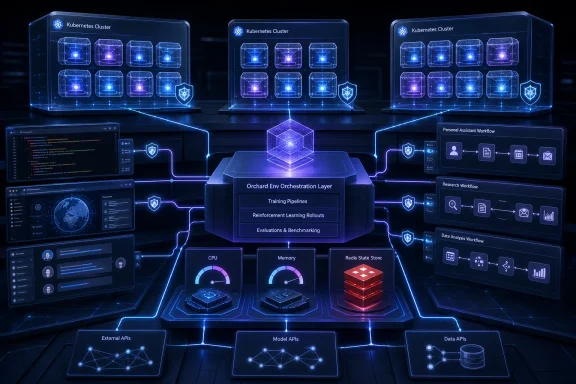 Orchard Env Turns Sandboxes Into a Shared Service
Most agent-training projects weld together three components: the agent loop, the training framework, and the environment in which tools run. That works for a narrow experiment but becomes expensive when a team wants to move from a coding benchmark to browser tasks, or replace a ReAct-style loop with Codex, Claude Code, OpenClaw, or another tool-using harness.
Orchard’s central design decision is to make the environment a network-accessible service. Orchard Env creates and destroys isolated containers, exposes command execution, file access, patch operations, network policy, and session management, then leaves the upper layers free to choose a model, trainer, and task format. Microsoft says it can provision thousands of isolated components in parallel; the project repository describes a multi-replica orchestrator with Redis-backed state and distributed locks.
For researchers and platform engineers, that is a more consequential release than another agent wrapper. A reusable environment boundary means the costly operational work—building images, imposing CPU and memory caps, handling timeouts, cleaning up processes, controlling egress, and collecting rollout artifacts—can be carried across studies. The alternative has been bespoke Docker scripts and benchmark-specific runners that become technical debt as soon as the task changes.
The implementation is aimed at teams already comfortable operating Kubernetes. Microsoft’s quick-start material points to Azure Kubernetes Service provisioning and says a basic deployment can be brought up in roughly 20 minutes, but Orchard is not a desktop utility or a Windows-native agent framework. Microsoft does not publish a Windows-container deployment path, Windows Server support matrix, or a supported on-premises configuration in the announcement. Windows administrators should therefore treat it as a Kubernetes research platform that can be operated from Windows tooling, not as a component that drops directly into Windows 11, Windows Server, or Microsoft 365.
The security posture is worth reading closely. The repository says sandbox networking is deny-by-default through Calico NetworkPolicy, with per-sandbox CPU, memory, and timeout controls, cleanup through time-to-live policies, and API-key authentication. Those are sensible defaults for running untrusted repositories and tool-using agents, but they do not eliminate the governance problem: a team training against live websites, code repositories, email-like workflows, or third-party agent harnesses still needs to control credentials, telemetry, prompt data, and outbound exceptions.
The Codex and OpenClaw Claim Belongs to OpenForge RL
Microsoft’s biggest practical claim is that Orchard can train a model inside the same multi-process harness used in deployment. The blog names Codex, OpenClaw, and ZeroClaw, arguing that conventional open training stacks often train against simplified agent loops and then deploy into a richer, stateful harness. That creates a train–deploy mismatch: improvements measured in the simplified loop may not survive contact with the production agent runtime.
The mechanism is plausible and concrete. Orchard runs each rollout in an isolated container and uses a proxy to record the harness’s own model interactions as trainable data. Rather than reimplementing tool invocation, context management, retries, subagents, and state handling in a research scaffold, the training run can observe the behavior of the actual harness.
But Microsoft’s own repository makes an important distinction the blog largely smooths over. The direct deployment-harness work is described there as OpenForge RL, a separate July 2026 project that extends Orchard. Orchard provides the environment substrate; OpenForge RL is the work that trains agents in real harnesses such as ZeroClaw, OpenClaw, and Codex.
That does not invalidate the August announcement. It clarifies the architecture: Orchard is the shared execution foundation, while OpenForge RL is one of the first research projects exploiting that foundation for harness-native training. Teams evaluating Orchard should not assume that cloning the base repository automatically delivers a production-ready Codex-training pipeline. The code supplies preinstalled harness tooling in each sandbox and an environment API; reproducing Microsoft’s results still entails model access, training infrastructure, datasets, task environments, and the specific recipe involved.
Microsoft says its sandboxes ship with several agent command-line tools already available, including Codex, Claude, Pi, OpenCode, and Hermes. This reduces image-building friction, but it also means the operational boundary extends beyond a Python package. Enterprises will need to scrutinize software licenses, model-provider terms, API credential injection, telemetry behavior, and outbound access before treating those images as approved internal build infrastructure.
The SWE-Bench Result Is Real, but Microsoft’s Page Mixes Generations
Orchard-SWE is Microsoft’s headline benchmark result. The newest paper revision reports 69.7% on SWE-bench Verified for a Qwen3.5-35B-A3B model with roughly 3 billion active parameters, rising to 73.0% when a separate 4-billion-parameter value model reranks candidate solutions. The recipe combines 107,000 distilled trajectories, supervised fine-tuning that keeps useful portions of failed attempts, reinforcement learning, and denser feedback about whether the agent followed a sound debugging process.
The value-model reranking number is especially important. It is not the score of one agent making one attempt. Orchard generates multiple possible solutions and uses a model trained on outcomes from previous rollouts to select the likely best candidate. That is a legitimate inference-time technique, but it adds compute and infrastructure beyond the base coding model. Organizations comparing a 73.0% headline to a single-shot coding-agent result should make sure the evaluation setup includes the same candidate count, test-time budget, and reranking stage.
Microsoft’s blog contains a visible documentation inconsistency. The current Figure 1 caption says Orchard-SWE reaches 69.7%, or 73.0% with reranking, on the Qwen3.5-35B-A3B backbone. Yet the figure’s image description still states 67.5% on SWE-bench and refers to an earlier 30B-A3B configuration. The arXiv record resolves the discrepancy: 67.5% was the prior result on Qwen3-30B-A3B-Thinking, while 69.7% and 73.0% are newer results in the July 30 revision using Qwen3.5-35B-A3B.
In other words, the result is not internally contradictory, but the announcement ships with stale figure metadata. Readers using screen readers, indexing tools, or copied image descriptions could easily repeat the older score and model identifier.
SWE-bench Verified itself is a human-filtered 500-task subset intended to measure whether an agent can patch real GitHub issues. It remains useful, but it is not a guarantee that an agent will safely repair a company’s private repositories. Microsoft’s own paper reports other benchmarks, including SWE-bench Multilingual and Terminal-Bench 2.0, which is a better signal that the team recognizes benchmark transfer as a separate problem. For IT teams, the operational test remains straightforward: run the agent against representative internal repositories with isolated secrets, reproducible tests, code-review gates, and hard limits on what it can modify.
Browser and Assistant Agents Show the Reuse Argument
Orchard-GUI uses a 4-billion-parameter vision-language model for browser tasks. Microsoft reports 74.1% on WebVoyager, 67.0% on Online-Mind2Web, and 64.0% on DeepShop, an average of 68.4%, after training on 400 distilled demonstrations and 2,200 open-ended tasks. The released dataset card confirms that the GUI portion includes 3,070 multimodal rollouts with screenshots and task metadata.
The stronger practical result is not simply the average score. Orchard-GUI’s claimed advantage is largest on Online-Mind2Web and DeepShop, where agents have to cope with less uniform interfaces or longer task flows. Microsoft argues that online reinforcement learning in an environment service helps a smaller model outperform its much larger teacher on some of these tests. That claim is based on Microsoft’s own experiments and has not yet been independently replicated.
Orchard-Claw makes the harness argument more visible. Microsoft reports 59.6% pass-at-three on Claw-Eval after training with 200 synthetic tasks, rising to 73.9% when paired with ZeroClaw. Under the Codex harness, the company says the trained model improved from 18.6% to 51.5% task success. The result underscores a lesson administrators already know from automation platforms: the model is only one part of the system. Tool permissions, retries, context persistence, integration reliability, and error handling can change the outcome as much as the underlying model weights.
Microsoft has released the code and data under MIT terms, which removes a licensing obstacle for experimentation. It has not released a managed Orchard service, support commitment, enterprise SLA, or a hardened production distribution. No independent outlet appears to have published a substantive technical reproduction of the August 3 announcement yet.
For now, Orchard is most relevant to AI platform teams that already run Kubernetes and want to stop rebuilding agent sandboxes for every benchmark or model experiment. Its immediate value is a reusable control plane for isolated agent work—not a turnkey replacement for a secure coding-agent service, browser automation platform, or Microsoft 365 assistant.
