

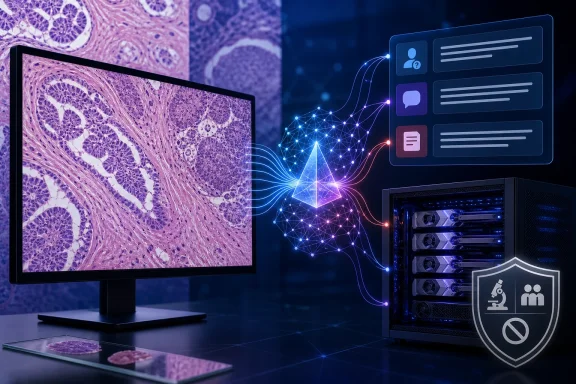
That is the important boundary missing from the more sweeping “AI that speaks pathology” framing. PRISM2 is a substantial research release and a useful new building block for academic computational-pathology work. It is not a drop-in replacement for a validated pathology workflow, and neither Microsoft nor Tempus is offering it as one.
The paper, published July 31 in Nature Medicine, comes from researchers at Paige, Microsoft Research, Memorial Sloan Kettering Cancer Center, and Yale. Microsoft’s August 4 overview describes the model as a way to reuse one system across future pathology tasks rather than rebuilding an AI classifier for each disease or tissue type. The record supports that claim as a research direction; it does not establish that a hospital can put the downloadable weights into production.
PRISM2 learns from the slide and the report
Most prior pathology AI has worked like a purpose-built appliance. A developer assembles a labeled collection of prostate biopsies, breast specimens, or lymph-node slides; trains a classifier for one defined question; validates it for that use; and then starts much of the process again for the next clinical problem.
PRISM2 tries to shift the expensive part of that cycle into pretraining. It was trained on 2.3 million H&E-stained whole-slide images representing roughly 685,000 specimens, paired with 14 million question-and-answer examples derived from pathology reports. The underlying data were retrospectively sourced from deidentified material licensed from Memorial Sloan Kettering, with slides originating both at MSK and from outside institutions submitted for review.
The architecture matters here. A pathology slide is not an ordinary photograph. A whole-slide image can contain thousands of high-resolution image tiles. PRISM2 first relies on Paige’s Virchow2 model to convert those tiles into numerical embeddings, then uses a slide-level perceiver encoder and a Phi-3 Mini language-model decoder to relate the visual material to clinical language.
That means the system is trained not only to associate tissue patterns with a class label, but to respond to prompts such as whether invasive carcinoma is present, what histologic type is shown, or to generate a single-turn report-style response. The study’s central finding is that this language supervision produces two kinds of output: a diagnostic representation optimized for detection and subtyping, and a broader base representation intended to transfer better to tasks such as biomarker prediction or prognosis.
There is a practical catch for anyone interpreting “full model weights are publicly available” as “download a slide and ask a question.” PRISM2 does not take a raw whole-slide image as its ordinary input. The model card says users must first generate Virchow2 embeddings using a prescribed 20×, 0.5-microns-per-pixel, 224-by-224-tile pipeline with background removed. It also calls for Python 3.10 or later, a CUDA-capable GPU, PyTorch, FlashAttention, and custom model code. This is an ML research pipeline, not a Windows desktop application or a pathology viewer plug-in.
The cancer-detection result is real, but narrower than it sounds
The paper’s most attention-grabbing result is prompt-based detection: a yes/no question posed to PRISM2 matched Paige Prostate and Paige Breast, and outperformed Paige Breast Lymph Node, without separate task-specific fine-tuning. Those are not casual comparison targets. Paige Prostate has FDA De Novo authorization in the United States, while Paige BLN has FDA Breakthrough Device designation; the products were developed and validated as specialized systems.
The benchmark design, however, deserves close reading. The comparisons to those three Paige products occurred on the corresponding product testing datasets, which were curated internally by Paige pathologists. The prostate set held 2,947 samples, the breast set 1,691, and the lymph-node set 753. Those are legitimate evaluation datasets, but they are not a prospective multicenter deployment study of PRISM2, and the study did not claim that they were.
That distinction is especially important because the result measures a defined prompt’s balanced accuracy against the labeled task, rather than whether a general-purpose generative model can safely conduct a full pathology review. In pathology, that is a major difference. A binary “is invasive carcinoma present?” score can be validated against a tightly specified endpoint. A full report must faithfully cover all significant findings, their relationships, margins, grade, stage-relevant details, and uncertainty.
The authors themselves provide a useful warning. In a pathologist review of 50 held-out specimens, PRISM2’s question-answering errors were reported in the 7% to 11% range, while report-style summaries performed worse. The paper identifies hallucinations and omissions as common error modes, with wrong staging or tumor grade dominating some open-ended and multiple-choice failures. Its training-data review also found error rates ranging from 3% to 18% depending on the generated question format, including irrelevant or inaccurate synthetic question-answer pairs.
So the strongest result is not “a chatbot can write pathology reports.” It is that a large model trained on report-derived clinical dialogue can become a better general slide representation and can perform well on specific, constrained questions. That is a meaningful advance, but it is a different one.
The downloadable release bars clinical deployment
The model card hosted with the PRISM2 weights is more restrictive than Microsoft’s “publicly available for research use” shorthand suggests. Access is gated: requesters need a registered Hugging Face account, an institutional email address, and acceptance of the terms. Commercial requests are rejected by default unless a separate statement of use is provided.
The license is CC BY-NC-ND 4.0, which permits noncommercial academic research with attribution. More significantly, the usage conditions explicitly prohibit using PRISM2—or allowing it to be used—to diagnose, cure, mitigate, treat, or prevent disease. That prohibition includes research use, investigational use, commercial use, clinical use, and use as a substitute for professional clinical judgment.
In other words, a hospital cannot reasonably treat the public PRISM2 checkpoint as a research-use-only component on the path to patient care under its existing terms. A commercial developer cannot train a monetized derivative from its outputs without prior approval either. Tempus may separately license pathology technology and has an established regulated-product portfolio, but PRISM2’s public release is deliberately fenced off from that route.
The model card also warns that generated text can contain errors and says the checkpoint is not designed as a multi-turn chatbot or agent. That aligns with the paper’s stated intent: dialogue is used as a training signal, not as an instruction to deploy a virtual pathologist.
This is not merely legal fine print. The restriction accurately reflects the observed technical behavior. A model that can make a strong binary cancer-detection score while still hallucinating, omitting a finding, or contradicting itself in a free-text summary needs a much tighter product definition, validation program, user-interface design, and regulatory strategy before it touches clinical decision-making.
Generalization is promising, but spatial limits remain
PRISM2 did not only perform on Paige’s internal product benchmarks. The research team also evaluated its embeddings on public and external datasets including TCGA cancer-subtyping material, CAMELYON lymph-node benchmarks, the PANDA prostate-grade dataset, and colorectal cancer grading data. Across many of those downstream tasks, the model’s diagnostic or base embeddings matched or exceeded several prior slide-level foundation models after a simple linear classifier was trained on top.
That breadth is the real contribution. A researcher studying a rare tumor subtype, a molecular biomarker, or a prognostic endpoint may be able to start from PRISM2’s representations instead of building an entire image model from scratch. The result could reduce the amount of task-specific labeled data and training required to explore a new hypothesis.
Yet the paper identifies a limitation that has direct consequences for certain pathology work. PRISM2’s slide encoder omits positional encoding and operates at one magnification. It can pool tissue information across a slide, but it does not explicitly retain global spatial relationships in the way needed for tasks such as measuring lesions or counting events across nodes. The authors specifically note that lymph-node staging in clinical practice requires measuring and counting lesions, while PRISM2 may be inferring stage from local morphology rather than globally reasoned spatial structure.
That caveat is more than an academic footnote. It explains why strong benchmark classification should not be confused with a complete digital pathology system. Many useful pathology tasks are about where findings are, how far they extend, whether they meet at a margin, how they are distributed, and what must be counted—not merely whether a pattern appears somewhere on a slide.
The immediate use case is research infrastructure
Tempus completed its acquisition of Paige on August 22, 2025, giving the combined company a larger position in digital pathology, oncology data, and regulated diagnostic products. PRISM2 now sits at the boundary between that commercial portfolio and a gated academic model release developed with Microsoft Research.
For IT teams and research-computing groups, the near-term decision is straightforward: treat PRISM2 as specialized GPU research infrastructure with a controlled data pipeline, license review, and reproducibility limits. The model card itself warns that bitwise-identical embeddings and benchmark results should not be expected across different hardware and software environments because preprocessing, floating-point accumulation, and filtering choices affect outputs.
For clinicians and hospital buyers, the immediate consequence is equally clear: PRISM2 is evidence that pathology foundation models are becoming more capable, not a new diagnostic product to deploy. The public checkpoint’s own terms prohibit that use, and its paper documents the exact sort of free-text errors that make an unbounded clinical rollout unacceptable.