
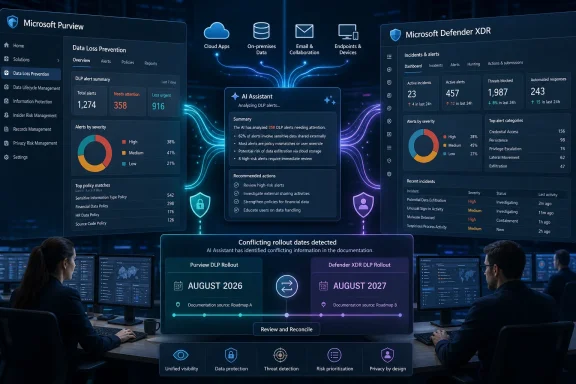
The Microsoft 365 Roadmap entry submitted for Roadmap ID 558860, last modified on August 17, lists the feature as still “In development,” with preview availability in April 2026 and general availability in August 2027. That schedule conflicts with Microsoft’s March Message Center notice for the same roadmap ID, which said the public preview would roll out in early-to-mid April 2026 and worldwide general availability would start in mid-August 2026, with completion expected by late August.
As of August 18, 2026, Microsoft has not publicly explained the apparent shift from an August 2026 rollout to August 2027. For Purview and Defender administrators, that discrepancy is more important than the short roadmap description: it changes this from a routine portal integration to a deployment-status question that needs verification in each tenant.
 The feature moves DLP analysis into Defender XDR
Microsoft’s March Message Center post described a narrow integration rather than a new DLP detection engine. When the Purview Data Security Triage Agent has analyzed a DLP alert, Microsoft Defender XDR is intended to display the resulting AI-generated summary and categorization directly in the alert experience.
The agent is designed to assess DLP alerts using sensitivity, exfiltration, and policy risk. Microsoft’s Purview documentation says triaged alerts are organized into categories including Needs attention, Less urgent, and Not categorized. The goal is to help an analyst establish why a DLP policy fired and which alerts deserve human attention before working through the underlying event details.
That distinction matters operationally. Defender XDR is where many security operations teams already handle incident queues and cross-domain investigations, while Purview is where DLP policy, data classification, and the agent’s configuration live. Showing an agent-generated assessment inside Defender XDR reduces a portal switch during the first stage of triage; it does not replace Purview’s DLP controls or change policy enforcement.
Microsoft said explicitly in its Message Center notice that existing DLP policies and enforcement would remain unchanged and that there would be no direct end-user impact. The new behavior is aimed at analysts and administrators reviewing alerts, not at users whose files, messages, or endpoint actions trigger a DLP rule.
Microsoft’s documentation indicates the plumbing exists
The scheduling conflict is difficult to reconcile with Microsoft’s more recent product documentation. A Microsoft Learn article updated on June 25 describes deploying the Purview Triage Agent in Data Loss Prevention from either the Microsoft Purview portal or Microsoft Defender XDR. It also says that Defender XDR’s alert queue can display agent-provided summaries and risk factors for DLP alerts the agent has triaged.
Microsoft’s earlier Message Center announcement similarly said eligible analysts could deploy the agent from a DLP alert page in Defender XDR if it had not already been deployed. Management functions—including custom instructions, pausing or deactivating the agent, and usage monitoring—would remain in Microsoft Purview.
Taken together, those documents establish an important boundary: the Defender portal is becoming a consumption and entry point for the agent, but Purview remains the system of record for configuring its behavior. Security teams should not assume that enabling visibility in Defender XDR means the agent is configured, licensed, permitted, or actively processing every DLP alert.
Microsoft’s current documentation also makes clear that the agent does not cover every possible DLP signal. It supports DLP policies scoped to Exchange, Teams, OneDrive, SharePoint, and endpoint devices. For endpoint alerts, organizations must enable evidence collection for file activities on devices and enable that collection in the applicable DLP policy rule configuration. A DLP team that has not done that preparation may see a far smaller set of triage results than its overall Defender queue suggests.
The agent adds another set of prerequisites, not a free alert label
The practical consequence of this integration is that it carries Security Copilot and Purview deployment dependencies into the DLP response workflow. Microsoft says the DLP Triage Agent runs on Microsoft Security Copilot and consumes Security Compute Units, or SCUs, as it performs work.
Microsoft’s deployment guidance requires a tenant to be onboarded to Security Copilot, Microsoft 365 data sharing to be enabled in Security Copilot, and the Microsoft Purview plug-in to be enabled. Organizations also need eligible Purview DLP licensing and the applicable Security Copilot billing configuration. Microsoft’s documentation has described both per-seat and pay-as-you-go licensing as part of the arrangement, so administrators should check their current licensing guidance rather than treating the presence of Microsoft 365 E3 or E5 as proof that automated alert analysis is ready to run.
Role assignment is another potential deployment blocker. Analysts need access to Purview DLP alerts to view the results, while agent setup and configuration require more elevated Purview and Security Copilot permissions. Microsoft recommends an Entra-based agent identity for setup in current documentation, rather than running the service under the identity of the administrator who configured it. That is a meaningful improvement for auditability and continuity, particularly in organizations where an individual administrator’s account can change roles, be disabled, or require credential rotation.
The agent can be configured to run automatically according to Microsoft’s schedule or manually on individual alerts. Microsoft says that, by default, it can process DLP alerts generated within the previous 30 days, though the timeframe and policy scope can be adjusted. That default deserves review before broad deployment. A 30-day lookback could create immediate SCU consumption and a backlog of newly categorized historical alerts, which may be useful for validation but can complicate a team’s active incident workflow.
The August 2027 date needs to be treated as unconfirmed
The submitted roadmap listing is now the newest public schedule in this record, but it provides no explanation for the date change. It also retains the April 2026 preview date, which is already in the past, while labeling the overall item “In development.” That combination could reflect a revised rollout plan, an administrative change to the roadmap record, or a stale status field. Microsoft has not supplied enough public detail to distinguish among those possibilities.
The earlier March Message Center notice was more specific than the revised roadmap entry: it named a planned mid-August 2026 start and late-August completion for worldwide general availability. Microsoft’s product documentation, updated in June, already documents the Defender XDR alert-queue experience. Neither source confirms that every eligible worldwide tenant has received the capability by August 18, and neither resolves why the current roadmap metadata points to August 2027.
Administrators should therefore avoid making a tenant-wide rollout decision based solely on either date. The appropriate test is whether the organization can deploy or view the Purview Triage Agent in its own Defender XDR and Purview portals, then whether a known eligible DLP alert surfaces the expected summary and risk factors.
A sensible validation sequence is short:
- Confirm that Security Copilot onboarding, Microsoft 365 data sharing, the Purview plug-in, and SCU capacity are in place before enabling the agent.
- Review DLP policy locations and endpoint evidence-collection settings so the team knows which alerts the agent can actually assess.
- Verify that analysts have alert-view permissions while the small group configuring the agent has the higher Purview and Security Copilot roles required for deployment.
- Test the experience against controlled DLP alerts and compare the agent’s categorization with the team’s established escalation criteria before using it as a queue-prioritization signal.
Defender XDR visibility does not settle the human triage decision
Microsoft describes the output as summaries and categorizations, not as an automatic disposition of DLP incidents. That is the right way to read it. A concise explanation of sensitive data, exfiltration context, and policy risk can save time in an overloaded queue, but the agent’s label should remain an input to an analyst’s decision—especially where an alert could involve regulated data, a privileged user, an external recipient, or an endpoint action with incomplete evidence.
The immediate issue is not whether AI-generated DLP context is useful. It is whether Microsoft is treating the Defender XDR integration as a rollout that began in August 2026 or a capability now targeted for August 2027. Until Microsoft reconciles Roadmap ID 558860 with its March Message Center schedule and its June deployment documentation, organizations should validate availability in their own tenants and plan around observed functionality rather than the roadmap date alone.
