
For Windows administrators, procurement teams, and organizations still operating substantial on-premise estates, the Microsoft ValueLicensing case has moved beyond a specialist dispute over grey-market software keys. It now tests the boundary between software copyright, volume licensing contracts, competition law, and Microsoft’s strategic transition from perpetual licences to recurring Microsoft 365 subscriptions.
The immediate question is whether Microsoft will be permitted to make one final appeal. The broader question is whether a company that has lawfully bought perpetual software entitlements can later resell unused licences—potentially even where those licences were purchased as part of a large enterprise volume agreement.
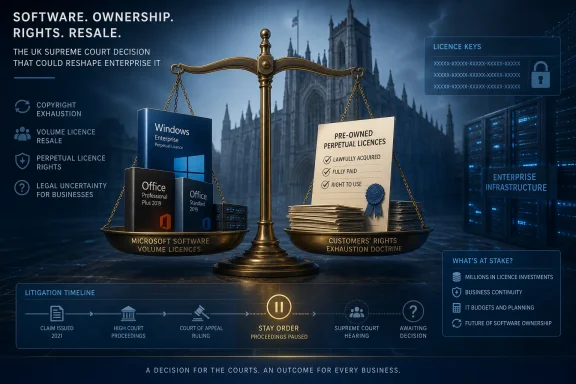 The narrow stay that carries wide consequences
The CAT’s latest order, issued on July 21, does not decide whether Microsoft will receive permission to appeal, let alone whether it would ultimately win before the Supreme Court. It is a case-management decision balancing the risk of expensive litigation work being wasted against the harm caused by another lengthy delay.
Microsoft applied for the extended stay on July 7, the same day the Court of Appeal dismissed both of its appeals. The tribunal ordered that the action be stayed while any application for Supreme Court permission is determined, and—if permission is granted—through the ensuing appeal. But two ValueLicensing applications are specifically exempted:
- A disclosure application dated January 22, 2026.
- A confidentiality application dated January 29, 2026.
Those applications can therefore move ahead while the larger proceedings remain on hold. The tribunal’s order describes this as a “middle ground”: a way to avoid potentially unnecessary liability-trial costs without allowing the litigation to freeze completely.
That distinction matters. Disclosure determines which internal documents and evidence may be obtained and used. Confidentiality arrangements determine how highly sensitive commercial material may be handled among the parties, advisers, experts, and tribunal. In a competition claim focused on licensing terms, discounts, and the availability of surplus licences, those are not administrative side issues. They may shape the evidentiary foundation of the eventual trial.
The CAT also left the door open to another case-management conference in September 2026, where the continuing scope of the stay can be revisited. The July 21 reasoned order therefore gives Microsoft breathing room but does not give it a clean procedural reset.
Background: a £270 million competition claim with a licensing-law core
The claim was brought by JJH Enterprises, trading as ValueLicensing, against Microsoft Corporation, Microsoft Limited, and Microsoft Ireland Operations Limited. ValueLicensing alleges that Microsoft’s licensing practices unlawfully restricted the supply of pre-owned perpetual software licences and harmed competition in the resale market.
The CAT’s case page identifies the underlying action as a damages claim based on alleged breaches of the UK Competition Act 1998, Article 102 of the Treaty on the Functioning of the European Union, and related competition-law provisions concerning software licensing. The official CAT case record confirms that the proceedings concern claims tied to the sale of software licences rather than a conventional copyright infringement action initiated by Microsoft.
ValueLicensing sued Microsoft in 2021 for £270 million, alleging that restrictive contractual practices choked off the supply of surplus Office licences and reduced choice for buyers. The reseller alleged that discounted subscription arrangements were linked to terms stopping customers from selling—or requiring them to retain—perpetual licences that they no longer needed. Contemporaneous reporting on the original claim described the case as a challenge to alleged anti-resale clauses and their impact on the market for pre-owned Microsoft software.
The litigation is not simply about whether a buyer can sell a product key. In legal terms, it concerns perpetual rights acquired under enterprise agreements, the effect of copyright exhaustion after a first lawful sale, the ability to subdivide volume licences, and whether Microsoft’s commercial terms suppressed a legitimate secondary market.
That is why the case is consequential for organizations with long-lived desktop and server deployments. Many businesses migrate in stages. A large institution might retain perpetual Office or Windows licences for older workflows, isolated environments, regulated systems, virtual desktops, or devices that do not justify a full cloud subscription. In that context, unused entitlement can be a recoverable asset rather than a write-off—if resale is lawful and operationally manageable.
Microsoft’s pivot to copyright law
ValueLicensing’s original competition allegations focused on Microsoft’s commercial conduct. But the preliminary issues that reached the CAT and Court of Appeal concerned a different, potentially decisive argument: copyright.
Microsoft argued that Windows and Office are not merely computer programs. They also include user interfaces, icons, graphics, clip art, help files, typefaces, and other non-program works protected by copyright. Its position was that even if software-program rights had been exhausted after the first sale, those additional works could trigger a different copyright regime and prevent resale.
The Court of Appeal judgment explains the issue with unusual clarity. Microsoft’s products include software code as well as graphic works such as icons and user interfaces. The company maintained that the latter category was governed by separate rules and that copyright in those non-program works was not exhausted in the circumstances under review. The Court of Appeal’s July 7 judgment frames this as a conflict between the computer-program rules of the Software Directive and the rules governing non-program copyrighted works.
The CAT rejected Microsoft’s position in November 2025. Its preliminary-issues ruling held, on the facts of the sample transactions before it, that exhaustion under Article 4(2) of the Software Directive operated by law and was not defeated by the contractual language of Microsoft’s enterprise agreements. The tribunal also held that Microsoft’s distribution and reproduction rights did not prevent the subdivision and resale of the licences at issue. The CAT’s official judgment summary sets out those findings.
The tribunal further concluded that the first electronic sale of Windows and Office exhausted relevant rights not just in the program code but also in works necessarily supplied, downloaded, and copied as part of the products’ intended use. That conclusion was tightly tied to the specific facts of the case, but it was a major loss for Microsoft’s attempt to use ancillary copyrighted elements as a barrier to resale. The CAT judgment summary emphasizes that the ruling concerns the products and sample transactions considered by the tribunal.
Why UsedSoft remains the central precedent
At the heart of the dispute sits the 2012 UsedSoft v Oracle ruling from the Court of Justice of the European Union. In that case, the CJEU held that a copyright holder could not oppose resale of “used” software licences covering programs downloaded from the internet where the relevant conditions were met; the distribution right in the copy was exhausted on its first sale. The CJEU’s official UsedSoft press material described the principle in precisely those terms.
UsedSoft is frequently simplified into the slogan that “used software can be resold.” That is useful shorthand, but it is not a complete compliance rule. The case dealt with specific licences, an enduring right to use the relevant software, and the premise that the original acquirer must cease using its own copy when reselling the licence.
Microsoft’s challenge sought to narrow the practical reach of UsedSoft for modern Windows and Office products. It argued that because Microsoft software contains protected material beyond pure program code, the more resale-friendly software-exhaustion principle should not settle the matter.
The Court of Appeal dismissed that challenge. It held that the CAT had been entitled to characterize the products as being, in substance, computer programs, with the other copyrighted materials incidental or accessory to their functionality. The appellate judgment says the CAT’s approach was a rational application of CJEU principles concerning “complex matter” containing both program and non-program elements.
The court also identified the practical difficulty in Microsoft’s theory. If the inclusion of a small amount of graphics or clip art could shift a software product outside the Software Directive’s exhaustion regime, a rights holder might effectively evade UsedSoft simply by bundling incidental non-program elements with the application. The judgment noted that such an approach would produce “odd results,” including a distinction between electronically distributed products and CD-ROM versions that Microsoft could not similarly control in the resale market. The Court of Appeal judgment accepted the CAT’s conclusion that the relevant non-program works did not change the essential character of Office and Windows as software products.
The volume licensing question: can a bulk purchase be split?
The second major preliminary issue is just as commercially significant as the copyright question: licence subdivision.
Enterprise customers often buy large blocks of licences. If a business purchases 1,000 perpetual licences, reduces headcount, divests a division, standardizes on a subscription service, or shifts workloads, can it keep 500 and sell 500? Or can an intermediary acquire all 1,000 and then sell them in smaller lots to multiple buyers?
Microsoft said no. It argued that UsedSoft did not allow a buyer to divide a multi-user licence and sell only a portion of the rights. The Court of Appeal judgment records the example directly: a customer buying 1,000 licences, keeping 500, and selling 500; or a reseller acquiring all 1,000 and splitting them between multiple subsequent customers. The Court of Appeal’s account of the subdivision issue shows why that question is so important to the secondary software market.
The Court of Appeal nevertheless upheld the CAT’s conclusion that subdivision was permissible in the circumstances before it. A key element was the distinction between the particular client-server setup in UsedSoft and a collection of independently usable equivalent copies of Windows or Office. The appellate court found that the CJEU’s language in UsedSoft about a purchaser not being authorized to divide a licence related to a different factual arrangement, not the volume licences being considered in the Microsoft case. The appellate analysis of subdivision treats the independent nature of the relevant licences as material.
This is a major practical point. A secondary market that only permitted the resale of an entire enterprise agreement would be far less useful. Few buyers need precisely the same quantity, product mix, language configuration, edition, and historical licence profile as the original customer. The ability to sell surplus entitlements in smaller, auditable tranches is what makes a pre-owned Microsoft licence market economically viable.
The important limitation: this is not a free-for-all for product keys
The ruling should not be misread as a blanket endorsement of every cheap Windows or Office key sold online.
A lawful secondary-market transaction still depends on the relevant licence being genuine, transferable under the applicable legal framework, fully documented, and no longer used by the seller. Licence provenance, the original transaction, product edition, geographic scope, upgrade history, downgrade rights, software assurance status, activation mechanics, and whether the entitlement was ever separated from a broader non-transferable benefit can all be material.
The CAT’s 2025 ruling is expressly grounded in the facts of the case and its sample transactions. Its official summary should be read as an authoritative statement of those particular preliminary findings, not as a substitute for transaction-specific licensing analysis.
That caveat is especially relevant for IT buyers. A low-cost key on a marketplace may be:
- A legitimate surplus perpetual entitlement with incomplete paperwork.
- An education, developer, OEM, MSDN, Visual Studio, volume, or subscription-derived key with restrictions that do not match the buyer’s intended use.
- A key linked to fraudulent procurement or compromised accounts.
- A key that activates today but cannot survive a future audit, hardware change, tenant migration, or support request.
Activation is not the same as compliance. The ValueLicensing litigation strengthens the legal position of a properly managed secondary licence market; it does not remove the need for a defensible audit trail.
The competition-law stakes extend beyond ValueLicensing
Microsoft’s legal exposure is not limited to ValueLicensing’s £270 million damages claim. The Court of Appeal judgment notes that Alexander Wolfson, the proposed class representative in separate collective proceedings against Microsoft, was permitted to intervene in the jurisdiction appeal. The July 7 appellate decision says the intervener’s position supported ValueLicensing on the CAT jurisdiction issue.
Reporting on that related action previously described a preliminary damages estimate of between £1.3 billion and £3.5 billion, including interest, for an estimated class of 2.3 million to 2.7 million members. Those figures are allegations and preliminary estimates rather than a court award, but they illustrate why the legal treatment of resale, licensing restrictions, and tribunal jurisdiction carries financial significance far beyond a single reseller. The reporting on the Wolfson collective action placed the ValueLicensing appeal in that wider litigation context.
There is a second implication: a successful Microsoft Supreme Court appeal could have influenced more than the damages available in the ValueLicensing case. It could have altered the legal foundation on which other challenges to licensing practices rely. Conversely, the Court of Appeal’s ruling strengthens the proposition that competition claims involving copyright questions can still be heard by the CAT where those questions must be resolved to decide the competition dispute.
Microsoft had argued that the CAT lacked jurisdiction because copyright was logically prior to the competition claim and should be dealt with in the High Court. The CAT rejected that position in 2025, and the Court of Appeal dismissed Microsoft’s jurisdiction appeal on July 7. The CAT’s jurisdiction ruling records Microsoft’s argument that the tribunal could not decide the disputed copyright issues; the Court of Appeal judgment upheld the CAT’s ability to determine issues necessary for the competition-law claim.
What Windows and Microsoft 365 customers should take from this
For enterprise IT decision-makers, the most useful lesson is that licensing procurement should be treated as an ongoing asset-management discipline, not merely an annual subscription renewal exercise.
Organizations moving from perpetual Office or Windows licences to Microsoft 365 should keep reliable records of what they owned, what was migrated, what was surrendered, what remained in use, and what conditions accompanied discounted subscription pricing. Those records matter for compliance, financial planning, audit defense, divestitures, and—where lawful—resale.
A sound approach includes:
- Maintain source documentation. Preserve enterprise agreements, order confirmations, invoices, true-up records, product-use rights, and entitlement histories.
- Separate licences from services. Perpetual software rights, Software Assurance benefits, cloud subscriptions, support arrangements, and tenant-linked services may be governed differently.
- Map actual deployment. Before selling any surplus entitlement, establish that the seller has stopped using the corresponding software copy and has not retained duplicate benefit.
- Use specialist due diligence. For buyers, a reseller’s claim that a licence is “EU-compliant” or “UsedSoft-compliant” should be backed by provenance documents and contractual warranties.
- Do not confuse the ruling with global law. This is a UK case applying a legal framework heavily shaped by EU-derived software copyright principles. It does not automatically govern licensing outcomes in the United States or every other jurisdiction.
Microsoft’s own commercial logic is understandable. Subscription products provide predictable revenue, ongoing security updates, cloud integration, identity management, AI features, and centralized administration. For many organizations, Microsoft 365 is a better operational choice than maintaining a patchwork of perpetual Office deployments.
But legal and commercial preference are not the same thing. The key issue in this litigation is whether customers that previously bought perpetual licences can be contractually or copyright-wise prevented from realizing the residual value of unused entitlements. The CAT and Court of Appeal have so far answered that question in ways favorable to ValueLicensing.
What happens next
The legal timetable now depends on whether Microsoft seeks, and receives, permission to appeal to the UK Supreme Court. The CAT explicitly recognized that permission may not be granted, which is why it allowed the disclosure and confidentiality work to continue despite the broad stay. The extended-stay order also permits ValueLicensing to seek lifting or variation of the stay if more information emerges about the appeal process.
If permission is refused, the preliminary findings and the Court of Appeal’s decision would stand, and the litigation could return more fully to the alleged anti-competitive conduct and damages. If permission is granted, the Supreme Court could revisit questions with repercussions for secondary software markets, enterprise agreement drafting, and copyright exhaustion in digital products.
For now, Microsoft has won time but not vindication. ValueLicensing has won twice on the substantive preliminary issues—first at the CAT and then at the Court of Appeal—and it has preserved access to the disclosure and confidentiality processes needed to prepare the larger competition claim. That balance is precisely why the CAT called its decision proportionate: it avoids forcing parties into potentially wasteful litigation work while refusing to let a Supreme Court bid turn into an indefinite freeze.
The result is a legal holding pattern with real commercial movement beneath it. The pre-owned Microsoft licence market has not received a universal green light, but it has emerged from two major appellate-level tests with its central legal foundation intact.
