

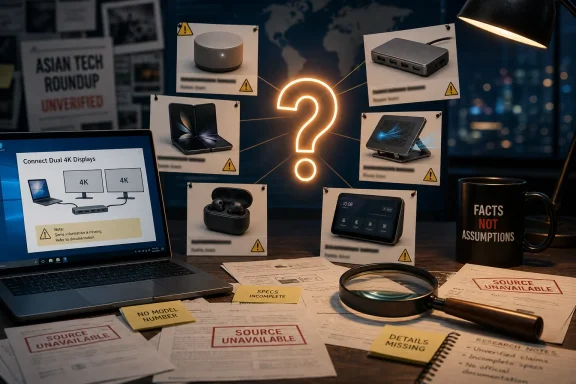
The gap is material for Windows users and IT buyers because several claimed launches concern desktop docks, tablet cooling stands, smart-home hubs, wireless accessories, and dual-display mobile hardware—categories where a model number, port specification, operating-system support statement, and warranty channel determine whether a device is usable. “Dual 4K” docking support, for example, says nothing about whether a dock uses Thunderbolt, USB4, DisplayPort Alt Mode, DisplayLink, or a proprietary chipset; those differences decide the number of displays a Windows laptop can actually drive and whether corporate endpoint policies will tolerate the driver.
Microwire.news identifies itself as a content outreach and amplification platform and says its material is “AI-augmented.” Its own article, attributed to Dr. Seamus Phan, presents the collection as developments from “the past week,” but offers no source material beneath any of the claims. Independent searches for the descriptions, prices, and unusual combinations of specifications did not surface matching vendor announcements or reporting from regional technology publications.
The consequence is straightforward: there is no verifiable product catalogue behind this roundup. Until Microwire or the underlying vendors publish identities and primary documentation, readers should treat the article as unsubstantiated commentary rather than regional launch news.
The products described have no identifiable identity
The Malaysia section describes a US$120 smart-home management hub combining environmental sensing, energy monitoring, lighting automation, and offline-first routines. That is a plausible class of product, and offline local control is a genuine differentiator in smart-home gear. But Microwire does not name the developer, hub platform, radio protocols, supported assistants, sensor types, mobile app, update policy, or the country in which it is being sold.
Those omissions turn the main claim into marketing language rather than product information. A local-control hub may depend on Zigbee, Thread, Matter, Wi-Fi, Bluetooth, Z-Wave, vendor-specific RF, or a mixture of them. For Windows users, it also matters whether configuration requires an iPhone or Android application, whether a web dashboard exists, whether local backups can be exported, and whether device data is routed through an overseas cloud service despite the claimed offline architecture.
The same problem recurs across the roundup. The Thailand headphones are described as US$95 open-ear bone-conduction units with titanium frames and sweat resistance, but no brand or model appears. Established products in Thailand and elsewhere do combine open-ear designs, water resistance, titanium components, and ambient-awareness positioning; Suunto’s Aqua is one example of a documented product class. That does not confirm Microwire’s claimed launch, price, or commuter-focused product.
Vietnam is said to have begun producing US$45 cooled tablet stands with high-speed pass-through hubs. Here the lack of identifiers is particularly consequential. Active cooling can reduce chassis temperature, but it cannot by itself guarantee that a tablet or Windows handheld will avoid throttling; system firmware, SoC power limits, ambient temperature, case design, and the host’s USB-C implementation all control the result. A stand with a “multi-port” hub also needs a stated USB Power Delivery profile, video-output standard, transfer rate, and power-adapter requirement before it can be evaluated.
The Philippine “smart entertainment displays” are likewise missing the basic facts that would distinguish a television, smart monitor, projector, or bundled display-and-soundbar package. The article invokes HDR LED panels and low-latency wireless soundbar pairing, yet does not specify screen size, panel type, HDR format, refresh rate, input latency, HDMI version, operating system, content-service support, or whether the US$310 price includes taxes. Without those details, the promise of affordable home cinema cannot be tested.
A US$250 dock claim is useless without its transport standard
The Singapore entry is the clearest example of why headline capabilities are insufficient. Microwire says ultra-compact desktop docking stations priced at US$250 offer dual 4K connectivity and fast charging for minimalist setups. It does not say who makes them or how they work.
A Windows PC with USB-C can expose radically different capabilities through ports that look identical. A USB-C port may carry only USB data; it may support one DisplayPort stream; it may carry USB4 or Thunderbolt bandwidth; or it may rely on DisplayLink compression, which requires a driver and can create friction in locked-down enterprise environments. A “dual 4K” label may mean two 4K displays at 30 Hz, two at 60 Hz only on a Thunderbolt host, or a combination that disables high-refresh output and reduces USB data bandwidth.
Charging claims require the same scrutiny. A dock that advertises 100 W input may deliver 85 W or less to the host after reserving power for ports, Ethernet, storage, or displays. Some OEM laptops will not accept full power through third-party USB-C docks, while gaming notebooks often need their own adapters for sustained performance. The alleged Singapore product could be excellent; Microwire supplies none of the documentation required to tell.
For forum readers, the appropriate response is to avoid purchasing against a country-level description. Require the product page, manual, exact dock chipset, Windows driver requirements, monitor-resolution table, host-port requirements, power supply rating, and local warranty details before treating “dual 4K” as a usable specification.
The China, Taiwan, Japan, and Korea claims mix categories without evidence
Microwire’s China section claims an ultra-slim book-style foldable with a titanium-alloy hinge, a 9,000 mAh battery architecture, reduced crease visibility, more than two days of heavy-use battery life, and a starting price of US$650. That would be a major handset announcement if attached to a vendor, model, launch market, processor, display dimensions, battery chemistry, charging speed, and regulatory filing. None is supplied.
The absence of a named manufacturer prevents even basic comparison with the foldable-phone market. Foldables have historically made trade-offs among thinness, camera hardware, battery volume, hinge complexity, water resistance, and software support. A 9,000 mAh claim would be among the defining specifications of any book-style foldable, not a detail that could be reported without a product name. No independent reporting located during this review corroborated the specific device described by Microwire.
The Shenzhen companion-robot claim follows the same pattern: US$140, tactile force feedback, localized voice recognition, and programming education, but no lab, company, product, language support, age guidance, privacy policy, or safety certification. “Localized voice recognition” is especially too vague for a children’s device. Buyers need to know whether speech is processed locally or in the cloud, what recordings are retained, whether parental consent is required, and whether the device works in the languages it is marketed to teach.
Taiwan’s semiconductor industry is credited with a low-power system-on-chip architecture that supposedly reduces thermal dissipation by 20 percent while enabling smooth 4K editing on battery. The article neither names a foundry, chip designer, processor family, fabrication node, benchmark methodology, reference laptop, nor baseline for that 20 percent figure. Foundries manufacture chips for customers; they do not ordinarily unveil consumer-laptop processor architectures as standalone retail products. Microwire’s wording collapses design, fabrication, and finished-device performance into a claim that cannot be audited.
Japanese balanced-armature earbuds and South Korean dual-screen mobile devices may also describe real product categories, but the roundup provides no evidence of the specific products it says arrived “this week.” No independent outlet identified a matching US$220 Japanese release or a named South Korean dual-screen device from the supplied details.
The regional policy claim is ahead of the record
The most concrete discrepancy appears in the final regulatory section. Microwire says Southeast Asian regional commerce bodies “have adopted a common set of cross-border digital trade rules” that will ease import and certification of consumer electronics. It does not name the agreement, adopting body, meeting, legal text, effective date, or implementation mechanism.
ASEAN’s Digital Economy Framework Agreement, or DEFA, is the obvious candidate. But official ASEAN material from January 2026 described member states as supporting the advancement of negotiations. Indonesia’s Coordinating Ministry for Economic Affairs subsequently said the agreement had reached a conclusion stage and was expected to be signed at the ASEAN Summit in November 2026. Vietnam’s Ministry of Science and Technology has also described a November 2026 signing timetable.
That chronology matters. A concluded negotiation, an adopted text, a signed treaty, ratification, and enforceable national implementation are different stages. As of August 2, 2026, calling the agreement already adopted and presenting it as a mechanism that has eased device import and certification is premature at best. Even a signed digital-economy agreement would not automatically replace national electrical-safety, telecom, radio, customs, consumer-protection, and cybersecurity requirements.
The ultra-wideband claim is similarly too broad. UWB spectrum is governed by national or territory-level radio rules, not a single “East Asia” spectrum authority. Hong Kong’s Communications Authority lists UWB conditions for short-range devices, while China and South Korea have each issued their own technical rules and updates. Those arrangements involve particular frequency bands, power limits, indoor or outdoor conditions, certification approaches, and coexistence requirements; they do not establish one region-wide setting that guarantees interference-free communication for future accessories.
The roundup’s core problem is not that the products sound impossible. Affordable smart displays, compact docks, open-ear headphones, cooled tablet stands, robot toys, foldables, and local-control home hubs are all recognizable categories. The problem is that Microwire offers claims without the identifiers that would allow anyone to separate a real launch from a generic description.
Until manufacturers, model numbers, primary announcements, and regional availability information emerge, there is nothing for a Windows enthusiast, procurement team, or systems administrator to test, buy, support, or standardize.