
 Overview: Minecraft’s “Can It Run?” Answer Has Changed
For more than a decade, Minecraft’s reputation has rested partly on its accessibility. Java Edition could run on aging office systems, inexpensive laptops, integrated graphics, and PCs that were already considered obsolete by the standards of most major games. That flexibility helped create a huge ecosystem of student players, family PCs, modders, server communities, and creators.
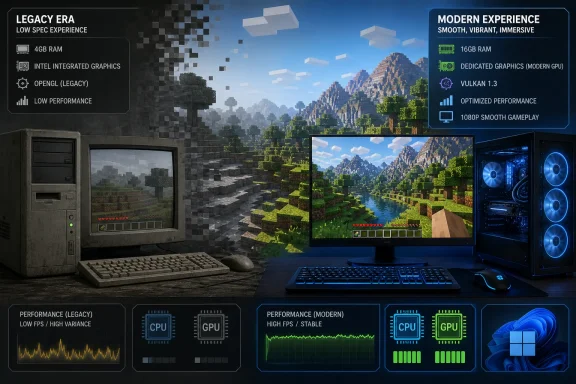
The new guidance does not erase that legacy. It does, however, replace a very old definition of “minimum” with a current, measurable performance target. Microsoft now defines the minimum specification around 1080p at 30 frames per second using the Fast preset, while recommended hardware targets 1080p at 60 FPS with the Fancy preset. Mojang’s published requirements therefore describe a practical standard of playability rather than merely the ability to reach the title screen.
That is a welcome bit of honesty. For years, a PC could technically meet Minecraft’s published requirements yet deliver choppy exploration, long chunk-loading pauses, compromised visuals, or an unpleasant experience in newer worlds and on multiplayer servers. The revised Minecraft Java Edition system requirements acknowledge that launching a game is not the same as running it well.
The change also arrives as Java Edition prepares for a graphics-transition milestone. Mojang explicitly says the game is moving away from OpenGL and toward Vulkan, a modernization effort that can improve the foundation for future rendering work but inevitably narrows the list of graphics hardware that will remain viable. The company says players will be kept informed as older hardware approaches retirement.
The New Minecraft Java Edition System Requirements
The change is substantial on paper. The most dramatic jumps involve memory, graphics support, and the age of the CPUs used as reference points.
| Category | Previous minimum | New minimum | Previous recommended | New recommended |
|---|---|---|---|---|
| Operating system | Windows 7, macOS 10.14.5, or newer | Windows 10 64-bit, Windows on ARM, macOS 12+, or 64-bit Linux | Windows 10, macOS 10.14.5, or newer | Windows 11 64-bit, macOS 14+, or 64-bit Linux |
| Processor | Intel Core i3-3210 / AMD A8-8600 / Apple M1 | Intel Core i3-10100 / AMD Ryzen 3 3100 / Qualcomm Snapdragon X / Apple M1 | Intel Core i5-4690 / AMD A10-7800 / Apple M1 | Intel Core i5-12400 / AMD Ryzen 5 5600 / Apple M2 Pro |
| Graphics | Intel HD Graphics 4000 / AMD Radeon R5 | GTX 950 / Radeon RX 460 / Arc A310 / newer compatible integrated graphics | GeForce 700-series / Radeon RX 200-series | GeForce RTX 2060 / Radeon RX 5600 XT / Arc A580 |
| Memory | 2GB | 8GB with discrete graphics; 12GB with integrated graphics | 4GB | 16GB |
The old and new reference hardware lists were reported alongside the announcement by Tom’s Hardware. The official store listing provides the current specifications in more detail, including the requirement for a four-physical-core processor, a 64-bit operating system, and a Vulkan 1.3-capable GPU with at least 2GB of VRAM for the minimum tier. Minecraft’s product page also assigns 6GB of VRAM to the recommended tier.
Minimum now means 1080p, not merely “it opens”
The minimum requirement is now:
- Windows 10 64-bit, Windows on ARM, macOS 12 or later, or 64-bit Linux
- 8GB RAM with a discrete graphics card, or 12GB RAM using integrated graphics
- At least a four-core CPU
- A compatible processor such as the Intel Core i3-10100, AMD Ryzen 3 3100, Qualcomm Snapdragon X, or Apple M1
- A Vulkan 1.3 GPU with at least 2GB VRAM
- A target of 1080p, 30 FPS, Fast preset
That is a major departure from the era when 2GB of memory and Intel HD Graphics 4000 could appear on the official sheet. It is still modest compared with current blockbuster PC releases, but it is no longer a specification designed around early-2010s integrated graphics. Mojang describes the revised minimum as a clearer baseline for a stable, modern Minecraft experience.
Recommended hardware is a realistic mainstream gaming PC
The new recommended configuration calls for:
- Windows 11 64-bit, macOS 14 or later, or 64-bit Linux
- 16GB RAM
- Intel Core i5-12400, AMD Ryzen 5 5600, or Apple M2 Pro
- Nvidia GeForce RTX 2060, AMD Radeon RX 5600 XT, Intel Arc A580, or Apple M2 Pro
- A target of 1080p, 60 FPS, Fancy preset
These are not exotic parts. The Core i5-12400 and Ryzen 5 5600 are mature, widely deployed desktop processors; the RTX 2060 and Radeon RX 5600 XT are also several hardware generations old. Yet the key point is not whether enthusiasts consider them “old.” It is that Microsoft is setting a contemporary floor for predictable performance, rather than promising that a much older PC will deliver an acceptable result simply because it can load the game.
Why 16GB of RAM Is the Headline Change
The leap from a previously recommended 4GB to 16GB is understandably attracting the most attention. On its face, it makes Minecraft sound four times more memory-hungry than before. In practice, the update is more nuanced.
Minecraft Java Edition does not necessarily reserve all 16GB for the Java process. The specification describes the total system memory a PC should have for the intended 1080p/60 FPS experience, leaving room for Windows, the launcher, browser tabs, voice chat, background services, texture packs, and other normal desktop activity. The game’s own support guidance notes that Minecraft may suffer crashes, lag, and stuttering when memory allocation does not fit the available RAM or the requirements of a chosen version. Minecraft’s support documentation also says the default memory allocation changed from 2GB to 4GB after version 26.1-snapshot-2.
That default allocation change matters because it puts the system requirement in perspective. A 4GB default heap is not the same as “Minecraft needs only 4GB.” A Windows PC with 4GB total memory has little capacity for the operating system and any other workload once the game begins loading a world. Even an 8GB machine can become constrained when it relies on integrated graphics, which borrow from system RAM rather than drawing on a separate pool of video memory.
The split between 8GB for PCs with discrete graphics and 12GB for integrated graphics is therefore one of the more thoughtful parts of the new specification. Integrated GPUs share memory bandwidth and memory capacity with the CPU and the rest of the system. Recommending more RAM in that scenario acknowledges a genuine architectural difference instead of treating every 8GB PC as equivalent.
There is also little evidence that 16GB is an unreasonable recommended capacity for today’s broad PC gaming audience. Valve’s June 2026 Steam Hardware Survey places 16GB as the single most common system-memory configuration at 41.57%, with 32GB close behind at 36.79%. Steam’s survey data is voluntary and is not a census of all Minecraft players, but it is useful confirmation that 16GB is firmly mainstream among active PC gamers.
The risk for low-cost laptops and school PCs
The downside is equally real. Many budget notebooks have soldered memory, leaving no practical upgrade path from 4GB or 8GB to 12GB or 16GB. A player with an old desktop may be able to add RAM or replace a graphics card. A player with a sealed low-end laptop often faces a much harsher choice: tolerate compromised performance, move to another edition, or replace the device.
That burden falls most heavily on households that benefited from Java Edition’s historic tolerance for low-end hardware. It is reasonable for Mojang to describe 16GB as a modern recommended capacity. It is less comfortable for players whose Minecraft machine is not a gaming PC at all, but an aging family laptop that previously remained usable precisely because Minecraft was forgiving.
Microsoft’s language is appropriately careful here. The updated chart is guidance, not an immediate technical block. Older machines should still start Java Edition for now, although Mojang states that performance and visual quality are not guaranteed below the new baseline. The official announcement specifically identifies old graphics cards, some older integrated GPUs, and older Intel-based Macs as systems likely to find themselves below minimum.
Vulkan Is the Long-Term Story
The new CPU and RAM targets are significant, but the Vulkan 1.3 requirement is the strategic heart of the announcement. Hardware recommendations can be adjusted on a store page. A rendering API transition changes the future support contract for the game.
Moving past OpenGL
Java Edition has longstanding OpenGL roots. That legacy helped the game run across Windows, macOS, and Linux for many years, but maintaining compatibility with aging graphics stacks and drivers carries an ongoing cost. Mojang says older requirements were tied to older graphics technology and no longer represent what Java Edition needs to run well. Its explanation ties the updated requirements directly to stronger graphics hardware with Vulkan 1.3 support.
Vulkan is not a magic frame-rate switch. It is a modern low-level graphics API, and the benefits players eventually see depend on the game’s renderer, drivers, operating system, and hardware. Still, the move can give developers more direct control over GPU work and establish a cleaner platform for future optimization and visual upgrades.
For Minecraft, the potential upside is not just prettier screenshots. A better graphics foundation can help reduce the friction involved in maintaining rendering code across platforms and make it easier to evolve the game over time. That matters for a title whose worlds have grown in scale and whose players increasingly expect high render distances, elaborate builds, shaders, resource packs, and busy multiplayer environments.
Compatibility will become more selective
The trade-off is unavoidable. Vulkan 1.3 support excludes hardware that may have been technically capable of running current OpenGL builds. The official minimum references GPUs such as the GeForce GTX 950, Radeon RX 460, and Intel Arc A310, while integrated Intel graphics require at least the iGPU found in a Core i5-6400 or newer. Minecraft’s current store listing also names Apple M1 and Qualcomm Snapdragon X as supported reference platforms.
This means that the compatibility concern is not limited to very old CPUs. A PC can have adequate processor speed and memory while still falling short because its graphics hardware or driver support does not meet the Vulkan requirement. The GPU becomes a more explicit gatekeeper for Java Edition’s future.
Mojang has not said that every below-spec PC will stop working on a fixed date. Instead, it says older systems may struggle or eventually fail to launch as the OpenGL-to-Vulkan transition advances. The company’s wording is important: a specification update describes the performance baseline now, while the eventual graphics migration is the event that could turn guidance into a true compatibility boundary.
The CPU Upgrade Is More Than a Generation Number
At minimum, Minecraft now points to an Intel Core i3-10100 or AMD Ryzen 3 3100. At recommended, it cites an Intel Core i5-12400 or AMD Ryzen 5 5600. Those examples are less about brand loyalty than about setting a floor for modern core counts, per-core performance, platform support, and sustained world simulation.
Minecraft remains heavily dependent on CPU performance. World generation, chunk loading, entity activity, redstone machines, simulation distance, server-side processing, and modded content can all impose processor pressure. The official product page plainly characterizes Minecraft as more CPU-intensive than GPU-intensive, even as graphics capability becomes more important for the Vulkan transition and Fancy-preset targets. Minecraft’s PC edition page makes that distinction in its FAQ.
A newer CPU does not guarantee identical results in every world. A lightly modded solo world, a high-population server, a giant technical build, and a shader-heavy installation are fundamentally different workloads. But a Core i5-12400 or Ryzen 5 5600 provides considerably more practical headroom than the formerly recommended Core i5-4690 or AMD A10-7800.
The requirements also recognize a changing PC landscape. Qualcomm Snapdragon X and Apple Silicon appear directly in the minimum list, while Apple M2 Pro appears in the recommended list. That is a meaningful signal that Minecraft Java Edition’s platform expectations are no longer framed solely around traditional x86 Windows desktops.
How the New Baseline Fits the Wider PC Market
The specification reset will feel severe to players on old hardware, but the recommended tier is not outside the center of the enthusiast PC market. Steam’s June 2026 figures show that Windows 11 64-bit accounts for 70.44% of surveyed systems across Steam’s combined platform data, while Windows 10 64-bit represents 23.56%. Valve’s June survey therefore indicates that Microsoft’s Windows 10 minimum and Windows 11 recommendation reflect the operating systems most active PC gamers are already using.
Likewise, the survey records six-core and eight-core systems as its most common physical CPU categories, at 27.64% and 26.69% in the overall data shown by Valve. Steam’s hardware breakdown should not be misread as a Minecraft performance database, but it supports the argument that four-core minimum and modern six-core recommended examples are not unusually demanding for a 2026 gaming PC.
The same data tells a more complicated story about graphics. Hardware such as the GeForce RTX 2060 is no longer cutting edge, but many active systems still use GPUs well below it. Valve lists the GTX 1650 at 2.50% of surveyed hardware and the GTX 1050 Ti at 1.16%, alongside numerous integrated Intel and AMD graphics configurations. Steam’s GPU list illustrates why a Vulkan-based minimum will matter: even among dedicated gamers, a non-trivial number of systems sit at the boundary between “still playable” and “no longer officially supported.”
Bedrock Edition Is a Safety Valve, Not a Complete Substitute
Players who cannot meet the updated Java Edition recommendation are not automatically shut out of Minecraft on Windows. Bedrock Edition remains much lighter on paper: its listed minimum is 4GB of RAM with an Intel Celeron J4105 or AMD FX-4100, while the recommended specification is 8GB of RAM with an Intel i7-6500U or AMD A8-6600K. Minecraft’s official comparison page says Bedrock often runs more smoothly and does not require powerful hardware.
That is a meaningful option, particularly because Minecraft for PC now bundles Java and Bedrock editions for many purchasers. For households using basic PCs, Bedrock may offer the more reliable path to local worlds, Realms, controller support, and cross-platform play with console and mobile users.
But it should not be presented as a frictionless replacement for every Java player. Java Edition’s identity is deeply linked to:
- Community-created mods
- Independent launchers and mod loaders
- Custom servers and server-side communities
- Java-specific resource packs, datapacks, and technical playstyles
- Cross-play with Java users on Windows, macOS, and Linux
Bedrock brings its own strengths, including broader device support, official Marketplace content, native controller options, and cross-play across Windows, Xbox, PlayStation, Switch, and mobile. Minecraft’s edition comparison makes clear, however, that the editions are not interchangeable: Java supports independent mods, while Bedrock has the broader cross-platform network.
For a casual player, Bedrock may be an excellent performance-oriented alternative. For a player tied to a specific Java modpack, a Java-only server, or a long-running technical world, it is a different ecosystem rather than a direct migration path.
What Existing Players Should Take From the Announcement
The practical message is calmer than the headline numbers suggest. A PC below the new minimum does not need to be discarded immediately. Mojang says the game should still launch on below-spec hardware today, and players who are already having a satisfactory experience may see no instant change. Its guidance advises using the revised recommended level primarily as the best target when assessing a new purchase or diagnosing ongoing performance problems.
A sensible response for Windows players is to separate three different situations:
- The PC already runs Java Edition well.
Continue playing, but recognize that future renderer changes may affect compatibility. Keep graphics drivers and Windows updates current, particularly on a system near the Vulkan support boundary. - The PC runs Java Edition poorly but is upgradeable.
More RAM may help, especially on a desktop with 8GB total memory or integrated graphics. A supported discrete GPU can also be decisive if Vulkan compatibility is the weak point. CPU upgrades require more caution because they may demand a new motherboard and memory platform. - The PC is an older, non-upgradeable laptop.
Bedrock Edition may be the most cost-effective way to retain a smooth Minecraft experience. The decision depends on whether the player’s worlds, friends, mods, and servers are tied specifically to Java Edition.
The most important shopping rule is to avoid buying to the absolute minimum. A four-core, 8GB desktop with a 2GB GPU may meet the current Java Edition baseline, but it leaves little margin for multitasking, future updates, high render distances, popular modpacks, or demanding shaders. The 16GB recommended target is the more durable starting point for anyone purchasing a Minecraft PC rather than simply extending the life of an existing machine.
A Necessary Modernization With a Real Accessibility Cost
Microsoft’s revised Minecraft system requirements are ultimately a defensible modernization. The old chart had stopped communicating what players could realistically expect from a current version of Java Edition. Specifying 1080p, frame-rate targets, presets, VRAM, core counts, and graphics API support is vastly more useful than repeating requirements rooted in a much older PC era.
The move to Vulkan is especially significant. It gives Mojang a path to improve and maintain Java Edition’s rendering architecture without indefinitely preserving every legacy OpenGL configuration. That should benefit the game’s long-term health, even if it creates a future compatibility line that some old hardware cannot cross.
Yet accessibility remains the uncomfortable side of the story. Minecraft became a cultural institution partly because it ran everywhere. A family PC with 4GB of RAM, an outdated integrated GPU, or an old Intel Mac may still launch the game now, but it no longer occupies a supported place in the game’s future. For players with soldered memory, unsupported graphics, or no budget for a new machine, that distinction has real consequences.
The fair reading is neither that Minecraft suddenly demands a powerful gaming rig nor that the change is meaningless. Minecraft: Java Edition is becoming clearer about the hardware it needs for the experience it wants to deliver. The published minimum remains relatively light for a modern PC game, but the age of treating every old Windows laptop as a dependable Java Edition machine is coming to an end.
