
Minecraft will receive a native Nintendo Switch 2 release on October 27, 2026, finally moving the game beyond the original Switch build that has run on Nintendo’s newer hardware through backward compatibility. The practical draw is Mojang’s Vibrant Visuals graphics mode—enhanced directional lighting, moving shadows, volumetric fog, water effects, and other rendering changes that the original Switch hardware did not support.
The date, first reported Wednesday by Insider Gaming and independently confirmed by GameSpot, fills in the major omission from Mojang’s June 9 announcement. Mojang had previously confirmed only that a native Switch 2 version was coming in 2026, calling it “optimized” for the more powerful console and promising Vibrant Visuals as the default graphics setting. Its public announcement still described the launch only as “coming soon,” even after the October 27 date began circulating.
For Windows and Xbox players who use Minecraft’s Bedrock cross-play, this is less a new content release than a long-delayed hardware parity update. A Switch 2 owner joining a Realm or a cross-platform world from Windows 11, Xbox, PlayStation, Android, or iOS will be running the same Bedrock game and sharing the same gameplay rules—but with a much more modern renderer available locally.
Nintendo’s existing store listing identifies the current Switch release as compatible with Switch 2 and says its behavior is consistent with the original Nintendo Switch. That is backward compatibility: the older software runs on the newer machine, but it is still constrained by the older target hardware and its rendering feature set.
Mojang’s October release is different. The company described the Switch 2 edition in June as a native version optimized for the console, which is why it can expose Vibrant Visuals rather than simply improve frame pacing or loading in the older build. In other words, players who have already launched Minecraft on Switch 2 have been using a compatible Switch title; October 27 is when the platform gets the version Mojang actually built around Switch 2 hardware.
That distinction also explains why an ordinary title update was not enough. Minecraft’s Bedrock Edition has had Vibrant Visuals on a growing list of platforms since the June 2025 Chase the Skies update, including Windows PCs using DirectX 12, Xbox consoles, PlayStation consoles, supported Android and iOS devices. Nintendo Switch was left out. The Switch 2 release brings Nintendo’s current platform into that rendering tier rather than making the original Switch version carry a feature it could not realistically support.
Mojang calls Vibrant Visuals its largest graphics upgrade to date. The description is promotional, but the underlying change is concrete: lighting becomes directional, shadows respond to the position of the sun, fog gains depth, water can reflect light more convincingly, and material effects such as emissive textures are rendered with greater range than the legacy graphics modes.
That is a meaningful qualification for the Switch audience, where one-console couch co-op remains a common way to play. The native Switch 2 edition can still support local multiplayer, but the purchasers most interested in sharing a TV with children or siblings should not expect the launch’s showcase lighting to remain active once a second local player joins.
This is not unique to Nintendo. Mojang has treated split-screen as unsupported for Vibrant Visuals on other Bedrock platforms as well, likely because rendering multiple camera views sharply increases the graphics workload. But it undercuts the impression that Switch 2’s extra power makes the new visual mode universal. It does not: the upgrade is a single-view experience first.
Marketplace compatibility is the second unresolved practical constraint. Mojang has not published a list of templates, add-ons, or worlds that will not work with Vibrant Visuals on Switch 2. The company has previously acknowledged that customized content can require fallback behavior, which makes sense when a world relies on its own rendering assumptions or resource packs. Until Mojang details the exclusions, players with large Marketplace libraries should view the mode as a per-world setting rather than a guaranteed visual overhaul for every saved game.
Mojang says the pack is being updated specifically to make use of Vibrant Visuals. This is more than a routine preservation step: the Mario pack was designed around Minecraft’s older, flatter console lighting. Applying the new renderer gives Mojang a reason to revisit one of the few pieces of Minecraft content tied to a specific hardware family rather than treating the Switch 2 version as a generic Bedrock port.
The update also reinforces the unusual relationship at work here. Minecraft is owned by Microsoft, but the Super Mario content is restricted to Nintendo versions of the game. Players moving worlds between a Switch 2 and a Windows PC can retain normal Bedrock cross-play, Microsoft-account features, and Marketplace access, but the Mario mash-up remains a Nintendo-side feature. It should not be treated as portable Minecraft DLC across the broader Microsoft ecosystem.
Those omissions are material. “Digital upgrade path” is not the same thing as “free upgrade,” and it does not establish eligibility for every ownership scenario. A customer who bought Minecraft digitally through the Nintendo eShop, a customer using an original physical Switch cartridge, and a household relying on Nintendo account sharing may not necessarily face the same steps. Mojang and Nintendo have not yet published those terms.
There is precedent for a smoother migration within Minecraft itself. When the 2017 Minecraft: Nintendo Switch Edition gave way to the cross-platform Bedrock release in 2018, Nintendo offered existing owners a free eShop upgrade and allowed worlds to be converted, while warning that migration could take time. That history makes a no-cost Switch 2 entitlement plausible, but it is not a promise for 2026. Mojang’s current language leaves the price and license conditions open.
The company has also said previously that progress and worlds from the Switch version can carry over to Switch 2. That is the more important assurance for long-term players: the October release should not force a choice between a better renderer and years of survival worlds, Realm participation, or shared Bedrock play with friends on Windows and Xbox.
The consequence is visual parity inside mixed-platform sessions. Switch players have spent more than a year as an exception while Minecraft’s newer renderer reached PC, Xbox, PlayStation, and mobile hardware. From October 27, a Switch 2 owner can choose a visual presentation closer to what their Windows and current-generation console friends see, provided the session is not local split-screen and the selected world supports Vibrant Visuals.
Mojang still needs to answer the purchasing question before the release is useful to the existing Switch audience it is courting. Until then, October 27 is a firm launch date for the native edition—but not yet a complete upgrade plan for the players who already bought Minecraft on Nintendo Switch.
For Windows and Xbox players who use Minecraft’s Bedrock cross-play, this is less a new content release than a long-delayed hardware parity update. A Switch 2 owner joining a Realm or a cross-platform world from Windows 11, Xbox, PlayStation, Android, or iOS will be running the same Bedrock game and sharing the same gameplay rules—but with a much more modern renderer available locally.
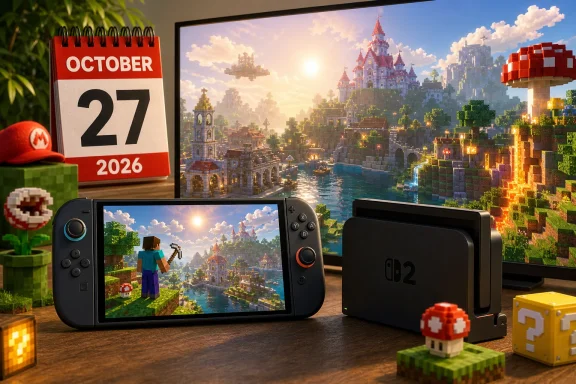 A native Switch 2 version, not merely compatibility mode
Nintendo’s existing store listing identifies the current Switch release as compatible with Switch 2 and says its behavior is consistent with the original Nintendo Switch. That is backward compatibility: the older software runs on the newer machine, but it is still constrained by the older target hardware and its rendering feature set.Mojang’s October release is different. The company described the Switch 2 edition in June as a native version optimized for the console, which is why it can expose Vibrant Visuals rather than simply improve frame pacing or loading in the older build. In other words, players who have already launched Minecraft on Switch 2 have been using a compatible Switch title; October 27 is when the platform gets the version Mojang actually built around Switch 2 hardware.
That distinction also explains why an ordinary title update was not enough. Minecraft’s Bedrock Edition has had Vibrant Visuals on a growing list of platforms since the June 2025 Chase the Skies update, including Windows PCs using DirectX 12, Xbox consoles, PlayStation consoles, supported Android and iOS devices. Nintendo Switch was left out. The Switch 2 release brings Nintendo’s current platform into that rendering tier rather than making the original Switch version carry a feature it could not realistically support.
Mojang calls Vibrant Visuals its largest graphics upgrade to date. The description is promotional, but the underlying change is concrete: lighting becomes directional, shadows respond to the position of the sun, fog gains depth, water can reflect light more convincingly, and material effects such as emissive textures are rendered with greater range than the legacy graphics modes.
The visual upgrade has limits that matter for households
The headline feature will not be active in every Minecraft session. GameSpot reports that Mojang’s own materials exclude split-screen play from Vibrant Visuals, and say certain Marketplace worlds and content will also run without the graphical upgrade. When local split-screen is enabled, Minecraft falls back to the older Fancy or Simple rendering modes.That is a meaningful qualification for the Switch audience, where one-console couch co-op remains a common way to play. The native Switch 2 edition can still support local multiplayer, but the purchasers most interested in sharing a TV with children or siblings should not expect the launch’s showcase lighting to remain active once a second local player joins.
This is not unique to Nintendo. Mojang has treated split-screen as unsupported for Vibrant Visuals on other Bedrock platforms as well, likely because rendering multiple camera views sharply increases the graphics workload. But it undercuts the impression that Switch 2’s extra power makes the new visual mode universal. It does not: the upgrade is a single-view experience first.
Marketplace compatibility is the second unresolved practical constraint. Mojang has not published a list of templates, add-ons, or worlds that will not work with Vibrant Visuals on Switch 2. The company has previously acknowledged that customized content can require fallback behavior, which makes sense when a world relies on its own rendering assumptions or resource packs. Until Mojang details the exclusions, players with large Marketplace libraries should view the mode as a per-world setting rather than a guaranteed visual overhaul for every saved game.
Mario’s Minecraft world gets the upgrade too
The Switch 2 edition will also refresh the Super Mario Mash-Up Pack, a Nintendo-exclusive Minecraft package that includes Mario-themed textures, skins, music, and a custom world with locations such as Peach’s Castle and Delfino Plaza. Nintendo’s current Switch store page says the pack includes 15 music tracks and 40 player skins.Mojang says the pack is being updated specifically to make use of Vibrant Visuals. This is more than a routine preservation step: the Mario pack was designed around Minecraft’s older, flatter console lighting. Applying the new renderer gives Mojang a reason to revisit one of the few pieces of Minecraft content tied to a specific hardware family rather than treating the Switch 2 version as a generic Bedrock port.
The update also reinforces the unusual relationship at work here. Minecraft is owned by Microsoft, but the Super Mario content is restricted to Nintendo versions of the game. Players moving worlds between a Switch 2 and a Windows PC can retain normal Bedrock cross-play, Microsoft-account features, and Marketplace access, but the Mario mash-up remains a Nintendo-side feature. It should not be treated as portable Minecraft DLC across the broader Microsoft ecosystem.
Existing Switch owners have a path—but no price
The central unanswered question is whether current owners will need to pay again. Mojang has said that people who already own Minecraft on Nintendo Switch will receive a digital upgrade path, with more details to follow. It has not said whether that path is free, what it costs if it is paid, whether it applies to physical cartridge owners, or whether it results in a separate Switch 2 software license.Those omissions are material. “Digital upgrade path” is not the same thing as “free upgrade,” and it does not establish eligibility for every ownership scenario. A customer who bought Minecraft digitally through the Nintendo eShop, a customer using an original physical Switch cartridge, and a household relying on Nintendo account sharing may not necessarily face the same steps. Mojang and Nintendo have not yet published those terms.
There is precedent for a smoother migration within Minecraft itself. When the 2017 Minecraft: Nintendo Switch Edition gave way to the cross-platform Bedrock release in 2018, Nintendo offered existing owners a free eShop upgrade and allowed worlds to be converted, while warning that migration could take time. That history makes a no-cost Switch 2 entitlement plausible, but it is not a promise for 2026. Mojang’s current language leaves the price and license conditions open.
The company has also said previously that progress and worlds from the Switch version can carry over to Switch 2. That is the more important assurance for long-term players: the October release should not force a choice between a better renderer and years of survival worlds, Realm participation, or shared Bedrock play with friends on Windows and Xbox.
Windows players gain parity, not a new feature set
For the Windows audience, the Switch 2 release does not introduce new blocks, mobs, server tools, or cross-play capabilities. Bedrock players on Windows already have access to the same family of graphical technology, and Minecraft’s cross-platform model means a Switch 2 player can continue joining Windows-hosted worlds and Realms without waiting for everyone else to move to the new version.The consequence is visual parity inside mixed-platform sessions. Switch players have spent more than a year as an exception while Minecraft’s newer renderer reached PC, Xbox, PlayStation, and mobile hardware. From October 27, a Switch 2 owner can choose a visual presentation closer to what their Windows and current-generation console friends see, provided the session is not local split-screen and the selected world supports Vibrant Visuals.
Mojang still needs to answer the purchasing question before the release is useful to the existing Switch audience it is courting. Until then, October 27 is a firm launch date for the native edition—but not yet a complete upgrade plan for the players who already bought Minecraft on Nintendo Switch.
References
- Primary source: Insider Gaming
Published: 2026-08-05T18:54:57+00:00
Loading…
insider-gaming.com - Related coverage: gamesradar.com
Loading…
www.gamesradar.com - Related coverage: minecraft.net
Loading…
www.minecraft.net - Related coverage: nintendo.com
Loading…
www.nintendo.com - Related coverage: minecraft.wiki
Loading…
minecraft.wiki - Related coverage: minecraft.net
What is Minecraft? Discover the World of Minecraft | Minecraft
Learn more about Minecraft, an action-adventure sandbox game. Discover the world of Minecraft, explore game features, and see what platforms you can play Minecraft on.www.minecraft.net - Related coverage: nintendo.com
Loading…
www.nintendo.com - Related coverage: help.minecraft.net
Loading…
help.minecraft.net - Related coverage: minecraft.it
Loading…
minecraft.it - Related coverage: help.minecraft.net
Loading…
help.minecraft.net - Related coverage: gamespot.com
Loading…
www.gamespot.com - Related coverage: nintendo.co.jp
Loading…
www.nintendo.co.jp - Related coverage: mojenintendo.cz
Loading…
mojenintendo.cz - Related coverage: news.xbox.com
Loading…
news.xbox.com - Related coverage: breakingnewsenglish.com
Loading…
breakingnewsenglish.com - Related coverage: windowscentral.com
Loading…
www.windowscentral.com - Related coverage: gamesradar.com
Loading…
www.gamesradar.com - Related coverage: time.com
Nintendo, Mojang Partner for 'Super Mario'-Themed Minecraft
Nintendo and Mojang are joining hands to bring Mario, Luigi, and more to Minecraft: Wii U Edition on May 17.time.com - Related coverage: gamespot.com
Minecraft - GameSpot
Minecraft is a game that involves players creating and destroying various types of blocks in a three dimensional environment.www.gamespot.com - Related coverage: gameinformer.com
Here's Everything Announced During Nintendo's 2026 Summer Direct
The Legend of Zelda: Ocarina of Time remake is real, Deltarune's next chapter is on the way, all the Xenoblades are being remastered, and lots moregameinformer.com - Related coverage: news.xbox.com
Minecraft Dungeons II Blows the Doors of the ARPG Wide Open - XBOX Wire
We played Minecraft Dungeons II at XBOX Games Showcase and found out how it's becoming the ARPG for everyone.news.xbox.com - Related coverage: theshortcut.com
Nintendo Direct live blog: all the announcements, trailers and real-time reactions
Get ready for games, games, games!www.theshortcut.com - Related coverage: gamewatcher.com
Minecraft Nintendo Switch 2 Release Date, Content & | GameWatcher
Minecraft is getting a Nintendo Switch 2 native version soon, but when is it launching and what unique features and content is it packing? Here we've collected all the answers so far.www.gamewatcher.com
- Related coverage: videogameschronicle.com
Nintendo Direct: Here’s everything announced during Nintendo’s show | VGC
Nearly 50 games featured during Nintendo’s latest presentation…www.videogameschronicle.com - Related coverage: mariowiki.com
Minecraft - Super Mario Wiki, the Mario encyclopedia
Minecraft is a game developed by Mojang Studios. It is a 3D sandbox game with a blocky aesthetic centered around gathering resources to survive from environmental hazards or hostile mobs, exploring the randomly generated terrain, and creating worlds...www.mariowiki.com - Related coverage: media.nintendo.com
- Related coverage: feedback.minecraft.net
Vibrant Visuals for split screen – Minecraft Feedback
I absoleutly love vibrant visuals and i think it should be enabled in split screen too. So many people are having this problem and if you...feedback.minecraft.net - Related coverage: perfectly-nintendo.com
Minecraft (Switch, Switch 2): all the updates (latest update: Ver. 26.40) – Perfectly Nintendo
Check out all the updates for Minecraft on Nintendo Switch and Nintendo Switch 2!www.perfectly-nintendo.com - Related coverage: play-asia.com
Minecraft: Nintendo Switch 2 Edition for Nintendo Switch 2
Minecraft: Nintendo Switch 2 Edition for Nintendo Switch 2Create your very own world and build to the limits of your imaginationExplore mighty mountains...www.play-asia.com - Related coverage: mp1st.com
Minecraft Update 3.16 for Bedrock Version 1.21.93/94 Applies Fixes
The latest Minecraft update is live now on all platforms, and this applies a short list of fixes as part of update 3.16.mp1st.com - Related coverage: trucoteca.com
Minecraft on Nintendo Switch 2: New Features and Vibrant Visuals
Minecraft is coming to Nintendo Switch 2 in 2026! Discover Vibrant Visuals mode, FPS enhancements, and how to transfer your worlds. Sign up now!trucoteca.com - Related coverage: altchar.com
Minecraft Bedrock 1.21.92 Patch brings key fixes to gameplay and visuals | AltChar
Mojang rolls out Minecraft Bedrock 1.21.92 update, addressing gameplay, projectile, and graphical issues following the Chase the Skies update. Get the full patch details here. www.altchar.com
- Related coverage: feedback.minecraft.net
Minecraft Beta & Preview - 1.21.90.20 – Minecraft Feedback
Posted: 22 April 2025 Information on Minecraft Preview and Beta: These work-in-progress versions can be unstable and may not be...feedback.minecraft.net - Related coverage: windowscentral.com
Minecraft Dungeons 2 quietly surfaces on the Nintendo eShop with a leaked September release and a $29.99 price | Windows Central
Nintendo accidentally reveals Minecraft Dungeons 2 early.www.windowscentral.com - Related coverage: techradar.com
Pokémon Pokopia launches in March 2026, and it seems like it'll be the first Nintendo-published Switch 2 game to release on a Game-Key Card | TechRadar
Nintendo has announced the release date for its Animal Crossing-like sandbox game, Pokémon Pokopia.www.techradar.com - Related coverage: tomsguide.com
Nintendo Switch 2 restocks live — Best Buy, Target, Walmart and more confirmed stock | Tom's Guide
Here’s where to buy a Switch 2 this weekwww.tomsguide.com - Related coverage: techradar.com
Cyber Monday Nintendo Switch 2 deals are over, but plenty of big discounts are still live today | TechRadar
Cyber Monday is in the rear view mirror, but you can still save on these Nintendo Switch 2 deals.www.techradar.com