
Montage’s July 31 announcement says the Type 3 controller supports CXL.mem and CXL.io, connects to DDR5 at up to 8000 MT/s, and is intended for PCIe add-in cards and EDSFF modules. Samsung and SK hynix are named as partners with initial validation completed. But neither Montage nor those partners has announced a shipping CXL 3.2 memory module, a module capacity, a price, a server qualification list, or a mass-production date.
That omission sets the practical boundary around this news: the controller is in trial production, not a generally available CXL 3.2 memory product. For Windows and Linux infrastructure teams, this is an early supply-chain milestone rather than a deployment notice.
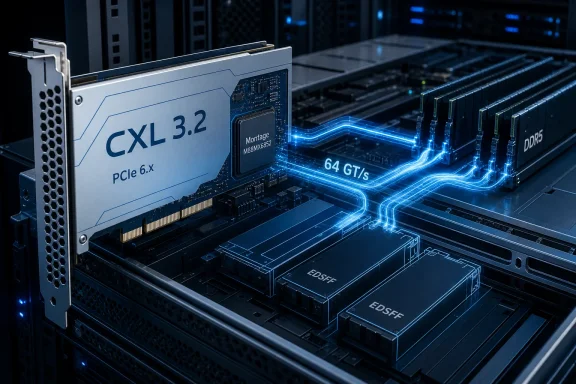 The same controller has moved from CXL 3.1 sampling to CXL 3.2 trial production
Montage’s own record makes this announcement more specific than the “industry-first” language suggests. On September 1, 2025, the company announced the M88MX6852 as a CXL 3.1 controller in customer sampling. That release listed the same basic hardware profile: a PCIe 6.2 physical interface at up to 64 GT/s over an x8 link, a dual-channel DDR5 controller running at up to 8000 MT/s, dual RISC-V processors, and support for E3.S EDSFF and PCIe add-in-card designs.
The company’s current M88MX6852 product page now describes that part as compliant with CXL 3.2, while also listing compatibility with CXL 1.1 and 2.0. In other words, the July announcement is best read as a production and protocol-revision milestone for a controller already disclosed under the same part number—not the debut of an entirely new 64 GT/s controller architecture.
That distinction matters in procurement planning. CXL 3.2 did not create the headline 64 GT/s link rate; CXL 3.0 introduced PCIe 6.0-class signaling and the jump from 32 GT/s in the CXL 2.0 generation. The CXL Consortium released CXL 3.2 in December 2024, following CXL 3.1 in November 2023. Montage’s move to 3.2 therefore brings its controller in line with a specification that has been available for more than a year and a half, rather than opening a new physical-bandwidth tier.
Montage calls this the industry’s first trial production of a CXL 3.2 MXC. The company has not identified the process node, manufacturing partner, production volume, yield status, or criteria that define “trial production,” and no public CXL Consortium certification result for this 3.2 controller accompanied the announcement. The claim should be understood as Montage’s own manufacturing-status assertion, not as an independently published ranking of every CXL controller program.
CXL memory solves a capacity problem before it solves a performance problem
A Type 3 CXL device contributes memory capacity to a host, presenting attached DDR5 as CXL-accessible memory rather than as directly attached DIMMs. The M88MX6852 translates host CXL memory requests into DDR commands, which is the essential work of a memory expander controller.
That architecture can help when a server needs more memory than its local DIMM channels can economically provide, or when an operator wants a separate tier of memory for workloads with very large resident data sets. In-memory databases, analytics, virtual-machine consolidation, retrieval systems, and some AI pipelines are the obvious candidates. A controller with two DDR5 channels can also give module makers flexibility to produce add-in cards or EDSFF memory devices that use conventional DDR5 components rather than waiting for a wholly different memory technology.
It does not make CXL-attached DDR5 equivalent to CPU-attached DDR5. The SNIA’s CXL education material places direct host DRAM at roughly 100 ns total access latency, compared with roughly 170–210 ns for a directly attached CXL memory module; a switch can raise the projected range to roughly 270–510 ns. Actual results vary sharply by platform, memory configuration, link width, firmware, and workload, but the direction is clear: CXL capacity comes with a locality and latency cost.
Intel makes the same operational point in its documentation for Xeon 6 Flat Memory Mode. In the ordinary CXL configuration, CXL memory appears to the operating system as a separate NUMA node without CPU cores, leaving the OS or application to manage placement. Flat Memory Mode can instead expose local DRAM and CXL memory as a single address space and automatically tier data in hardware—but Intel says it is intended for capacity-constrained workloads, not those that demand fine-grained locality control or latency-critical placement.
For administrators, that means CXL is not an automatic performance upgrade. It is an additional memory tier whose value depends on avoiding SSD paging, increasing usable memory density, or placing less latency-sensitive data away from expensive local DRAM. A system that treats all memory as interchangeable may gain capacity while obscuring a performance trade-off that database, virtualization, and AI teams will still need to measure.
PCIe 6.x hardware is the gate before the controller becomes useful
Montage lists a PCIe 6.2 physical layer and 64 GT/s over x8 lanes for the M88MX6852. PCI-SIG defines PCIe 6.0 at 64 GT/s, using PAM4 signaling with forward error correction and CRC mechanisms that are necessary at that speed. Those electrical requirements are central to why controller availability is only one part of the deployment equation.
The host processor, motherboard routing, BIOS or UEFI, retimers where required, switch fabric, memory module, operating system, and management software all need to agree on a usable configuration. A CXL controller can negotiate down or maintain compatibility in some environments, but a CXL 3.2 label does not cause an older CXL 1.1 or CXL 2.0 host to gain CXL 3.x pooling and fabric capabilities.
Montage says its controller is designed for Intel Xeon and AMD EPYC platforms, but the statement deliberately names processor families rather than validated server models or CXL generations. The current platform picture is uneven. Intel’s public Xeon documentation describes CXL support across recent Xeon generations, while its Xeon 6 Flat Memory Mode documentation requires supported Type 3 devices, platform firmware support, and OS support validated by the system vendor. AMD’s public EPYC material likewise shows CXL capability varying by generation.
The missing detail is the one operators need: which shipping server platforms have a qualified PCIe 6.x/CXL 3.x path for a M88MX6852-based module. Montage has not published that list. Samsung and SK hynix have not published it either.
That makes the partner validation claim encouraging but preliminary. Montage says Samsung and SK hynix have integrated the controller into next-generation CXL products and completed initial validation. It does not say whether that validation covered CXL 3.2 operation at 64 GT/s, which host CPUs and boards were used, whether switching and pooling were exercised, or whether validation included operating systems used in production.
The Windows Server implications remain largely unannounced
CXL memory is fundamentally a server feature, not a Windows 11 upgrade path. The immediate audience is OEMs, hyperscalers, memory-module manufacturers, and enterprises operating supported Xeon or EPYC servers. A desktop with an open PCIe slot is not a CXL memory expansion platform unless its CPU, board firmware, and operating system expose the required CXL capabilities.
Windows Server support also needs to be treated as a platform qualification issue, not a chip feature. A Type 3 device may be visible as memory, but how Windows Server reports NUMA topology, how Hyper-V workloads are placed, whether the OEM enables tiering features, and whether monitoring tools correctly account for the additional memory tier all determine whether the configuration is operationally useful.
Montage says it supplies an SDK plus analysis and test tools to customers building products around the controller. That is useful for module vendors, but it is not a public driver package, a Windows Server compatibility statement, or a management stack for enterprise administrators. The company has not disclosed a Windows Server version matrix, Hyper-V guidance, failover-clustering support, or RAS behavior for a completed module.
Administrators should therefore resist treating the July announcement as a reason to revise hardware standards today. The test plan must start with OEM validation, BIOS maturity, supported memory modules, NUMA behavior, application memory-placement policy, and failure handling—not the controller’s maximum transfer-rate figure.
The next visible proof point is a module, not a booth demonstration
Montage is scheduled to show the controller at CXL Mini DevCon in Santa Clara on August 3 and at the Future of Memory and Storage conference from August 4 through August 6, where it will exhibit at booth 845. Those demonstrations may clarify which form factors and partner products are closest to market.
The material test will come later: a named Samsung, SK hynix, or other vendor module; a named PCIe 6.x-capable server platform; published interoperability and performance data; and a date for volume availability. Until those pieces are public, Montage has advanced an important controller program, but the deployable CXL 3.2 memory systems promised by the announcement remain a product roadmap rather than an item an IT team can order.
