

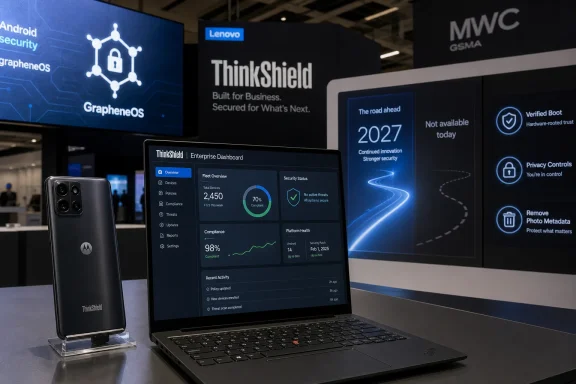
Motorola paired that long-term hardware agreement with Moto Analytics, a fleet-health telemetry platform, and Private Image Data, an automatic photo-metadata removal feature. The three products serve different jobs, but together they show Motorola and parent company Lenovo trying to move further into managed mobility: security at the device level, operational data for administrators, and a privacy control that can be applied without relying on employee behavior.
The important distinction is timing. Motorola announced a direction, a platform, and a feature rollout—not a finished GrapheneOS enterprise handset portfolio.
GrapheneOS support depends on Motorola hardware that does not exist yet
Motorola said it is working with the GrapheneOS Foundation on “future devices engineered with GrapheneOS compatibility.” The GrapheneOS project’s own announcement is more specific about the commitment: the partnership covers future Motorola devices that meet its privacy and security standards and will receive official support.
That language matters. GrapheneOS is not merely an Android launcher, a set of privacy apps, or an operating-system image that can be safely adapted to any phone with an unlockable bootloader. Its support model depends on a chain that includes device-specific firmware, kernel and driver updates, verified boot, hardware-backed attestation, downgrade protection, and security capabilities such as hardware memory tagging. GrapheneOS’s current build documentation still lists only Google Pixel hardware as production-ready supported devices.
In other words, Motorola is not adding a download page for current Razr or Edge owners. Existing Motorola devices are not part of the announced support plan. GrapheneOS representatives have said the first eligible devices are expected to be 2027 flagship-class models, similar to the Motorola Signature, Razr Fold, and Razr Ultra families, because those are expected to meet the project’s hardware requirements.
Motorola itself did not announce a model, price, regional availability, carrier arrangement, update commitment, or a date for a GrapheneOS-capable phone. It also did not say whether GrapheneOS will be factory-installed, offered as an alternate official image, or both. That is more than a missing marketing detail: the answer determines who owns enrollment, support, warranty workflow, compliance attestation, and incident response in an enterprise deployment.
ITmedia reported that Motorola intends to bring some GrapheneOS-derived protections into Moto Secure and its mainstream phones in the near term. Motorola’s own release is narrower. It promises joint research, software enhancements, and new security capabilities in coming months, but does not identify which GrapheneOS features will arrive, on which devices, or under what version requirements. Administrators should therefore treat any claim of near-term GrapheneOS feature parity on ordinary Motorola phones as unconfirmed until Motorola publishes a device-and-build matrix.
The partnership does still alter the market. Until now, an organization wanting officially supported GrapheneOS hardware was effectively choosing from the supported Pixel range. A second hardware supplier could reduce that dependency and eventually give buyers a choice between form factors, supply channels, and commercial support relationships. But the operative word is could. The proof will be whether Motorola ships a device with an unlockable and relockable verified boot path, timely firmware support, and a security-update lifecycle that stands up to the standard GrapheneOS has applied to Pixels.
Moto Analytics promises visibility, but Motorola has not published the operational details
Moto Analytics is the product in this announcement aimed most directly at Windows administrators and mobility teams. Motorola describes it as an enterprise analytics platform offering real-time visibility into app stability, battery health, and network connectivity across a device fleet. It positions the service beside traditional enterprise mobility management tools, which usually focus on enrollment, compliance policies, app deployment, conditional access, and remote administration.
That division is plausible. Microsoft Intune, for example, can report device compliance and inventory while applying configuration and access rules, but operational fleet telemetry often requires separate vendor dashboards, endpoint analytics, carrier tools, mobile threat defense products, or custom reporting. A dashboard that identifies a failing battery cohort, a crash-prone line-of-business app version, or a connectivity problem tied to a location or carrier could reduce help-desk triage time for organizations with field workers, retail devices, warehouse scanners, or company-owned Android handsets.
Motorola’s wording, however, leaves the buying-critical questions unanswered. The company has not published a public data sheet explaining whether Moto Analytics is a standalone cloud service, part of ThinkShield for Mobile, bundled with certain devices, or licensed per device. There is no stated integration with Microsoft Intune, VMware Workspace ONE, SOTI, Ivanti, or Google’s Android Enterprise management APIs. Motorola also has not disclosed data-retention rules, tenant residency options, role-based access controls, export APIs, alerting mechanisms, or the fields collected from managed phones.
Those omissions are especially consequential because an analytics product designed to show device health necessarily gathers operational data. For a global organization, the question is not only whether the dashboard can flag poor connectivity. It is whether the system records user identifiers, app inventories, location-adjacent network information, timestamps, or other data that turns device telemetry into employee monitoring. Motorola says Moto Analytics scales within Lenovo’s ThinkShield ecosystem, but “integration” is not a substitute for documentation about data flow and administration.
For now, Moto Analytics should be regarded as an announced capability, not a proven replacement for existing mobile telemetry or EMM reporting. Organizations evaluating it should ask Motorola for supported-management-platform details, a data-processing agreement, API documentation, sample reports, pricing, and a clear list of device models and regions where the service is available. Without those, it is impossible to judge whether the platform fills a real operational gap or simply creates another console alongside Intune.
Private Image Data is the first announcement with a practical near-term use case
Private Image Data is the most concrete of Motorola’s three announcements. Motorola says the Moto Secure feature automatically removes sensitive metadata from new camera images when enabled, including location and device information, while preserving the visible image. The company says the feature will begin rolling out to Motorola Signature devices in the coming months.
For organizations where staff photograph customer sites, insurance claims, construction work, medical-adjacent environments, documents, or sensitive facilities, automatic metadata removal solves a mundane but real failure mode. Employees are unreliable policy engines. Asking every worker to remember to strip location data before attaching a photo to a ticket, messaging app, email, or cloud upload is a control designed to fail under time pressure.
The feature’s limits should be stated just as clearly. Motorola says it affects new images from the device camera; it has not said that it sanitizes existing gallery photos, screenshots, documents, images saved from other apps, or photos captured by third-party camera software. It also does not establish that every possible EXIF field is removed. Motorola specifically mentions location and device information, not a comprehensive field-by-field deletion policy covering serial numbers, timestamps, editing history, or metadata introduced later by a sharing service.
That means Private Image Data can reduce accidental disclosure at capture, but it is not a complete data-loss-prevention system. Teams handling regulated evidence, engineering imagery, legal material, or protected customer records still need approved capture workflows, managed storage, retention rules, sharing controls, and audits. The feature is best understood as a default privacy safeguard that removes one routine source of leakage before a file leaves the handset.
Its rollout also deserves scrutiny. Motorola named the Signature line but has not supplied an exhaustive eligible-device list, minimum Android version, country schedule, or confirmation of whether carrier variants will receive the feature on the same timetable. Administrators should not write it into a mobile-security baseline until it appears in a shipping Moto Secure build and can be validated on enrolled devices.
Lenovo’s ThinkShield name is doing much of the commercial work
Motorola repeatedly places all three announcements under Lenovo’s ThinkShield umbrella. That is strategically useful: Lenovo already sells business systems through enterprise procurement channels, and Motorola can present phones as another managed endpoint rather than a consumer purchase with a corporate case attached.
The GrapheneOS agreement lends credibility at the high-security end. Moto Analytics gives Motorola a reason to remain in the administrator’s daily workflow after the phones are deployed. Private Image Data supplies a straightforward privacy feature that can be demonstrated to compliance teams. Together, they form a more coherent business pitch than simply offering Android hardware with device-management compatibility.
But the announcements also reveal the gap Motorola still needs to close. GrapheneOS hardware is at least months away and likely tied to 2027 devices. Moto Analytics lacks public availability, licensing, integration, and data-governance details. Private Image Data is limited to an as-yet unspecified set of Signature devices and new camera images. None of those gaps makes the announcements hollow; they do mean that Motorola has announced a roadmap rather than a turnkey enterprise stack.
For IT departments, the action now is modest: keep Motorola’s 2027 GrapheneOS hardware on the strategic watch list, ask Lenovo business representatives for a Moto Analytics technical briefing, and test Private Image Data once it lands on supported Motorola Signature phones. The first deliverable that will truly change procurement is not the partnership announcement—it is the first Motorola device that GrapheneOS lists as officially supported, with a published security-update commitment and a management story that works alongside the tools enterprises already use.