
The laptop is part of MSI’s Artisan Collection and comes in two exterior treatments, based on The Starry Night and Starry Night Over the Rhône. MSI’s Philippine product page confirms both are the same Prestige 14 Flip AI+ D3M family, rather than separate hardware tiers. Buyers are choosing the art treatment and matching accessories, not a different processor or display configuration.
For mobile Windows users, the important distinction is that this is not a low-spec collector shell built around old hardware. MSI is positioning it as a current-generation convertible with a touch OLED screen, Thunderbolt 4, Wi‑Fi 7, HDMI 2.1, and Windows 11 Home or Pro support. But shoppers should treat the PHP 162,995 price as a Philippine-market figure, not a worldwide MSRP, and should get the exact store configuration in writing before comparing it with conventional Prestige models.
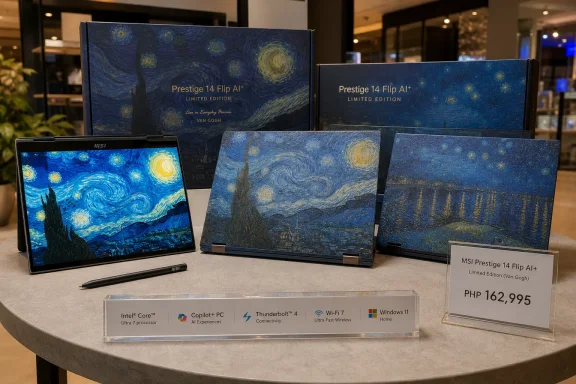 The Philippine price arrived before this week’s coverage
Teknogadyet described the Prestige 14 Flip AI+ Vincent van Gogh Edition as newly launched on August 27. MSI had already published the product globally, however, and UnGeek reported Philippine pricing and Concept Store availability on August 12. MSI’s own regional product pages have also been live in multiple markets since earlier in the summer.
That timing matters because the headline’s “only PHP 162,995” framing makes the machine sound like a value-led release. It is a premium product at roughly the equivalent of a high-end ultrabook, with some of the cost clearly tied to its finish, accessory pack, and limited-edition positioning. MSI has not published a Philippine price for a like-for-like plain Prestige 14 Flip AI+ configuration on the product page, so there is no reliable local figure showing exactly how much buyers are paying for the Van Gogh treatment.
The submitted report is correct on the core local price and on the two-in-one form factor. Its wording about a just-announced release needs more context: the Philippine sales announcement has been public since mid-August, while the laptop itself was shown at Computex 2026 and featured in MSI’s June product coverage.
MSI’s official specification is more specific than the launch write-up
MSI lists the Vincent van Gogh Edition with an Intel Core Ultra X9 378H processor, Intel Arc B390 integrated graphics on qualifying memory configurations, and up to 64GB of soldered LPDDR5x memory. The system meets the NPU threshold MSI uses to market it as a Copilot+ PC, with up to 50 NPU TOPS claimed for the platform.
That provides a clearer picture than the submitted article’s broad reference to “Intel Core Ultra processing.” For Windows users, it means the laptop is aimed at the same class of local AI features as other current Copilot+ PCs, including Windows experiences such as Recall, improved Windows search, and Cocreator where they are available. Availability remains dependent on language, region, Windows updates, and Microsoft account requirements; the Copilot+ badge is not a guarantee that every advertised Windows AI feature is active in every country on day one.
MSI also promotes its own AI Engine and MSI Center S utility, which can change performance behavior based on detected workloads. The submitted story repeatedly calls the customized software “MSI Center M.” MSI’s official product page instead names MSI Center S as the current control application. That is a small naming error, but it matters for owners looking for the promised Van Gogh-inspired interface after setup: MSI Center S is the app they should expect to find on the machine.
The machine’s ports are unusually practical for a 1.37kg convertible. MSI’s specification sheet lists two Thunderbolt 4 ports with DisplayPort and USB Power Delivery support, two USB 3.2 Gen 2 Type-A ports, and HDMI 2.1 rated for 8K at 60Hz or 4K at 120Hz. It also lists Wi‑Fi 7, Bluetooth 6, an IR 1080p webcam with HDR, a privacy shutter, fingerprint reader, dTPM 2.0, Microsoft Pluton security technology, and Secured-core PC support.
That collection gives the Van Gogh Edition a more credible enterprise and hybrid-work profile than its art-first marketing suggests. A user can connect modern docks through Thunderbolt 4 without sacrificing HDMI or legacy USB-A peripherals, while Windows Hello-capable IR hardware and the physical shutter cover the basics for meetings and travel.
The display and pen are the practical creative hardware
The Prestige 14 Flip AI+ uses a 14-inch, 1920×1200 OLED touchscreen with a 100% DCI-P3 color-gamut claim. MSI also says the panel carries SGS low-blue-light and flicker-free certifications. For photographers and designers, DCI-P3 coverage is useful, but it is not by itself a professional color-management guarantee: MSI does not publish a factory-calibration delta-E result on the product page, nor does it describe a hardware calibration workflow.
The 16:10 resolution is also worth reading accurately. It provides additional vertical room over a 1920×1080 panel for documents, editing timelines, and browser-based work, but it is still a relatively modest pixel count for a luxury-priced 14-inch OLED. It should be easier on battery life than a 2.8K or 4K alternative, though buyers prioritizing dense text rendering or high-resolution image review should compare it directly with competing premium convertibles.
The 360-degree hinge and bundled MSI Nano Pen are the more meaningful productivity additions. The pen is stored in a groove in the lower chassis and supports fast charging; MSI says 30 seconds of charging provides up to 60 minutes of writing under its test conditions. Tablet mode, handwritten annotations, markup, and presentation use are all legitimate advantages over a standard clamshell, especially for people working in OneNote, Whiteboard, Adobe applications, or PDF review tools.
MSI calls the display a creative canvas, but Windows users should be realistic about the integrated graphics. Intel Arc B390 graphics may handle photo work, light video work, and hardware-accelerated creative applications well, yet this is not a workstation replacement with a discrete Nvidia RTX GPU. The Prestige 14 Flip AI+ is built for portability and mixed productivity, not sustained GPU-heavy rendering or demanding 3D production.
The 30-hour claim has a test condition attached
MSI advertises up to 30 hours of 1080p local-video playback from the 81Wh battery, which is a large capacity for a 14-inch convertible. The company’s disclosed test configuration used an FHD+ OLED display at 60Hz, brightness set to 150 nits, Wi‑Fi disabled, location services disabled, low speaker volume, lighting disabled, and Eco-Silent mode. That is a controlled playback test, not a promise of 30 hours in browser-heavy work, video calls, stylus use, or AI-assisted creative workloads.
The company lists a 65W USB-C PD adapter in the formal specification, while its marketing material highlights support for 100W PD fast charging. Those statements are compatible: a 65W charger is included, and a 100W-compatible USB-C charger can be used for faster charging. Still, buyers who need the advertised fastest charging should check whether MSI is claiming a maximum supported input or including a 100W adapter in the Philippine retail box.
MSI’s 11.9mm thickness is similarly qualified. That figure applies to the thinnest part of the chassis; the company gives a full height range of 11.9mm to 13.9mm. It remains an exceptionally slim form factor, but it should not be mistaken for a uniform 11.9mm body.
The collector bundle is part of the product, but may vary by market
The two designs extend beyond the lid. MSI says the Twin Skies collection includes an artwork-matched sleeve, mouse pad, Bluetooth mouse, ID badge, keyboard cover, and custom retail packaging. Tom’s Guide, which handled the machine at Computex, independently described the textured, layered lid treatment as tactile rather than simply a printed image.
That physical finish is the edition’s strongest differentiator. The hardware itself belongs to MSI’s broader Prestige 14 Flip AI+ platform; the collector version gives a buyer an exterior that will be conspicuous in a meeting room, studio, or classroom. Whether that is worth a potential premium is a personal decision, but it is the part of the package that cannot be replicated by choosing a standard model and applying a skin.
One caveat is buried in MSI’s own fine print: bundled items may vary by country. Philippine buyers should therefore confirm which design is in stock and which accessories are included with that specific SKU. The local reporting says both Van Gogh versions will be available through MSI Concept Stores at the PHP 162,995 price point, but MSI has not put a detailed Philippine configuration sheet alongside that price.
At PHP 162,995, the Prestige 14 Flip AI+ Vincent van Gogh Edition should be purchased as a premium Windows convertible with a highly specific aesthetic, not as a bargain AI PC. Its core appeal is the uncommon combination of current Copilot+ hardware, pen-enabled OLED flexibility, strong wired connectivity, and a finish that MSI has made deliberately difficult to ignore.